Table of Contents
- What Is a Lipoma, How Dangerous Is It, and How Is It Treated?
- What Is a Lipoma (Wen)?
- What Does a Wen Look Like?
- Localization of Lipomas
- What Causes a Wen?
- Types and Features of Lipomas
- Why Does a Wen Hurt?
- Diagnosis of Lipomas
- How to Distinguish a Wen from a Tumor
- Should a Wen Be Removed?
- How to Get Rid of Wens
- Complications of Lipomas: How Dangerous Are They?
- Can a Wen Turn into a Malignant Tumor?
- Who Treats Lipomas?
A small subcutaneous lump that does not hurt or cause discomfort is often perceived as harmless. However, any new growth requires proper evaluation, even if it does not cause discomfort. Quite often, this may be a lipoma — a benign tumor of fatty tissue. Let us take a closer look at what it is, how it forms, and whether it poses a health risk.
What Is a Lipoma (Wen)?
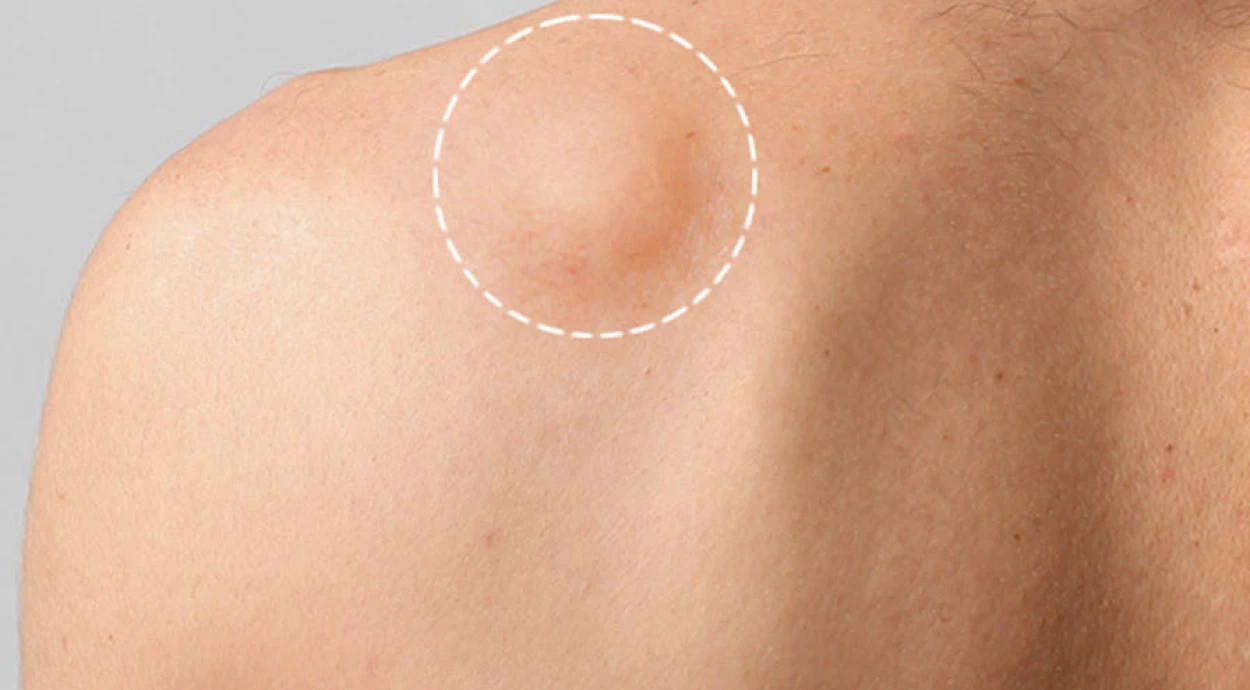
A lipoma, or wen, is a benign tumor that develops mainly from fat cells. It forms under the skin and initially looks like a small lump. A lipoma grows slowly and does not cause pain, itching, redness, or other symptoms. In most cases, it does not pose a health threat but may cause aesthetic discomfort.
Lipomas can be effectively removed using laser, radio wave, or conventional surgical procedures. Removal is performed under local anesthesia in an outpatient setting.
What Does a Wen Look Like?
Lipomas, commonly known as wens, appear as a lump or a small skin growth. They do not differ in color from the surrounding skin and usually have a symmetrical round or oval shape. They are soft and movable to the touch. Most often, they occur as single growths, but sometimes several may appear close to each other.
It is important to note that externally, wens may resemble other types of tumors: subcutaneous cysts, hygromas, liposarcomas, etc. To establish an accurate diagnosis, it is necessary to consult a dermatologist.
A doctor’s consultation is required if:
- the growth increases rapidly in size;
- new lesions appear;
- there is pain, itching, redness, or skin peeling;
- other symptoms of illness are present.
Localization of Lipomas
Lipomas can develop in any area of the body where fatty tissue is present. They most commonly appear on the:
- head;
- face;
- eyelids;
- ear;
- neck;
- shoulder;
- armpit;
- arm;
- breast;
- abdomen;
- back;
- buttock;
- thigh;
- labia;
- internal organs.
What Causes a Wen?
Specialists identify several different factors that may contribute to the development of a wen. The most common include:
- genetic predisposition;
- lipid metabolism disorders;
- blockage of sebaceous glands;
- Cowden syndrome — accompanied by the development of multiple benign tumors;
- Gardner syndrome — characterized by tumors on the skin and bones.
Risk factors also include obesity, diabetes mellitus, high blood cholesterol levels, liver diseases, and certain other conditions.
Wens most commonly occur in women and men between the ages of 40 and 60.
Types and Features of Lipomas
Depending on the tissues from which they develop, lipomas are classified as:
- simple lipomas — composed only of white fat cells;
- hibernomas — composed of brown fat tissue;
- angiolipomas — composed of fat tissue and blood vessels (may be painful);
- fibrolipomas — composed of fat and connective tissue.
Simple lipomas occur much more frequently than other types.
Depending on their location, the following are distinguished:
- Lipomas of the breast — develop within the gland, do not cause pain or other symptoms, and are usually diagnosed in women during menopause during routine examinations.
- Lipomas of the brain — develop in different areas of the brain and generally do not pose a health risk or affect well-being. For small tumors, surgery is rarely recommended, but each case is assessed individually by a doctor.
- Lipomas of the spinal cord — when large, they may cause compression and corresponding symptoms (pain, urinary disorders, etc.) and sometimes require surgical removal.
- Epidural lipomatosis — a growth that forms between the vertebrae and the spinal cord, mainly in patients with obesity and/or Cushing’s syndrome.
- Angiomyolipoma — a benign tumor composed of fat tissue, blood vessels, and muscle fibers. It is most often localized in the kidneys and, in most cases, does not cause symptoms for a long time. When large, it may cause lower back pain or bleeding. Treatment tactics are determined individually depending on the size of the tumor and clinical manifestations.
Why Does a Wen Hurt?
In most cases, a wen does not cause pain. It grows slowly and is not accompanied by inflammation. However, sometimes patients report discomfort or tenderness in the area of the growth.
Causes of pain may include:
- compression of nerve endings as the tumor increases in size;
- location near joints or in areas of constant friction from clothing;
- inflammation of surrounding tissues;
- formation of an angiolipoma, which contains blood vessels and may be sensitive.
Sometimes patients try to find out how to drain pus from a lipoma, assuming that the pain is caused by suppuration. It is important to understand that a typical lipoma does not contain pus, as it consists of adipose tissue. If redness, swelling, or discharge appears, this may indicate inflammation of another type of lesion, such as an atheroma, and requires medical evaluation.
If the lipoma becomes painful, rapidly increases in size, or changes in consistency, it is necessary to consult a doctor to clarify the diagnosis.
Diagnosis of Lipomas
To undergo diagnosis, you should consult a dermatologist. During the appointment, the doctor will perform a visual examination and palpation of the growth, and ask when it appeared, how quickly it is growing, and whether there is pain or other complaints. In some cases, this information is sufficient to confirm the diagnosis.
If atypical symptoms are present or another type of tumor is suspected, the doctor may prescribe:
- a biopsy — taking a tissue sample of the growth using a needle;
- a histological analysis — a laboratory examination that evaluates cell structure and accurately determines the type of tumor;
- an ultrasound examination (US) — to assess the exact size and shape of the growth.
Lipomas located in internal organs and in the spinal area are diagnosed using:
- ultrasound;
- X-ray;
- computed tomography (CT);
- magnetic resonance imaging (MRI).
If associated conditions are suspected, the doctor may refer the patient to a specialized specialist and for additional examinations.
How to Distinguish a Wen from a Tumor
A lipoma is a benign tumor of fatty tissue; however, accurate differentiation from other types of tumors requires professional medical evaluation.
Typical signs of a wen:
- soft consistency;
- mobility relative to surrounding tissues;
- slow growth;
- absence of pain and skin changes over the growth.
Signs that may be concerning and require additional diagnosis:
- rapid increase in size;
- hardening or irregular contours;
- fixation to deeper tissues;
- pain without an obvious cause;
- change in skin color.
A wen can be accurately distinguished from other tumors only after a medical examination and, if necessary, ultrasound or biopsy with histological analysis.
Should a Wen Be Removed?
You should consult a doctor regarding this issue. Small subcutaneous growths that do not cause pain or other discomfort often do not require removal. However, many patients choose to remove the growth for aesthetic reasons.
As for lipomas of internal organs, breasts, or the spine, the decision to remove them is made individually in each case. Surgery may be recommended if the lipoma is large, compresses blood vessels or nerves, and causes functional disorders.
How to Get Rid of Wens
.jpg)
Most patients with wens consult a doctor due to aesthetic discomfort. If the growth is located on the head, face, or another exposed part of the body, many prefer to have it removed.
Specialists at "Oxford Medical" note that from a medical standpoint, treating a subcutaneous lipoma is not mandatory if it is small, grows slowly, and does not affect the function of internal organs.
For lipomas of the breasts, spine, brain, or spinal cord, the doctor decides on the need for surgical intervention based on diagnostic results. It may be necessary if the growth is large, causes pain, or leads to other disorders. Depending on its location, endoscopic, laparoscopic, or conventional open surgery may be performed.
Methods for removing subcutaneous lipomas:
- Surgical excision — the doctor makes a small incision with a scalpel and removes the lipoma together with its fibrous capsule, then applies a cosmetic suture.
- Laser or radio wave removal — the procedure is performed without incisions using a specific type of energy radiation. Advantages include minimal damage to healthy tissues, absence of bleeding, and a reduced risk of wound infection.
- Liposuction — a thin tube is inserted into the lipoma, and the fatty tissue is removed using a special device. The disadvantage of this method is that the fibrous capsule remains under the skin, which may lead to recurrence over time.
These procedures are performed under local anesthesia in outpatient settings.
Complications of Lipomas: How Dangerous Are They?
Most subcutaneous lipomas do not threaten health or life. They are often small and may remain unnoticed for a long time, even by the patient. Removing such growths is not mandatory, especially if they do not grow and do not cause aesthetic discomfort.
The most dangerous lipomas are those located in the brain, spinal cord, and internal organs. If they are small and do not cause any disorders, specialists may recommend observation.
Large lipomas in the gastrointestinal tract may cause obstruction, bleeding, and other serious complications. Cardiac lipomas may provoke arrhythmias and embolism. Lipomas in the spinal area may compress the spinal cord and cause pain and neurological disorders such as numbness of the arms and legs, muscle weakness, and urinary problems.
To reduce the risk of complications, it is important to consult a doctor when a lipoma appears, undergo diagnosis, and follow medical recommendations.
Can a Wen Turn into a Malignant Tumor?
A wen is a benign growth and does not transform into a malignant tumor. It consists of mature fat cells and has a well-defined capsule.
However, it is important to understand that some malignant soft tissue tumors, particularly liposarcomas, may externally resemble a lipoma. Therefore, you should not attempt to diagnose yourself when a subcutaneous lump appears.
If the growth has atypical features or increases rapidly in size, the doctor may prescribe additional examinations to rule out malignancy.
Who Treats Lipomas?
When a subcutaneous lump appears, you should first consult a dermatologist — a doctor who specializes in diseases of the skin and subcutaneous tissue. The dermatologist performs the initial examination, assesses the size, structure, and mobility of the growth, and determines whether additional examinations are necessary.
If the lipoma is large or located deeper, a surgeon may be involved in treatment. In complex cases, when it is necessary to rule out other types of tumors or when the growth is located in internal organs, the patient may be referred to a specialized physician.
Management tactics are determined individually after diagnosis and depend on the location, size of the lipoma, and the presence of symptoms.