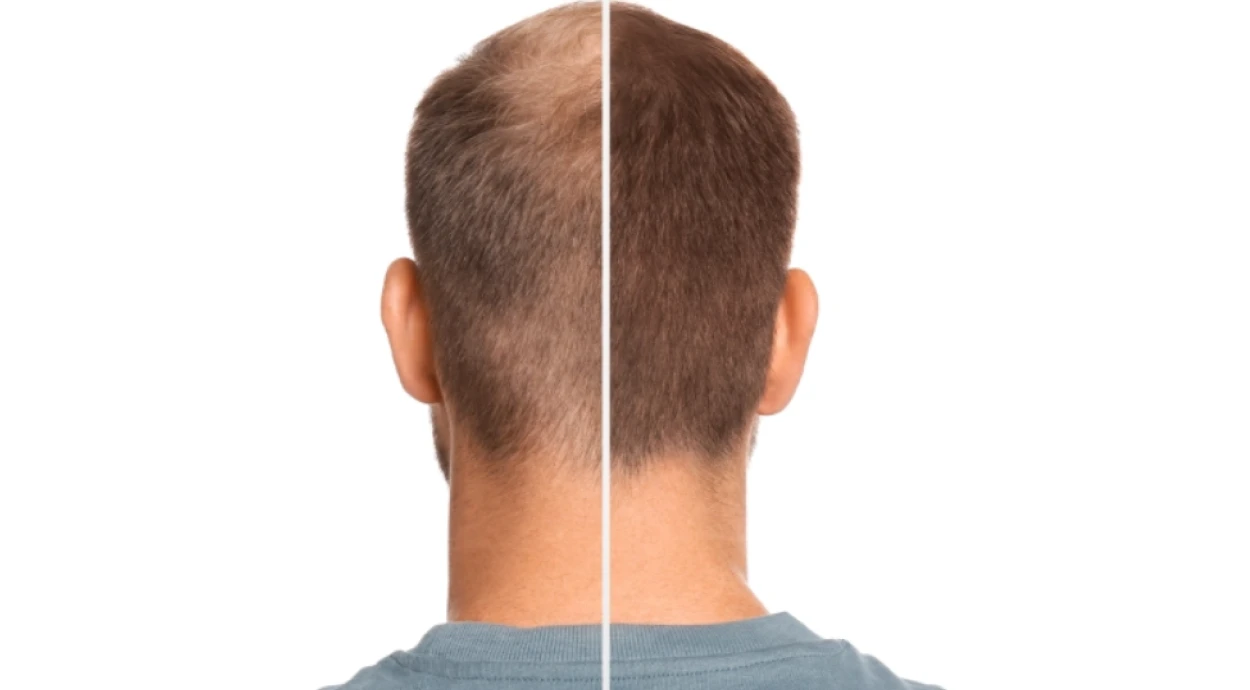
What problems does hair transplantation solve, and can this procedure help everyone? What should you know about the process? A plastic surgeon explains.
Plastic surgeon at “Oxford Medical” clinic and member of the International Society of Aesthetic Plastic Surgery, Olga Hyndych, answers the most common patient questions about hair transplantation. Several points should be considered. Hair transplantation is performed only in cases of local alopecia (baldness). If there is no hair on the head at all, the procedure cannot be done because only a patient’s own hair follicles are used—follicles from another person will not take root.
The best donor hair is taken, usually from the back of the head. Therefore, this area must have sufficient density since new follicles will not appear where they were taken. The human body is not a permanent hair generator, so during a consultation, an experienced specialist analyzes whether it will be possible to take additional follicles for future transplants. For a conscientious professional, the aesthetic result on the donor area is just as important as the final outcome.
In What Cases Is Hair Transplantation Performed
The procedure is performed in the following cases:
-
with androgenetic or local alopecia in women, when hormonal disorders cause frontal hairline recession;
-
in cases of scarring alopecia after burns;
-
with androgenetic alopecia or scarring in men;
-
in cases of absent (burns on the face) or insufficient eyebrow density;
-
to change the physiological hairline shape in women and men, as well as to correct the shape and density of the beard and mustache in men.
Whom to Consult First About Baldness
To determine whether there are dormant follicles that can be stimulated cosmetically, you must first consult a trichologist.
Thus, people whose hair is weak or falling out due to stress should not rush to a surgeon. They must first identify the cause—hormonal disorders or stress—and undergo treatment. If there is no improvement after therapy, then hair transplantation is an option.
Will Hair Volume Change Immediately After Surgery
Results are assessed only after one year because hair growth occurs in stages.
From the third week after the procedure and during the first two months, transplanted hair will fall out. This is called shock hair loss. There is no need to panic—it is a normal physiological process.
After the hair shaft falls out, the follicle remains in the scalp tissue and produces a new hair. For some patients, new hair grows in 4 months (and the final result can already be evaluated), for others in 6 months, and in rare cases only after a year.
What Is the Rate of Transplanted Hair Survival
Today, the survival rate is quite high—95–98%—thanks to advanced instruments that preserve follicle viability.
In scar tissue areas, the survival rate is lower due to poorer blood supply, but hair still takes root, though in smaller numbers.
The result also depends not only on the surgeon but on the patient. If, within 2 weeks after surgery, the patient does not follow instructions, transplanted grafts can be pulled out mechanically.
A graft is an anatomical unit of one or several hair follicles surrounded by soft tissue. Transplanting 1,000 grafts does not mean 1,000 hairs.
Which Method Is the Most Effective
The most common technique is the non-traumatic, suture-free FUE method. Each hair follicle is carefully extracted with forceps, leaving no linear scars in the donor area. When the hair grows back (it is trimmed before surgery), it covers the tiny dots left after extraction. This way, the donor area looks natural.
How Long Does the Surgery Last
The procedure can last from several hours to a full day, depending on how many follicles and grafts are needed to cover the bald area.
The surgeon does not recommend transplanting more than 3,000 grafts at once, as it is exhausting for the patient and can affect the donor area’s appearance. The closer the grafts are taken, the higher the risk of local alopecia in the donor zone. Therefore, an expert determines in advance how many grafts are necessary. If more than 3,000 are required, the procedure is divided.
Hair transplantation consists of two stages, each lasting several hours:
-
the surgical team extracts grafts, sorts them, checks their viability, and counts them;
-
once enough grafts are collected, they are immediately transplanted.
The quality of the patient’s skin and hair affects the speed, so the procedure duration may vary.
What Is Included in the Preparation Stage
Because specialists work with blood, rapid tests for hepatitis, HIV, and syphilis are performed first.
Then the area to be corrected is marked. Together with the patient in front of a mirror, the surgeon agrees on the desired appearance. Hairstyles can be modeled, and if a woman has long hair, the surgeon can suggest styling options. An experienced specialist also shows photo examples from their practice.
Next, depending on the transplantation method, the patient’s head is shaved completely or partially in the area to be treated.
Important Postoperative Nuances
The first 2 weeks after the procedure are the most critical. During this time, patients must not touch or scratch the transplanted area or comb the hair. Clothing collars must be controlled to avoid accidentally pulling out grafts.
After 2 weeks, follicles are securely fixed, and restrictions are less strict. However, patients should avoid sports and heat procedures such as baths and saunas for the first month to prevent swelling and impaired blood circulation in the transplanted area.
How to Determine How Many Grafts Are Needed
There is extensive literature and conference data with formulas for calculating graft numbers in different areas.
However, the expert emphasizes that an individual approach is key. Hair transplantation is more an art than strict mathematics. During the consultation, the surgeon’s experience determines how many grafts can be taken and transplanted based on the patient’s skin and hair quality. Usually, grafts are counted in hundreds. For a small area, at least 1,000 grafts are needed for visible results.
How to Choose a Specialist
Hair transplantation has long been performed in Ukraine, but previously men did not openly admit undergoing it. Thanks to Turkey, which popularized the procedure, Ukrainians have become more open, and personal recommendations now spread actively.
The main things to consider are the surgeon’s experience in hair transplantation and patient reviews.
It is not advisable to blindly trust “before–after” photos, as they can be taken from the internet. It is better to talk to the specialist beforehand to see whether they explain the procedure in detail and demonstrate expertise.
The expert believes the procedure should be performed by the lead specialist with a valid certificate and medical degree. This may be a dermatologist, trichologist, or surgeon.
Besides experience, the surgeon must have aesthetic vision to know where to place a graft for optimal volume. There is no place for templates here. Each face requires an individual approach, so the hairline must be designed to harmonize with the patient’s features.