The information in the article is provided for informational purposes only and is not a guide to self-diagnosis and treatment. If symptoms of the disease appear, you should consult a doctor.
Scarlet fever - is an infectious disease that develops when infected with hemolytic toxigenic streptococcus group A. The disease is acute and is accompanied by high fever, minor rash, sore throat and intoxication of the whole body.
Scarlet fever is treated with antibiotics. If started on time, the disease can be easier and not cause complications. However, with an atypical course of scarlet fever, diagnosis becomes more difficult, which leads to a delay in the start of treatment.
Scarlet fever most often affects children of preschool and primary school age. Adults are rarely infected, as a stable lifelong immunity to the disease is formed.
SYMPTOMS OF SCARLET FEVER IN CHILDREN AND ADULTS

The disease scarlet fever occurs in an acute form and is accompanied by characteristic symptoms. In adults and children, the disease manifests itself in a similar way, but in older age the symptoms may be more pronounced or, conversely, blurred.
Symptoms of scarlet fever in adults and children are:
-
sore throat;
-
redness of the throat and tongue;
-
enlarged tonsils;
-
temperature above 38-39 °C;
-
small red rash on the skin;
-
headache;
-
nausea;
-
weakness, etc.
Symptoms of scarlet fever appear gradually. At first, redness and sore throat appear, the temperature rises, headache and general malaise occur. The first symptoms of scarlet fever resemble the flu or other viral infection.
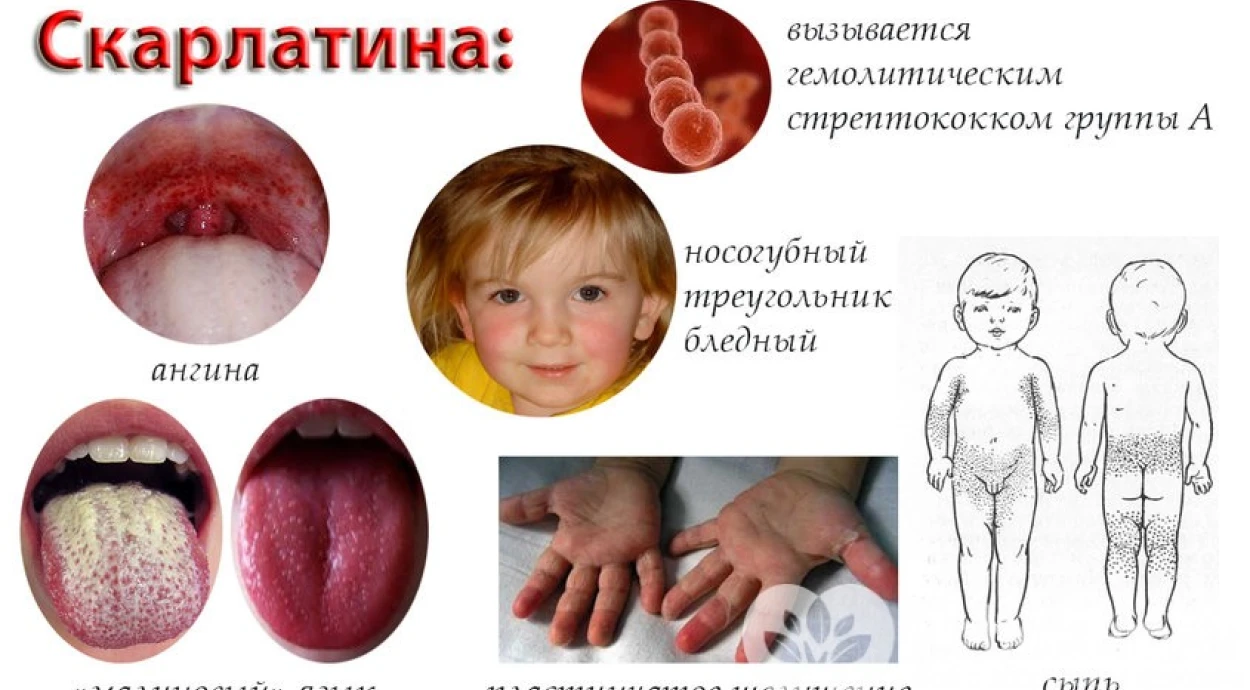
A specific rash appears on the 2nd-3rd day - a small red rash. At first, it covers the face, neck and chest, and then gradually spreads to the entire body. The skin in the areas of the rash becomes rough and dry, itches a lot.
The rash with scarlet fever is most pronounced in natural folds of the body: on the elbows, armpits and inguinal folds. If you lightly press your finger on the reddened area of skin, a pale stripe will appear on it after 10 seconds, which will disappear after a couple of minutes.
Another distinctive sign of scarlet fever is a white triangle under the nose, which is clearly visible against the background of reddened cheeks.
The rash lasts on average from 2 to 6 days. Then the skin gradually turns pale and begins to peel.
With scarlet fever in children, the rash appears as a result of the skin being exposed to toxins produced by bacteria. Under their influence, the upper layers of the skin become inflamed. Later, the cells affected by the toxins are rejected, and the skin peels.
A "crimson tongue" is also a manifestation of scarlet fever. At the beginning of the disease, a pale coating appears on the tongue, which disappears after a few days. Then the papillae on it greatly increase, and the tongue acquires a bright crimson color.
Causes of scarlet fever
Scarlet fever occurs as a result of infection with hemolytic streptococcus group A, which secretes toxins that cause intoxication of the body, rash and damage to the mucous membranes. This type of bacteria is the causative agent not only of scarlet fever, but also of angina, erysipelas, pyoderma and some other diseases.
The main causes of infection are:
- Contact with a sick person — airborne droplets during coughing, sneezing, talking.
- Using shared household items — dishes, towels, toys, etc.
- Reduced immunity — A weakened body is more susceptible to infection.
- Untimely or ineffective treatment of streptococcal sore throat - can contribute to the transition to scarlet fever.
The pathogen is resistant to the external environment, especially in dry warm air, which contributes to its spread in children's groups and families.
HOW IS SCARLET FEVER TRANSMITTED: CONTAGIOUSNESS OF THE DISEASE
Scarlet fever can be contracted by airborne droplets or contact. The infection spreads from a sick person mainly when coughing or sneezing through small droplets of saliva. The bacteria in them can move through the air, enter the respiratory tract of other people, or settle on various objects. Because of this, infection also occurs through things (dishes, towels, etc.) that an infected person used.
The infection spreads within 2-3 weeks from the moment the first symptoms appear. Most often, they are pronounced, and the doctor can immediately make a diagnosis. But in some cases, scarlet fever occurs in a mild or latent form and remains undiagnosed, and the infected person continues to contact others.
You can also get infected from people who are carriers of streptococci, who are sick with anginu or erysipelas, since the causative agent of these diseases is the same. But most often infection with scarlet fever occurs when contacting patients with this diagnosis.
The incubation period of scarlet fever can last from 2 to 12 days, but in most cases, symptoms appear a week after infection. Thus, the incubation period for scarlet fever can be longer or shorter, depending on individual characteristics.
TYPES AND STAGES OF SCALPHERE IN CHILDREN AND ADULTS
Scarlet fever is divided into two types depending on the route of infection and the symptoms that appear.
Scarlet fever can be:
-
typical – accompanied by classic symptoms;
-
atypical – symptoms may be mild, and some may be absent.
The atypical form of scarlet fever is more common in adults than in children. In some, the disease proceeds almost imperceptibly, with a slight increase in temperature and a small focal rash. The symptoms of the disease in such cases differ, which makes it difficult to make a diagnosis. Other patients, on the contrary, tolerate scarlet fever in adulthood more severely. The temperature can rise to 40 °C and above. Convulsions may also occur, and complications develop more often.
Depending on the severity of the course, the following are distinguished:
-
mild form;
-
moderate;
-
severe.
The severity of the disease is determined by the degree of damage to the nasopharynx, the prevalence of the rash, and intoxication of the body.
Which doctor treats scarlet fever?
Scarlet fever is treated by a pediatrician or a therapist - depending on the patient's age. These are the specialists you should contact if you experience symptoms of the disease: sore throat, fever, rash, weakness.
In the event of a complicated course of the disease or signs of involvement of other organs in the process, the following may be involved in the treatment:
- Infectious disease specialist — for severe forms of scarlet fever or doubts about the diagnosis.
- Otolaryngologist — for severe angina, otitis or adenoiditis.
- Cardiologist, nephrologist, rheumatologist — in case of complications (myocarditis, glomerulonephritis, rheumatism).
Timely consultation with a doctor, correct diagnosis and prescription of antibiotics can prevent complications and achieve a quick recovery.
DIAGNOSTICS OF SCARLET FEVER
An experienced doctor can diagnose scarlet fever when examining a child. The disease is characterized by specific symptoms that allow you to distinguish it from others. But with an atypical or mild form of scarlet fever, the symptoms may resemble measles, rubella, or another disease accompanied by a rash.
An analysis for scarlet fever allows for an accurate diagnosis: bacteriological culture of mucus from the nose or throat.
TREATMENT OF SCARCLATISM

When scarlet fever develops, it is important to start treatment early. Patients are prescribed antibacterial therapy that suppresses the growth of streptococcal bacteria and reduces the likelihood of the infection spreading to other organs. Antihistamines, antipyretics, and other drugs are also used to eliminate the symptoms of the disease and improve well-being. Patients should regularly gargle with special solutions and get more rest.
Most often, scarlet fever is treated at home, but under the constant supervision of a doctor. Hospitalization may be required in severe cases of the disease or the development of complications.
After recovery, the patient should visit a doctor and take the tests prescribed by him. They are needed for timely diagnosis of complications that may develop after scarlet fever.
COMPLICATIONS OF SCALPHERE
Scarlet fever can cause serious complications. Only timely treatment can reduce their likelihood.
Toxins released by bacteria cause intoxication of the body and can affect the condition of blood vessels, heart, adrenal glands, and nervous system. They can also cause a severe allergic reaction, one of the manifestations of which is a scarlet fever rash.
The infection can also spread throughout the body with blood and lymph and cause purulent inflammation in various organs.
Scarlet fever can provoke:
-
necrotic angina;
-
purulent lymphadenitis;
-
adenoiditis;
-
otitis;
-
bronchitis;
-
pneumonia;
-
meningitis;
-
infectious-allergic myocarditis;
-
post-streptococcal glomerulonephritis;
-
rheumatism;
-
streptococcal toxic shock and other complications.
PROPHYLAXIS OF SCARLET FEVER
Scarlet fever – is an infectious disease, but there is no vaccine for scarlet fever. You can only get vaccination against pneumococcal infection, which is a type of streptococci, but it does not provide immunity to scarlet fever.
Immune protection appears after infection with hemolytic streptococci group A, which in addition to scarlet fever, also cause the development of angina, erysipelas and some other diseases. After contact with the infection, the body forms natural immunity to streptococcal toxins. In most children, it appears by the age of 10.
In addition, to prevent infection, it is recommended to strengthen the immune system and follow all hygiene rules.
FREQUENTLY ASKED QUESTIONS:
WHAT ARE THE MAIN SYMPTOMS OF SCARLET FEVER?
The main signs of scarlet fever are redness and sore throat, high fever, and a small red rash. It first appears on the face and neck, and then spreads to the shoulders, chest, abdomen, back, and legs.
IS THERE A RASH WITH SCARCLATE FEVER?
A small red rash is characteristic of scarlet fever. It spreads from top to bottom, covering first the face, neck, chest, and then the entire body. Scarlet fever is also characterized by a profuse rash in the elbows, armpits, and groin. A distinctive feature is a clear white triangle under the nose. In rare cases, with atypical scarlet fever, the rash may be mild or absent altogether.
WHY DO CHILDREN MAINLY GET SCALPHERE?
Scarlet fever is mainly suffered by children under 10 years of age. After the disease, they develop lifelong immunity. Scarlet fever develops when infected with group A hemolytic streptococcus, which also causes the development of angina and erysipelas. After these diseases, immunity to toxins secreted by streptococci is also formed. Also, the incidence in adults is lower due to a stronger immune system.
What is scarlet fever?
Scarlet fever — is an acute infectious disease caused by hemolytic streptococcus group A. It is characterized by sore throat, fever, small red rash and intoxication of the body. In cases of increased morbidity, an scarlet fever outbreak is possible in children's groups or closed spaces.
What does scarlet fever look like?
Scarlet fever is accompanied by a small red rash that appears on the neck, chest, face, and then spreads to the entire body. The rash with scarlet fever is absent on such parts of the body as the nasolabial triangle — this area remains pale against the background of reddened cheeks. Also characteristic are «crimson tongue» and a rash in the folds of the skin.
Can scarlet fever be transmitted to adults?
Yes, adults can also get scarlet fever, although this happens less often than in children. People with weakened immune systems are at risk. Scarlet fever in pregnant women is especially dangerous, as it can cause complications in both the mother and the fetus, and therefore requires careful medical supervision.
Does scarlet fever occur in adults?
Yes, scarlet fever can also develop in adulthood. It often has an atypical course: the symptoms are blurred or resemble other infections. In severe cases, a significant increase in temperature and complications are possible. During treatment, adults, like children, should observe quarantine for scarlet fever for at least 10 days.
How to treat scarlet fever?
Scarlet fever is treated with antibiotics, mainly penicillin group. Therapy includes antipyretics, antihistamines, gargling and bed rest. Patients with severe form require special attention. Treatment should be carried out under the supervision of a doctor to prevent complications.
How does scarlet fever manifest itself?
Scarlet fever begins with a sore throat, fever, weakness, headache. After 1-2 days, a small rash appears, the cheeks turn red, and the tongue acquires a bright color. At the same time, a sore throat develops and the tonsils enlarge — this is how scarlet fever typically presents in children and adults.