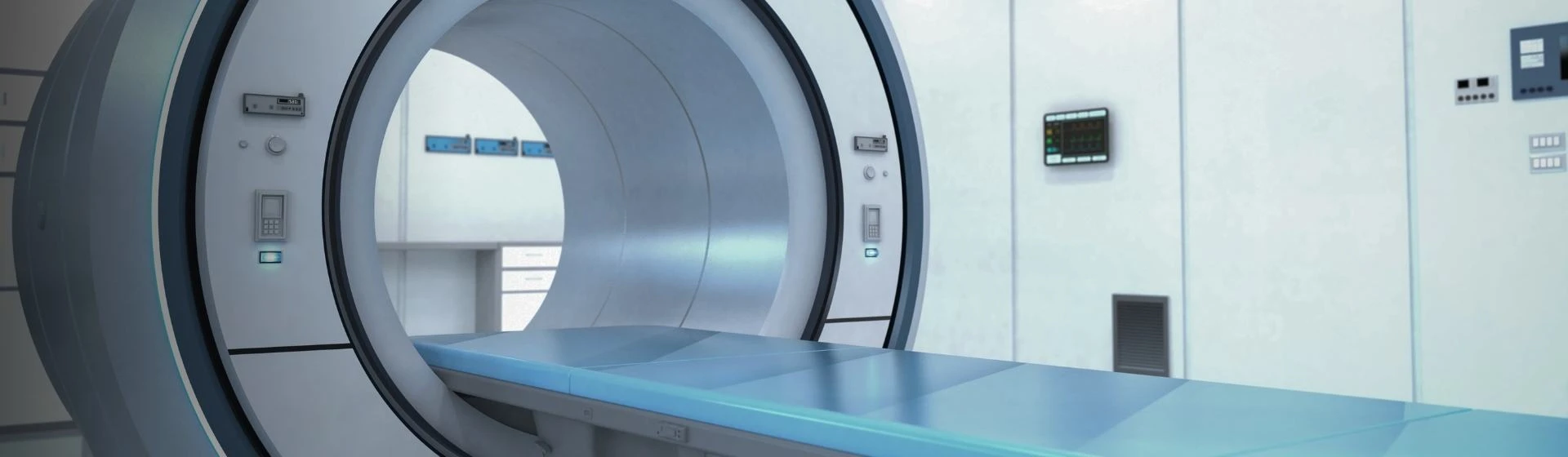
Before the procedure begins, the patient lies down on the movable table of the tomograph. To obtain clear images, the head is fixed with a special coil and soft pads — this helps maintain stillness during scanning.
After preparation, the table smoothly moves inside the machine, and scanning begins. During the operation of the tomograph, rhythmic sounds are heard — this is a normal feature of the functioning of the equipment. The procedure is painless.
Brain MRI for a child is performed in the presence of one of the parents or a legal representative, which helps the child feel calmer and more confident during the examination.
The duration of the examination usually is 15–25 minutes. If contrast enhancement is used, a series of images is first taken without the agent, after which a contrast substance is administered intravenously and scanning is continued. In such a case, the procedure may last up to 30–40 minutes.
After brain MRI is performed, the interpretation is carried out by a radiologist with a detailed analysis of all the obtained images in different projections and modes. The written report describes the detected changes, their localization, and nature. If no abnormalities are detected, it is indicated that the findings correspond to a variant of the norm. If changes are detected, the doctor describes the possible pathology, its features, and the degree of severity. The results are provided to the patient for further consultation with the doctor who referred them for diagnostics.