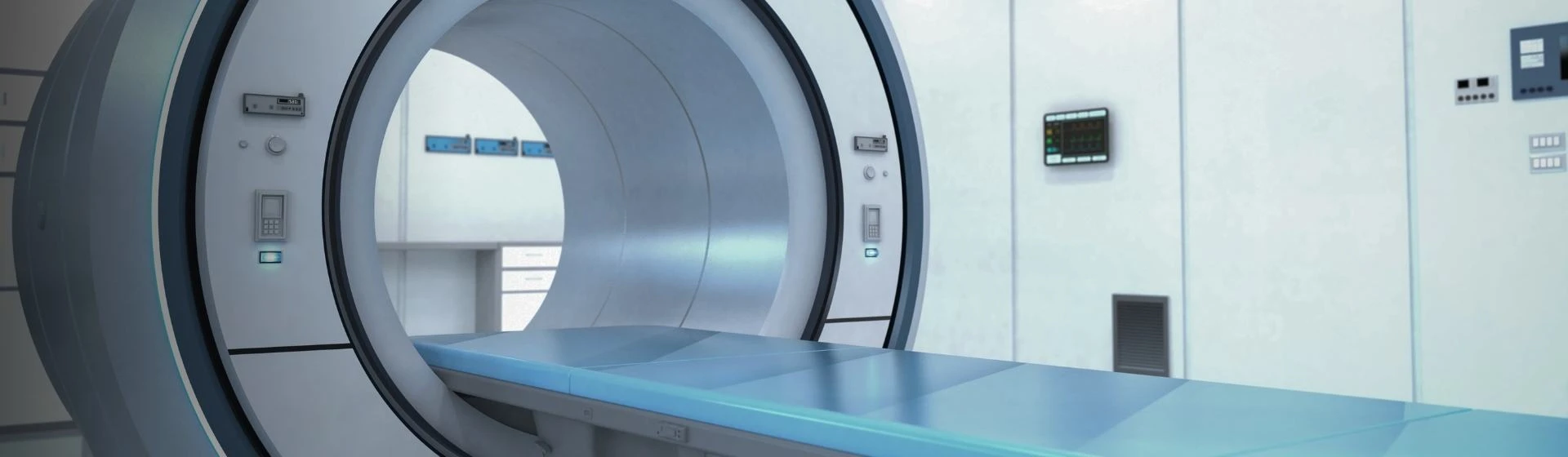
During the procedure, the patient lies down on a special tomograph table. The head is fixed with soft rollers or a special frame to ensure immobility during scanning.
The table smoothly moves inside the machine, after which scanning begins. During the operation of the tomograph, characteristic rhythmic sounds are heard — this is a normal feature of the procedure. MRI of the orbits is a painless examination and usually does not cause discomfort.
During the examination, a series of layered images is obtained, which allows a detailed assessment of the condition of the ocular structures, muscles, vessels, and nerves.
In some clinical situations, the examination is performed using contrast in order to assess the nature of pathological changes more accurately. If MRI is performed with contrast enhancement, a series of images is first taken without the agent. After that, the contrast substance is injected intravenously and scanning is continued. In this case, the procedure may last up to 30–40 minutes.
After the completion of scanning, the radiologist analyzes the obtained images and prepares a written report. The diagnostic results are provided to the patient for further consultation with the doctor who referred them for the examination. Most often, this is an ophthalmologist or a neurologist, who assess the MRI results taking into account the patient's complaints, examination data, and other examinations.