Contents
-
Why is it important to restore baby teeth?
-
Indications for placing crowns
-
What crowns are placed on children’s teeth?
-
Advantages of pediatric crowns
-
Stages of placing pediatric crowns
-
Contraindications for placing crowns in children
Baby dentition begins to change at the age of 6–7 years. Tooth roots gradually resorb, and they fall out, giving way to permanent teeth. Because of this, the question arises: is it worth treating them?
Dentists say yes! It is important to remove caries in time and perform fillings, and in cases of significant destruction even place crowns. Modern technologies allow this to be done quickly, painlessly, and at an affordable cost.
Why is it important to restore baby teeth?
Baby teeth play an important role in chewing food, forming the permanent bite, and developing speech. They must remain intact and healthy until the eruption of permanent teeth.
Premature loss of several or even one tooth can cause serious consequences:
-
tooth movement and reduced space for the future permanent tooth;
-
incorrect formation of the dental arch;
-
speech impairment;
-
difficulty chewing food;
-
psychological discomfort.
Dentists at “Oxford Medical” explain that when one tooth is removed, others begin to move into the freed space. And while in adults this process occurs slowly, in children it happens quickly. As a result, there is not enough space for the permanent tooth, and it erupts unevenly. This leads to bite disorders that require long orthodontic treatment.
In addition, the absence of baby teeth prevents a child from fully chewing food and pronouncing words and sounds correctly.
If a front tooth is destroyed or removed, the child may also feel shy about speaking or smiling in front of others, which affects social adaptation in kindergarten and school.
Indications for placing crowns
Most often baby teeth are restored using composite materials. They fill cavities formed after caries removal and cover damaged enamel. But there are cases when this method is ineffective, and a crown is required.
Indications for prosthetics include:
-
destruction of 2 tooth walls or 2/3 of hard tissues;
-
pulpitis, periodontitis;
-
demineralization of a large area of enamel;
-
enamel hypoplasia (partial or complete absence);
-
increased enamel wear, bruxism.
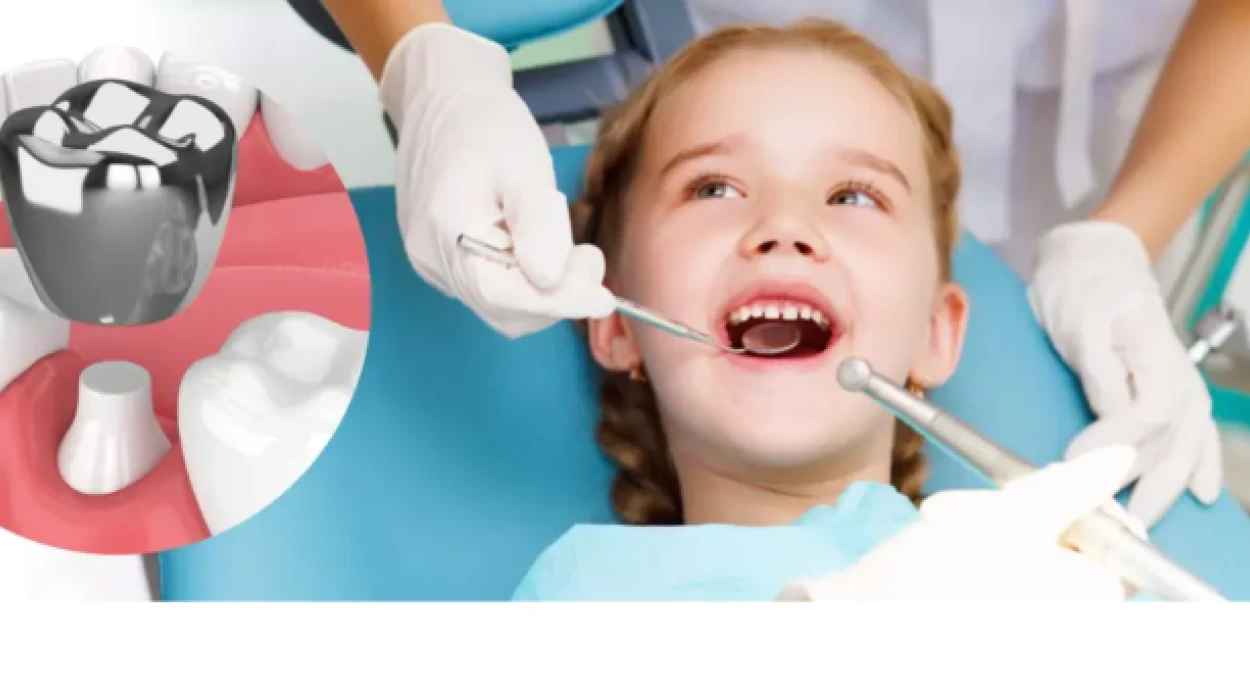
Crowns are placed on baby teeth when the root is preserved and the upper part is significantly destroyed. They allow stopping the pathological process and keeping the tooth until its natural loss.
What crowns are placed on children’s teeth?
Placing a crown on a baby tooth is much easier than on a permanent one. If an adult needs to visit the clinic at least 3 times for depulpation and tooth preparation, taking impressions, and placing the crown, for a child 1 visit may be enough.
For prosthetics of baby teeth, individual production is usually not required — standard crowns are used instead. They come in different shapes and sizes, corresponding to each unit of the dental arch.
After being fixed on the tooth, standard crowns are additionally adjusted so the child feels comfortable.
As for material, children usually receive crowns made of:
-
metal – an alloy of nickel or chromium is used;
-
metal-composite – consist of a metal base covered with composite material (has a natural white shade);
-
ceramic or zirconia – produced individually, as for permanent teeth, and highly aesthetic.
Most often, metal or metal-composite crowns are recommended for prosthetics of baby teeth. They are highly durable and allow complete restoration of chewing functions. However, for damaged incisors, where aesthetics are important, ceramic or zirconia crowns can be placed – they look as natural as possible and are visually indistinguishable from other teeth.
Advantages of pediatric crowns
Dentists recommend not to hesitate and place crowns on baby teeth if there are indications. This provides the child with several advantages, namely:
-
restoration of chewing function and the aesthetic appearance of the tooth;
-
protection of the tooth from further destruction;
-
preservation of the tooth until it is replaced by a permanent one;
-
proper formation of bite and speech.
Unlike fillings, which may fall out or chip over time, crowns are highly durable and reliably protect the tooth. Thanks to their tight fit, they do not allow bacteria to penetrate into the inner cavity and provoke the development of secondary caries.
When the time comes, crowns fall out together with baby teeth and do not require additional intervention.
Stages of placing pediatric crowns
Modern dentistry is comfortable and painless, and play-based adaptation methods help find an approach to each child and prevent stress.
Placement of crowns in children is carried out under local anesthesia or sedation (medicated sleep). The latter is recommended if the child is very frightened, cannot sit still in the dental chair for long, or needs treatment of several teeth at once.
Sedation is performed using mild sedative drugs that put the child to sleep but do not affect vital functions. It is carried out by an anesthesiologist, who stays with the young patient until all procedures are completed.
Direct crown placement is performed as follows:
-
The dentist performs professional cleaning of the teeth to remove plaque and caries.
-
Then the tooth is prepared by removing damaged tissues and shaping it for the crown.
-
Next, the dentist selects the crown that best fits the shape and size (if a standard crown is used).
-
It is tried on the tooth and fixed with dental cement.
-
After that, if necessary, it is slightly adjusted and polished so that it does not stand out from the dental arch.
In most cases, the procedure can be performed in 1 session, but if parents choose an individual crown made of metal-ceramic or zirconia, several visits are required. First, the tooth is prepared and impressions of both jaws are taken, and at the next visit the finished crown is placed.
Contraindications for placing crowns in children
Unfortunately, as in adults, in children a tooth cannot always be saved with a crown. Prosthetics may be contraindicated in cases of:
-
resorption of more than 1/3 of the tooth root;
-
deficiency of hard tissues in the cervical zone;
-
deep subgingival defect;
-
allergy to metal or other components used.
You can learn more about placing crowns on baby teeth and receive individual recommendations by making an appointment with a pediatric dentist at “Oxford Medical.” The clinic employs experienced specialists who not only know how to solve any dental problem, but also know how to find an approach to each young patient. To ensure fast and easy adaptation, they use play techniques.
Treatment and prosthetics of children’s teeth at “Oxford Medical” are carried out using modern technologies and high-quality European and American materials. All procedures are performed under local anesthesia or sedation (medicated sleep), ensuring complete comfort and painlessness.
To make an appointment, call our contact center or write in the chat on the website.
Sources:
National Library Of Medicine
MDPI
Research Gate