Contents:
-
The importance of using modern technologies in dentistry
-
The latest methods used in dental treatment
-
Digital dentistry: advantages of using digital technologies in prosthetics
-
Advantages and impact of modern technologies in dentistry
-
Frequently asked questions
Modern dentistry is no longer associated with the sound of a drill. Digital technologies and their rapid development make it possible to care for your healthy and radiant smile without pain or stress. Thanks to the latest treatment methods and world-class modern equipment at the “Oxford Medical” clinic, dental diagnostics and treatment are not only high-quality but also fast and comfortable for patients.
The importance of using modern technologies in dentistry
Specialists at “Oxford Medical” explain that innovative technologies in dentistry combine unique equipment and current developments that take medicine to a new level. They not only speed up and simplify treatment, making it high-quality and painless, but also improve the aesthetics of the performed treatment.
Innovative methods in dental diagnostics:
-
3D smile modeling technology. Thanks to an intraoral scanner, the dentist creates absolutely accurate digital impressions of your teeth without even touching them (at a distance of 5–10 mm from the teeth). The images are transmitted to a computer and form an exact copy of your oral cavity. The procedure takes up to 10 minutes for both jaws. This digital jaw model not only helps avoid the unpleasant procedure of making plaster impressions but also improves the quality of many dental procedures. With the virtual model of your teeth displayed on the screen, the dentist shows the patient a carious cavity and clearly explains the treatment plan. The scanner is indispensable in procedures such as veneer placement, crowns, inlays, and dental implantation. In addition, the digital model of your teeth is stored on the computer and can be used later to compare changes or restore the exact tooth shape in case of loss or wear.
-
CAD/CAM technology. This is a three-dimensional tooth modeling system that allows the creation of individual constructions for each patient, taking into account the anatomy of their dentoalveolar system, and reviewing the future construction from different angles. Thus, the prosthetic result can be seen even at the design stage. The number of working steps is reduced, and the quality of prosthetics increases significantly!
-
Computer anesthesia STA, or single-tooth anesthesia. Optimal pain relief without syringes using a modern device approved by the American Dental Association. It is a small device with a control panel and an injection unit that delivers anesthetic. The device itself selects areas for injection with the least resistance. Pressure and injection speed are regulated automatically. Thanks to this, much less anesthetic is required, and the likelihood of vessel and ligament damage or numbness of the lips, cheeks, and tongue is greatly reduced.
The latest methods used in dental treatment
-
Sedation. This is a light sleep induced by safe medical drugs for the body. They do not cause loss of consciousness but reduce sensitivity to manipulations during the procedure and increase the pain threshold. Sedation therapy makes it possible to avoid general anesthesia, which, due to side effects such as muscle pain, vomiting, etc., requires recovery afterwards.
-
Plasmolifting. This procedure helps normalize metabolism, eliminate gum bleeding and inflammation, and reduce tooth mobility. It is practiced after surgical interventions, tooth extractions, and implant placement. How does it work? The doctor draws blood from the patient’s vein (10–30 ml), and from the obtained material plasma enriched with platelets is separated. It is used for injections in the areas requiring treatment. The injections are completely safe. Treatment course: 2–3 procedures with an interval of 7–10 days.
-
Orthodontic treatment with Invisalign. This is an alternative orthodontic treatment using transparent aligners (mouthguards). Unlike braces, aligners cover the entire jaw. Each stage of treatment and the final result can be modeled in a special program. To maintain results, retainers are used for 1–1.5 years.
-
Hyaluronic acid injections into the gums. This natural acid, present in every human body, is an effective way to correct and restore the soft and hard tissues of the dental arch. This innovation in dentistry is used in the treatment of periodontitis and caries, in surgery, and in implantation. Hyaluronic acid regenerates periodontal and bone tissues, and proper hygiene in combination ensures the rapid formation of healthy vessels. The procedure does not cause pain or discomfort.
-
Ozone therapy. This is a new safe technology that sterilizes the jaw with ozone, destroys bacteria without harming the body, prevents caries, extends the service life of prosthetics, and has immunomodulating and anti-inflammatory properties.
Digital dentistry: advantages of using digital technologies in prosthetics
At the “Oxford Medical” clinic, all methods of digital dentistry are used, allowing the production of any type of dental prosthetics or implants of the highest quality.
For prosthetics, precise tooth sizes are taken with an intraoral camera, and based on them, automatic milling machines and dental 3D printers create the perfect prosthesis. This minimizes surgical risks and speeds up the healing and integration process of the implant.
How does implantation take place?
Based on your digital impression and dental CT scan, doctors can determine even the angle at which the implant should be placed. The recorded dimensions are used for accurate implant placement during digital dental implantation.
Advantages and impact of modern technologies in dentistry
Unique equipment, artificial intelligence, computer design, 3D printing, and much more are revolutionizing dentistry and changing our approach to dental treatment. Digital medicine with the use of the most modern devices personalizes medical services, where each procedure is performed taking into account the smallest features of your oral cavity. As a result, treatment outcomes are higher in quality, faster, and more aesthetic.
Frequently asked questions
What materials are used in modern dentistry?
-
Fillings. Photopolymer and glass ionomer fillings lead. Glass ionomer fillings are better for primary teeth, cervical areas, and hard-to-reach places. Photopolymer fillings are used in other cases.
-
Implants. Titanium is a high-strength, durable, relatively inexpensive material biocompatible with human tissues. Ceramic implants are substitutes for natural tooth roots, similar in color to natural enamel shades, and are installed in the smile zone. Due to heavy loads in the chewing zone, such implants are not placed there. Zirconium dental implants made of zirconium dioxide match natural teeth in aesthetics. They last a very long time after integration and do not require special care. Their cost is slightly higher but justified.
-
Bracket systems. Today, metal, ceramic, sapphire, and plastic braces are offered.
-
Veneers. Composite (quick to place, service life of 5 years), zirconium (strong, durable, do not change color), ceramic (aesthetic, functional, durable).
What is a laser used for in dentistry?
A dental laser is used in almost all areas of dental treatment:
-
filling teeth, treating non-carious lesions, processing and treating canals;
-
treating periodontitis;
-
laser physiotherapy for tissue recovery when inflammation is present, improving microcirculation of blood and lymphatic vessels to consolidate therapeutic or surgical treatment;
-
laser whitening — a highly effective, painless, contactless, gentle, and quick procedure that does not overdry the tooth enamel while lightening the teeth up to 8 shades. A special compound is applied to the tooth surface in advance, whose components are activated by the laser beam, and plaque is removed. After such a procedure, the enamel is not only undamaged but strengthened;
-
prosthetics and implantology. A laser incision during implantation minimizes tissue trauma, prevents heavy bleeding, and ensures rapid healing.
What equipment is used in dental diagnostics?
The “Oxford Medical” clinic is fully equipped with the latest generation digital dental equipment. We have gathered the best innovative equipment and use modern dental units from world brands.
-
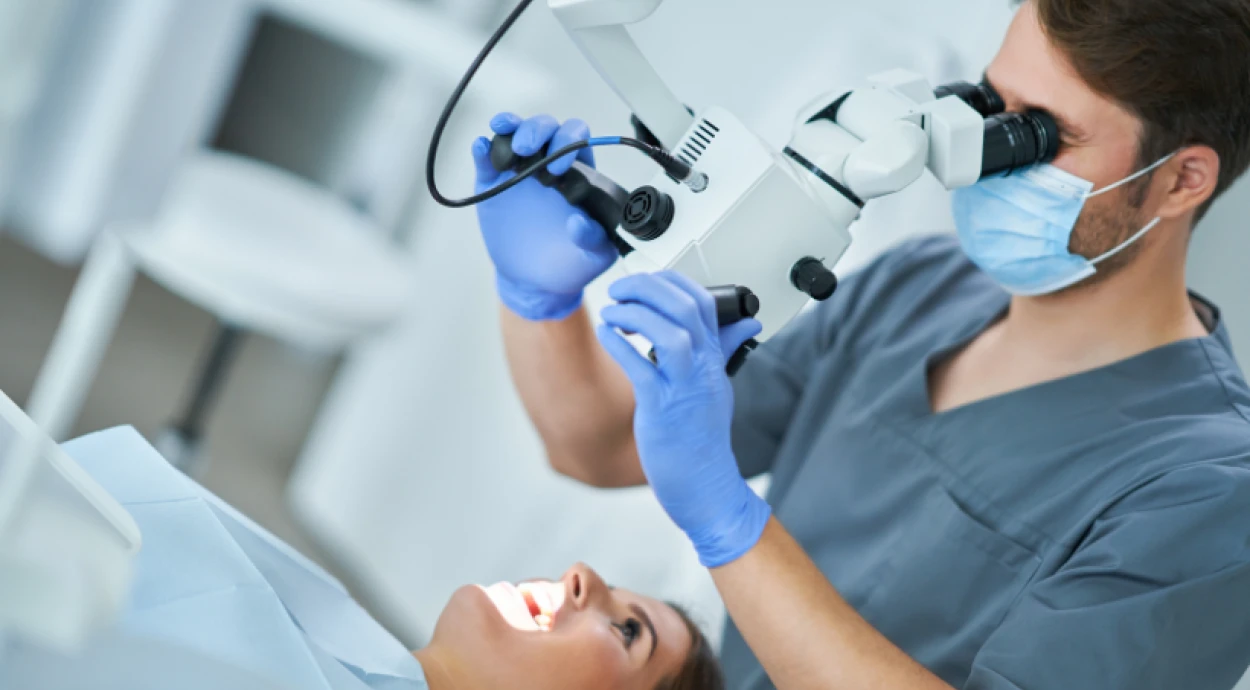
A dental microscope for complex operations requiring high precision. Its use in dental practice is becoming the gold standard of treatment. It is a powerful and highly accurate tool in the hands of a doctor, allowing examination of the smallest details of the tooth and root, proper treatment of necessary areas without touching undamaged tissues, reliable filling, and quality treatment of canals with complex anatomy and positioning.
-
An intraoral digital scanner for creating digital images of natural and artificial teeth.
-
A latest-generation CT scanner that provides full 3D diagnostics of the condition of the soft and hard tissues of the oral cavity.