


Contents:
- Which diseases are similar to psoriasis
- How to distinguish psoriasis from other skin diseases
- Which doctor to see
Redness, dryness, and scaling of the skin are symptoms that may occur in various dermatological diseases. Such changes often cause concern that it may be psoriasis. At the same time, a similar clinical picture is also characteristic of other conditions that have a completely different mechanism of development.
At an early stage, the differences between psoriasis, dermatitis, eczematous lesions, or fungal skin infections may be subtle. Small spots or plaques with scaling can sometimes look similar, so without an examination by a specialist it is difficult to establish an accurate diagnosis.
In this article, we will look at which diseases most often mimic psoriatic manifestations, what signs can help differentiate them, and when it is worth seeing a specialist to clarify the diagnosis.
Which diseases are similar to psoriasis
Skin lesions with redness and scaling can occur in various dermatological diseases. Externally, they may sometimes resemble psoriatic plaques, but they have a different nature and mechanism of development. Most often, such manifestations are observed in the following conditions:
-
Atopic or contact dermatitis — an inflammatory skin disease that occurs in response to an allergen or an external irritant. It is accompanied by redness, itching, sometimes swelling and weeping. After the provoking factor is eliminated, the condition of the skin gradually improves.
-
Seborrheic dermatitis — a chronic inflammatory process associated with impaired function of the sebaceous glands and a reaction to the skin microflora. It manifests with redness and greasy scaling, mainly on the scalp, face, and in skin folds.
-
Fungal skin infections — infectious lesions caused by pathogenic fungi. They often form round foci with more pronounced redness at the edge and a relatively lighter center. They may gradually spread to adjacent areas.
-
Pityriasis rosea — a temporary inflammatory skin disease that usually begins with one larger patch, after which smaller elements appear. In most cases, it has a self-limited course.
-
Eczema — a chronic or recurrent inflammatory skin disease. It is characterized by redness, small blisters, cracks, and intense itching. During an exacerbation, weeping and crust formation are possible.
Although the clinical manifestations of these diseases may be similar, their nature and approach to therapy differ. That is why it is important not to rely only on the appearance of the rash, but to consult a specialist to clarify the diagnosis.
How to distinguish psoriasis from other skin diseases
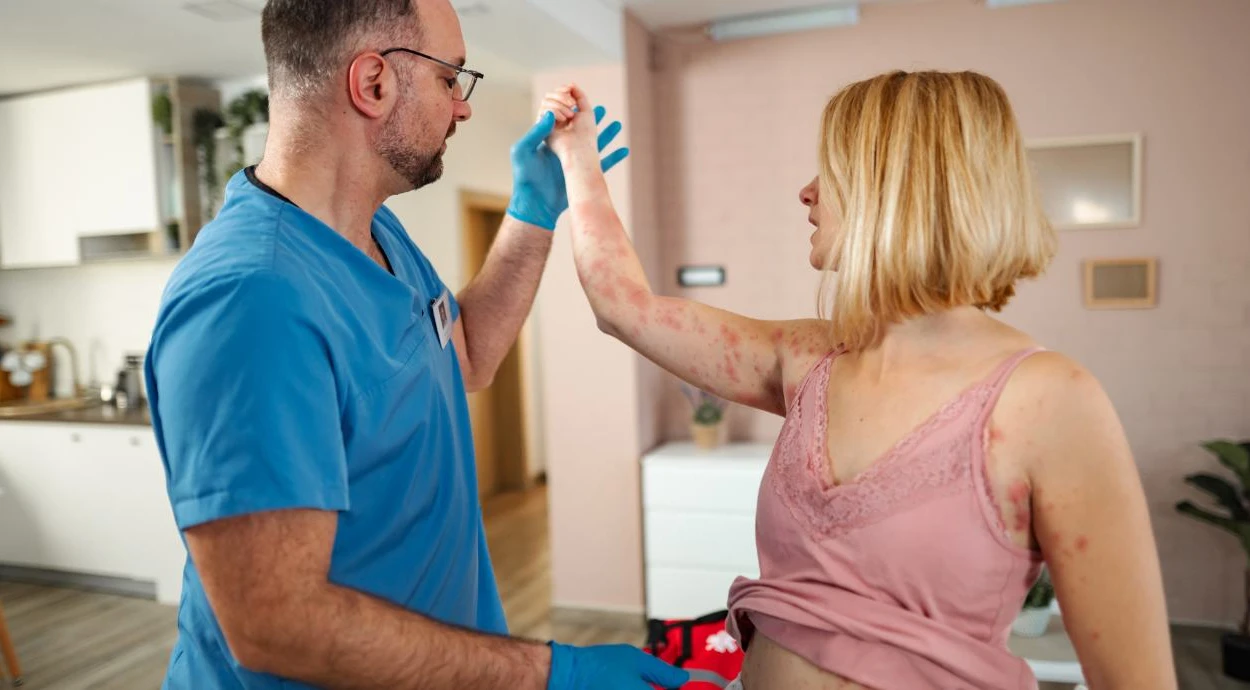
The appearance of skin lesions can be similar in different diseases, but to establish an accurate diagnosis, the doctor assesses not only the color and shape of the rash. Its localization, density, the nature of scaling, the presence of itching, the duration of the course, and the relationship with possible triggering factors are taken into account.
Psoriatic plaques usually have well-defined borders, a dry surface with dense scaling, and a tendency to a prolonged course. Other dermatological conditions have different features that allow clinical differentiation.
Key differences between the most common conditions:
It is important to understand that even the presence of typical signs does not allow a diagnosis to be made without a doctor’s examination. The final decision is made after a clinical evaluation, and if necessary — with the use of additional methods, including dermoscopy or laboratory tests.
How to distinguish psoriasis from dermatitis
.jpg)
Psoriasis and dermatitis can present with redness, scaling, and itching, but their nature is different. Dermatitis is usually a skin reaction to an external irritant or allergen. This may be a cosmetic product, household chemicals, fabrics, metal jewelry, or other factors with which the skin comes into direct contact.
Dermatitis is characterized by an association with a specific trigger. After the provoking factor is eliminated, the condition gradually improves. The rash often has less distinct borders and may be accompanied by swelling, weeping, and pronounced itching.
Psoriatic lesions, on the other hand, are usually not linked to a specific external irritant. Plaques have well-defined contours, a dry surface with dense scaling, and persist for a long time. Even in the absence of contact with possible triggers, the rash does not disappear on its own.
In addition, psoriasis often has a chronic relapsing course with periods of activity and stabilization, whereas dermatitis usually regresses after the cause is eliminated and treatment is provided.
How is psoriasis different from eczema
.jpg)
Psoriasis and eczema can have similar manifestations, but their clinical course and the structure of the rash elements differ. Eczema typically has an acute or subacute onset with small blisters that may rupture, leading to weeping and crusting. Itching is usually intense and can lead to scratching.
Psoriatic plaques, as a rule, are dry, dense, and covered with scales. They are rarely accompanied by weeping and do not have a vesicular stage. Localization may also differ: psoriasis more often affects the elbows, knees, and scalp, whereas eczema often occurs on the hands, flexural surfaces of the limbs, or areas of frequent irritation.
Specialists at «Oxford Medical» note that the differences also concern therapeutic tactics. In eczema, treatment is aimed at reducing acute inflammation, eliminating irritants, and restoring the skin barrier function. At the same time, psoriasis treatment involves controlling immune mechanisms, reducing the chronic inflammatory process, and preventing relapses. That is why proper differentiation of these conditions is important for choosing an effective treatment regimen.
Which doctor to see
If persistent rashes, scaling, or thickened areas of skin appear, it is worth seeing a dermatologist. This specialist deals with the diagnosis and treatment of skin diseases.
During the appointment, the doctor analyzes the complaints in detail, уточнює, when the first changes appeared, how they progressed, and whether there were similar episodes before. The localization of the rash, its structure, borders, the intensity of scaling, and other clinical features are assessed. For a more accurate assessment of the skin condition, the doctor may perform dermoscopy immediately. If necessary, additional laboratory tests are prescribed to clarify the diagnosis.
A timely dermatologist consultation helps establish an accurate diagnosis and determine further treatment tactics. If a rash appears that resembles psoriasis, do not delay seeing a specialist.
The information in this article is provided for informational purposes only and is not a guide for self-diagnosis or self-treatment. If symptoms of a disease appear, you should consult a doctor.
Sources:
American Academy of Dermatology (AAD)
National Institute for Health and Care Excellence (NICE)
U.S. National Library of Medicine (PubMed)