Sign up via call center
Department
Treatment of pancreatic cancer at the private clinic Oxford Medical Kyiv

Treatment of pancreatic cancer

Pancreatic cancer treatment in Kyiv

Pancreatic cancer is a malignant disease that develops from exocrine or endocrine cells of the organ. It is quite rare, but is characterized by a long asymptomatic course and aggressive behavior after reaching stage 2-3. Earlier, the tumor is diagnosed in only 20% of patients.

The effectiveness of treatment largely depends on the timing of diagnosis and the possibility of removing the tumor. Large tumors and tumors that have spread to neighboring organs require a complex operation, which requires special equipment and a highly qualified doctor.

Oxford Medical operates a high-tech surgical hospital with two operating rooms, an intensive care unit and an intensive care unit with equipment to monitor and support vital body functions. Thanks to this, as well as the involvement of a team of oncologists and oncological surgeons, who are rightfully considered the best in Kyiv and all of Ukraine, the clinic has created all the conditions for treating cancer and performing operations of any complexity.

Stages of pancreatic cancer

To determine the stage of pancreatic cancer, oncologists use the international TNM classification system, which stands for: T (tumor size), N (nodes) – involvement of lymph nodes, M (metastasis) – presence of metastases. Specialists assess the disease according to each parameter separately, which allows them to determine the spread of the disease as accurately as possible and choose the optimal treatment.

It is quite difficult for patients to understand it, so they often use a simplified system, according to which 4 stages of cancer are distinguished:

  • Stage 1 – a small neoplasm localized in the pancreas;
  • Stage 2 – the size of the neoplasm is large, but it remains within the organ, there is no lymph node involvement or metastasis;
  • Stage 3 – malignant cells spread to the lymph nodes;
  • Stage 4 – the tumor has grown into adjacent organs, there are distant metastases.

Pancreatic cancer risk factors and prevention

The risk of developing pancreatic cancer is increased by:

  • smoking - 30% of cases of carcinoma formation are associated with it;
  • alcohol abuse;
  • unbalanced diet - chronic deficiency of fresh vegetables and fruits is considered the leading cause of the disease in 20% of patients;
  • diabetes mellitus - the likelihood of cancer increases by 2 times;
  • hereditary predisposition - up to 10% of cases;
  • chronic pancreatitis - over 20 years, cancer is diagnosed in 4-8%;
  • colorectal cancer;
  • adenomatous polyposis;
  • Hippel-Lindau, Gardner syndromes;
  • obesity, etc.

For the purpose of prevention, experts recommend leading a healthy lifestyle (doing sports, eating right, giving up bad habits), maintaining weight within normal limits, timely treating all diseases and regularly undergoing preventive examinations.

Symptoms of pancreatic cancer

Initially, a malignant tumor develops asymptomatically. Signs of the disease
occur as it grows, but they are nonspecific. This leads to a patient's late visit to a doctor
and untimely diagnosis. The number and severity of symptoms in patients may vary.
The presence of several is a reason for a thorough examination.

Symptoms of pancreatic cancer can be:

impaired food passage (may be temporary due to necrosis of tumor tissues)

pain in the stomach and right hypochondrium, which may worsen at night

discoloration of stool and darkening of urine

jaundice of the skin

heaviness in the stomach

decreased appetite

nausea, vomiting

general weakness

constipation, diarrhea

bloating

weight loss

List of diseases

Diagnosis of pancreatic cancer

Many diseases of the pancreas and digestive system manifest themselves in a similar way, which complicates diagnosis. Patients with cancer often have pancreatitis and develop diabetes, which is why the main diagnosis can remain unnoticed for a long time. To prevent this, it is necessary to undergo a complex of examinations.

To assess the condition of the pancreas, the following are performed:

  • ultrasound examination (US);
  • ultrasonography;
  • spiral computed tomography with double contrast (CT);
  • positron emission tomography (PET-CT);
  • endoscopic retrograde pancreaticocholangiography (ERCP);
  • puncture biopsy under ultrasound or CT control;
  • histological analysis of a tumor tissue sample obtained through a biopsy;
  • blood tests for hormones and tumor markers;
  • X-ray, CT, MRI and other examinations to detect metastases.

Ultrasound and CT scans can visualize the tumor, but a biopsy and histological analysis are necessary to confirm the diagnosis.

Treatment of pancreatic cancer

The treatment tactics depend on the stage at which the diagnosis was made. At 1 and 2, surgical treatment is first performed. The part of the pancreas in which the tumor is localized or the entire organ as a whole is removed.

If large vessels are affected and the tumor has significantly spread to neighboring organs, a more complex operation is required. One of the options is pancreaticoduodenal resection or Whipple's operation. In Ukraine, it is performed only in a few clinics, in particular in Oxford Medical. The operation is performed by a highly qualified surgeon who has undergone extensive training in Germany, with more than 30 years of experience.

In some cases, if the disease is diagnosed at a late stage, surgical treatment is performed only to relieve symptoms and prolong life. Some patients may not be eligible for surgery and are prescribed palliative treatment.

Conservative methods for pancreatic cancer are mainly used:

  • chemotherapy - prescribed before surgery to reduce the tumor, and after to eliminate remaining cancer cells, prevent relapse and/or treat metastases;
  • radiation therapy - also used before and after surgical treatment to stop tumor growth and reduce its size.

Targeted and immune therapy are also sometimes prescribed.

The treatment program for each patient is developed individually. As a rule, it includes several treatment methods that alternate or are carried out simultaneously.

Oxford Medical has created all the conditions for highly accurate diagnostics, as well as surgical and conservative treatment of pancreatic cancer. The clinic has new medical equipment from the best brands and employs top-class doctors with more than 20 years of experience.

To make an appointment for a consultation, call our contact center or write to the chat on the website.

Our services
Consultations
Consultation with an oncologist
1100.00 ₴
Add Added
Consultation with a leading oncologist
1989.00 ₴
Add Added
Consultation with a leading surgeon-oncologist
1989.00 ₴
Add Added
Online consultation with an oncologist
1100.00 ₴
Add Added

Frequently asked questions

What does an ultrasound show in pancreatic cancer?

Ultrasound allows you to visualize the tumor in the pancreas and preliminarily estimate its size. To clarify the diagnosis, CT scan, tumor biopsy and histological analysis of the obtained sample are performed. Only the results of this determine whether the disease is malignant.

How often does pancreatitis turn into cancer?

Chronic pancreatitis increases the risk of developing pancreatic cancer. Within 20 years of diagnosis, a malignant tumor appears in 4-8% of patients, which is 15 times higher than the frequency in the general population.

How is pancreatic cancer detected?

To diagnose the disease, a comprehensive examination is performed, which includes ultrasound, CT scan, biopsy of the neoplasm with histological analysis of the sample, and other studies.

What is the life expectancy with pancreatic cancer?

Pancreatic cancer is one of the most aggressive. Due to the lack of specific symptoms, it is diagnosed late, which complicates treatment. When a tumor is detected at stage 3-4, the 5-year survival of patients after surgery is 20%, without it - no more than 5%. At an early stage, the effectiveness of treatment is much higher.

( Rating: 4.85 , Votes: 98 )

Benefits of pancreatic cancer treatment at Oxford Medical

New expert-grade equipment

Oncologists and oncological surgeons with many years of experience

High-tech surgical hospital with conditions for performing operations of any complexity

Intensive care unit and intensive care unit equipped with equipment to support vital body functions

Possibility of chemotherapy, targeted therapy and immunotherapy

Comfortable therapeutic and day hospital

Our doctors

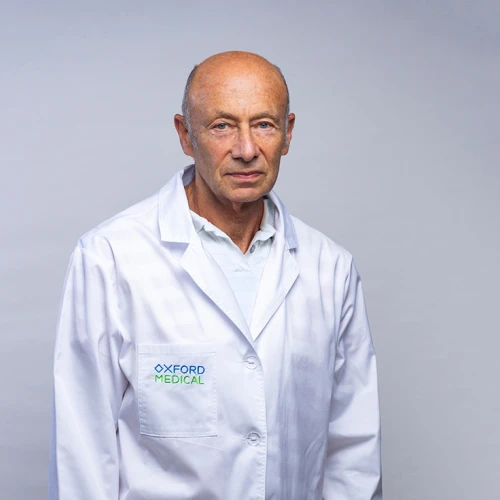
Lifshitz Yuriy Zinovievich
4.9
rating (48)
47+
Years of experience
Online consultation
Surgeon of the highest category, Doctor of Medical Sciences
47+ Years of experience
Make an appointment
Dechtjar Tetyana Volodymyrivna
4.86
rating (35)
34+
Years of experience
Oncologist of the highest category
34+ Years of experience
Consultation 1989
Kyiv, st. Bereznyakivska, 30b
Make an appointment
Doctor at the private clinic Oxford Medical Kyiv
0
rating (0)
8+
Years of experience
Category I oncologist
8+ Years of experience
Consultation 1100
m. Kyiv, Parkovo-Syretska St., 7A
Make an appointment
All doctors
Reviews
Vladislav But 21.03.2021
Из всех клиник здесь наиболее оптимальное соотношение качества и цены. Все врачи, с которыми мне приходилось сталкиваться очень добрые и хорошие люди, объясняют всё максимально в деталях и отвечают на все вопросы, так что после приема не остаётся чувства недосказанности или непонимания. Советую.
Star Star Star Star Star
Марія 15.03.2019
Дякую за консультацію головному лікарю клініки Петру Олексійовичу Зайченку - за професіоналізм, уважність, тактовність і за те, що бачить не просто чергового пацієнта, а конкретну людину з її проблемами, які потрібно вирішувати комплексно. Бажаю Вашій клініці вдячних пацієнтів!
Star Star Star Star Star
Sign up
in the clinic
online
This site is protected by reCAPTCHA technology, and the Google Privacy Policy and Terms of Service apply.
Hello!
Let's take care
about your health:
Sign up via call center

We use cookies and other technologies to remember your preferences and find out exactly how you use and interact with the site.

By using our site, you also agree to the terms of the "User Agreement" and "Regulation on the processing and protection of personal data". By clicking "I AGREE", you consent to the processing of your data.