Sign up via call center
Department
Skin cancer treatment at the private clinic Oxford Medical Kyiv

Skin cancer treatment

Skin cancer treatment in Kiev

Skin cancer is the general name for a number of malignant neoplasms that develop from different layers of the epithelium. It is one of the most common types of cancer - the number of diagnosed cases increases by 5% annually.

The disease most often develops in men and women over 60 years of age. The first foci of the tumor appear mainly on exposed areas of the skin: on the nose, in the corners of the eyes, on the hands, feet, lower legs, armpits, upper back and torso.

The prognosis of the disease depends on its type and stage. Some forms of skin cancer detected at stages 1 and 2 are well treatable, which gives patients the opportunity to fully recover. With more aggressive forms of cancer, there is a risk of rapid development of oncology and the appearance of metastases.

At the Oxford Medical Medical Center, skin cancer treatment is carried out by highly qualified oncologists, oncological surgeons and other specialists with many years of experience. Thanks to this, as well as the availability of new expert-class diagnostic equipment and a high-tech surgical hospital, the clinic has created all the conditions for providing care to patients with skin cancer.

Causes and risk factors for skin cancer

The cause of cancer is the mutation of skin cells, the probability of which increases in the presence of the following risk factors:

  • genetic predisposition;
  • fair skin;
  • tendency to form a large number of moles;
  • sunburn;
  • prolonged exposure to ultraviolet radiation;
  • regular visits to the solarium;
  • frequent skin trauma in one area;
  • decreased immunity;
  • undergoing radiation therapy;
  • contact with toxic substances.

Experts recommend that if there are several risk factors, you should pay attention to moles and other skin neoplasms, as well as undergo an annual examination by a dermatologist.

Types of skin cancer

The most important classification of skin cancer is by the type of cells from which it develops.

Depending on this, the following are distinguished:

  • basal cell skin cancer (carcinoma, basal cell carcinoma);
  • squamous cell skin cancer;
  • melanoma of the skin;
  • Merkel cell carcinoma.

Different types of cancer differ in their aggressiveness and response to treatment. We will consider each of them in more detail below.

Basal cell skin cancer

Basal cell carcinoma (BCCC) is the most common, accounting for 75% of all skin cancers. It develops from basal skin cells, which are found in the lower layer of the epidermis (the outer layer of the skin). Their main function is to ensure that new cells grow to replace those that die. It usually appears as a slightly translucent bump on the skin, although it can also take other forms.

Basal cell carcinoma most often occurs on areas of the skin that are exposed to the sun, such as the head and neck. UV radiation is believed to be the main cause of the disease, so you can reduce your risk by using sunscreen and avoiding heavy tanning.

The main symptoms of basal cell skin cancer:

  • a small bump on the skin that is flesh-colored, white, or pearly and may be covered with a translucent layer of skin;
  • the formation of a brown, black, or purple hue or a lesion with dark spots and slightly raised, translucent edges.
  • a flat neoplasm that peels and gradually grows;
  • a neoplasm of asymmetrical shape, elongated, outwardly resembling an old scar.

Depending on the morphological features, the following types of BSC are distinguished:

  • nodular basal cell skin cancer;
  • superficial;
  • sclerosing, or infiltrative;
  • pigmentary.

BSC less often than other types of cancer penetrates into the deep layers of the dermis and metastasizes, due to which it is better amenable to treatment.

Squamous cell skin cancer

Squamous cell skin cancer (SCSC) accounts for up to 20% of all cases of this disease. It develops from the cells of the squamous epithelium, which make up the outer and middle layers of the skin.

Squamous cell skin cancer also forms mainly on areas of the skin exposed to sunlight: the face, neck, back of the hands and forearms, as well as on scars, burned areas of the skin and affected by ulcers that do not heal for a long time.

Unlike basal cell cancer, SCSC progresses a little faster, but if diagnosed in a timely manner, it is well treatable and rarely metastasizes.

There are different types of squamous cell carcinoma, which are distinguished by the histological principle (morphological features of the cells):

  • adenoid or pseudoglandular squamous cell carcinoma;
  • intraepidermal squamous cell carcinoma;
  • large cell keratinizing squamous cell carcinoma;
  • squamous cell carcinoma without keratinization;
  • lymphoepithelial carcinoma;
  • papillary squamous cell carcinoma;
  • papillary thyroid carcinoma;
  • small cell squamous cell carcinoma;
  • spindle cell squamous cell carcinoma;
  • verrucous squamous cell carcinoma.

This classification is of great importance when drawing up a treatment plan and allows the oncologist to choose the most effective option.

Merkel cell carcinoma

Merkel cell carcinoma, or neuroendocrine carcinoma, is a rare type of skin cancer that develops from healthy Merkel cells. They are located in the basal layer of the epidermis and hair follicles and are connected to sensitive nerve endings in the skin papillae.

Merkel cell carcinoma appears as flesh-colored or bluish-red nodules, sometimes painful to the touch. They most often form in older people on the face, head, or neck. Merkel cell carcinoma is characterized by a tendency to rapidly progress and develop metastases.

Skin melanoma

Melanoma is a malignant neoplasm that develops from melanocytes, skin cells that contain the pigment melanin. It is the rarest and most dangerous type of skin cancer, as it is highly aggressive and can quickly grow into the deep layers of the dermis, affect blood vessels and lymph nodes, and metastasize.

Melanoma lesions can form on any part of the body, including the head, neck, arms, legs, back, etc. Sometimes neoplasms appear even on the feet, under the nails, in the genital area, and in other areas that are never exposed to sunlight. In very rare cases, the primary lesion develops in the vagina, eye, or other internal organs.

On the skin, melanoma can look different: like a mole, a pigmented spot that rises slightly above the skin, a colorless or slightly red formation.

When detected early, melanoma can be completely cured with surgery in many patients. However, in the late stages, it is difficult to treat due to rapid metastasis.

Classification of skin cancer stages

There are different types of skin cancer, and the approach to classifying them varies. For basal cell carcinoma, typical staging is rarely used because it rarely spreads to the lymphatic system or other organs.

For squamous cell carcinoma and melanoma, the stage of the disease is sometimes determined according to the international TNM classification system, where T (tumor size) indicates the size of the tumor, N (nodes) indicates the involvement of lymph nodes, and M (metastasis) indicates the presence of metastases.

However, a more common system is to use a simplified system, according to which 5 stages of cancer are distinguished:

  • Stage 0, or carcinoma in situ, means that the cancer cells are present only at the site of primary development and have not spread further;
  • Stage 1 means that the size of the squamous cell carcinoma is less than 2 cm, and the thickness of the melanoma is less than 2 mm;
  • Stage 2 means that the size of the squamous cell carcinoma is more than 2 cm, and it has penetrated deeper into the tissues of the epidermis, and the thickness of the melanoma does not exceed 4 mm;
  • Stage 3 – the tumor increases in size, progresses rapidly, spreads to nearby lymph nodes, but there are no distant metastases;
  • Stage 4 – the tumor affects deep tissues and has metastases.

Skin neoplasms are also classified by the depth of germination. They can affect:

  • epidermis;
  • upper parts of the papillary layer of the dermis;
  • the entire papillary layer of the dermis;
  • reticular dermis;
  • subcutaneous fat.

No less important is the determination of the degree of differentiation of cells (G), which is responsible for their aggressiveness and tendency to rapid growth. Accordingly, they are distinguished:

  • GX – the degree of malignancy of the tumor cannot be assessed;
  • G1, highly differentiated tumor cells – their structure is slightly different from normal, which indicates a low probability of metastasis;
  • G2, moderately differentiated tumor cells are significantly different from healthy ones;
  • G3, poorly differentiated tumor cells – have only partial similarity to healthy cells;
  • G4, undifferentiated tumor cells – the tumor behaves aggressively, develops rapidly and responds poorly to treatment.

In order to determine the type, stage and other features of skin cancer as accurately as possible, the patient first undergoes a thorough diagnosis. Detailed classification allows for the most effective treatment for each case.

Symptoms of skin cancer

Skin cancer most often begins on the face, hands, feet, lower legs, armpits, upper back, and torso.

The main symptom of skin cancer is the appearance of new moles, age spots, or other growths, as well as changes in existing ones.

You should see a doctor immediately if:

its structure changes – it becomes harder or, conversely, softer

has an asymmetrical shape, uneven edges, different colors

itching, burning, tingling in the area of ​​the mole or pigment spot

neoplasms appear, including numerous small foci around a large

the tumor is growing rapidly

diameter over 6 mm

inflammation on both sides

peeling and crusting of the mole

cracks, ulcers, bleeding

List of diseases

Skin cancer diagnosis

With the appearance of a large number of moles, an increase in their size and other symptoms of skin cancer, you should consult a dermatologist. During the appointment, he will conduct an examination and dermatoscopy - a study of the features of the neoplasm through a special magnifying device. At the same time, the doctor will assess its size, structure, edges, color, etc. If one or more indicators indicate the malignant nature of the neoplasm, the dermatologist will prescribe a biopsy with histological analysis.

A biopsy is a sample of tumor tissue taken, which is sent to the laboratory for histological analysis. Specialists evaluate the structure of the cells and its compliance with the norm. Any deviation from it indicates the development of cancer.

If there is a likelihood of cancer spreading to other organs and to determine its stage, the patient may also be prescribed other examinations:

  • digital dermatoscopy;
  • ultrasound;
  • x-ray;
  • CT, PET-CT, MRI, etc.

Skin cancer treatment

An individual treatment program is drawn up for each patient with skin cancer. It depends on the type of malignant neoplasm, the degree of cell differentiation, the stage of cancer, the patient's age and other features.

When cancer is detected at an early stage, when there are no lymph node damage and distant metastases, more than 80-90% of patients recover completely. In this case, surgical treatment is sufficient for many.

It is carried out using:

  • cryodestruction - removal of the tumor using chilled liquid nitrogen;
  • laser destruction - removal of tissue with a laser;
  • curettage and electrodissection - removal of the tumor with a curette followed by treatment of the wound edges with an electric current;
  • excision - classic removal of tissue with a scalpel (used for larger neoplasms).

In more complex cases, the scope of the operation may be greater. After recovery, reconstructive or plastic surgery may be performed to eliminate the aesthetic defect.

If necessary, after surgical treatment, additional radiation therapy, chemotherapy, targeted and immune therapy are performed. They are also used for inoperable tumors.

Oxford Medical has a modern oncology department and a high-tech surgical hospital. The clinic has new expert-class equipment that allows for thorough diagnostics, as well as medical and surgical manipulations of any degree of complexity.

We employ some of the best oncologists and surgeons in Kyiv and Ukraine with many years of experience who possess all modern methods of treating skin cancer, including targeted and immunotherapy. By contacting Oxford Medical, you can be sure that you are in safe hands.

To make an appointment for a consultation, call our contact center or write to the chat on the website.

Skin cancer prevention

The main risk factors for skin cancer are considered to be prolonged exposure to ultraviolet rays, hereditary predisposition, frequent skin damage, previous burns and non-healing ulcers.


For prevention, the following are recommended:

Avoid visiting the solarium.

Avoid or limit sun exposure between 10:00 a.m. and 4:00 p.m.

Use special clothing, wide-brimmed hats that cover the face and neck, glasses, etc. to protect against UV rays.

Use sunscreen with an SPF of at least 30, which should be applied to the skin every 2 hours, or 1 hour if swimming in a body of water or sweating heavily.

Regularly examine your skin for new moles and changes in their appearance.

Regularly undergo a preventive examination by a dermatologist and consult a doctor at the first symptoms of the disease.

Skin cancer is treatable in its early stages, so self-diagnosis and timely medical attention are of great importance.

Our services
Consultations
Consultation with an oncologist
1100.00 ₴
Add Added
Consultation with a leading oncologist
1989.00 ₴
Add Added
Consultation with a leading surgeon-oncologist
1989.00 ₴
Add Added
Online consultation with an oncologist
1100.00 ₴
Add Added

Frequently asked questions

What is the life expectancy with skin cancer?

There are several types of skin cancer, which differ in their aggressiveness. Accordingly, the patient's life expectancy depends on the type of neoplasm and the time of diagnosis. Melanoma is considered the most dangerous. According to statistics in the USA, the 5-year survival of patients with melanoma detected at stage 1 reaches 99%, at stage 2 - 80%, at stage 3 - 66%, and at stage 4 - 27%.

How quickly does squamous cell skin cancer develop?

The time it takes for squamous cell carcinoma to develop depends on the degree of differentiation of the cells, which determines how different they are from normal. Highly differentiated cancer develops slowly and manifests as crusted growths. Poorly differentiated cancer is more aggressive and can penetrate into the deeper layers of the skin within 6-8 months. Its symptoms are painful lumps or ulcers with periodic bleeding.

How does skin cancer form?

Skin cancer develops as a result of a mutation in the DNA of epidermal cells. As a result of the disorder, their morphological structure and growth characteristics change, leading to the appearance of a malignant neoplasm.

What tests show the presence of skin cancer?

For primary diagnosis, dermatoscopy is performed. The doctor examines the affected area of ​​the skin using a special device that provides multiple magnification and studies its features. If there are signs of a malignant process, a biopsy is performed - a tissue sample is taken, which is sent to the laboratory for histological analysis. The results determine whether the patient has cancer or whether the neoplasm is benign.

( Rating: 4.81 , Votes: 88 )

Benefits of skin cancer treatment at Oxford Medical

Affordable price and loyalty program for regular patients

Expert-grade diagnostic and surgical equipment

Oncologists and oncological surgeons with many years of experience

High-tech surgical hospital

Intensive care unit (resuscitation), equipped with equipment to support vital body functions

Chemotherapy, targeted therapy, and immunotherapy

Our doctors

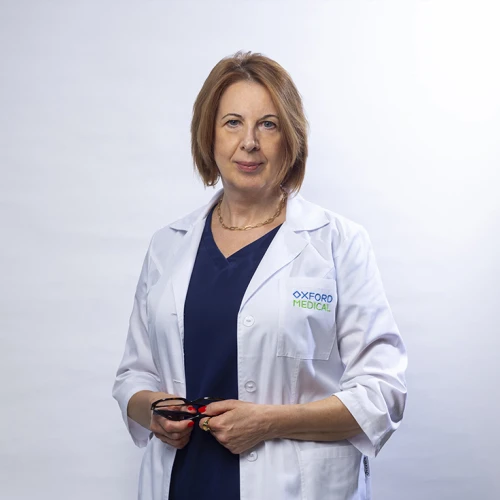
Dechtjar Tetyana Volodymyrivna
4.86
rating (35)
34+
Years of experience
Oncologist of the highest category
34+ Years of experience
Consultation 1989
Kyiv, st. Bereznyakivska, 30b
Make an appointment
Doctor at the private clinic Oxford Medical Kyiv
0
rating (0)
8+
Years of experience
Category I oncologist
8+ Years of experience
Consultation 1100
m. Kyiv, Parkovo-Syretska St., 7A
Make an appointment
All doctors
Reviews
Vladislav But 21.03.2021
Из всех клиник здесь наиболее оптимальное соотношение качества и цены. Все врачи, с которыми мне приходилось сталкиваться очень добрые и хорошие люди, объясняют всё максимально в деталях и отвечают на все вопросы, так что после приема не остаётся чувства недосказанности или непонимания. Советую.
Star Star Star Star Star
Марія 15.03.2019
Дякую за консультацію головному лікарю клініки Петру Олексійовичу Зайченку - за професіоналізм, уважність, тактовність і за те, що бачить не просто чергового пацієнта, а конкретну людину з її проблемами, які потрібно вирішувати комплексно. Бажаю Вашій клініці вдячних пацієнтів!
Star Star Star Star Star
Sign up
in the clinic
online
This site is protected by reCAPTCHA technology, and the Google Privacy Policy and Terms of Service apply.
Hello!
Let's take care
about your health:
Sign up via call center

We use cookies and other technologies to remember your preferences and find out exactly how you use and interact with the site.

By using our site, you also agree to the terms of the "User Agreement" and "Regulation on the processing and protection of personal data". By clicking "I AGREE", you consent to the processing of your data.