blurred vision when looking into the distance
Fundus examination, which allows you to assess the condition of the retina, blood vessels, and optic nerve. Important if degenerative myopia is suspected, which can lead to serious complications.

 Adults Adults Adults Adults Adults Adults Adults Adults Adults
  Children Children Children Children


 Hotline:
 Adults Adults Adults Adults Adults Adults Adults Adults Adults Children Children Children Children
Myopia is a visual impairment in which a person sees objects up close clearly, but they appear blurry when they are far away. This happens because the image is not focused on the retina, as it should be, but in front of it. Modern ophthalmology offers effective methods of diagnosis and correction of this condition, which help improve the quality of life of patients.
The Oxford Medical clinic employs experienced ophthalmologists who conduct a comprehensive examination, select the optimal correction method and develop an individual treatment program.
If you notice a deterioration in vision, do not postpone a visit to a specialist. Make an appointment with an ophthalmologist at the Oxford Medical clinic in Kyiv.
Myopia is a disorder of light refraction in the eye, in which a person sees close objects clearly, but distant objects appear blurry due to improper focusing of the image in front of the retina.
In a normal state, light rays focus directly on the retina, but with myopia, the image is formed in front of it, which causes distant objects to be blurry.
There are several degrees of myopia:
Separately, progressive myopia is distinguished, in which visual impairment rapidly worsens. In severe cases, degenerative myopia may develop, accompanied by pathological changes in the retina and blood vessels of the eye. There is also a condition where myopia is combined with a violation of the curvature of the cornea, for example, moderate myopia with astigmatism, which can cause image distortion, double vision and difficulty focusing on objects at different distances.
It is important to have your vision checked regularly, especially if you notice symptoms characteristic of myopia:


blurred vision when looking into the distance
the need to squint to see objects
frequent headaches and eye fatigue
deterioration of night vision
increased sensitivity to light

If you notice these signs, you should make an appointment with a doctor. Ophthalmologists at the Oxford Medical clinic in Kyiv will conduct a comprehensive diagnosis to determine the degree of the disorder and select the appropriate treatment for myopia. If the symptoms of myopia worsen, you should make an appointment with a doctor as soon as possible.
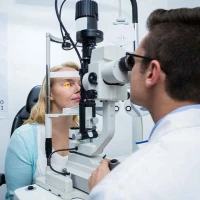
To determine the degree of myopia of the eyes and choose an effective treatment, it is necessary to undergo a comprehensive ophthalmological examination. In the Oxford Medical clinic, diagnostics are carried out using modern equipment that allows you to assess the condition of the visual system and identify possible complications.
Depending on the results obtained, the ophthalmologist determines an individual strategy for correcting myopia and provides recommendations for further treatment and prevention of myopia.
The main methods of diagnosing myopia:
Fundus examination, which allows you to assess the condition of the retina, blood vessels, and optic nerve. Important if degenerative myopia is suspected, which can lead to serious complications.
Objective determination of refractive error, which helps to accurately determine the degree of myopia.
Mapping the corneal surface to detect corneal deformations and astigmatism.
Visual field testing to detect changes in peripheral vision, which may be important in complicated forms of myopia.
Used in cases of progressive or high myopia to assess the length of the eyeball and the condition of the internal structures of the eye.
Vision correction for myopia can be done in several ways:
For myopia in children, treatment may also include vision correction with glasses or lenses, prescribing pharmacotherapy and special eye exercises.
At the Oxford Medical clinic, experienced ophthalmologists select the optimal treatment methods taking into account the condition of each patient.
The development of myopia can be caused by various factors that affect the shape and function of the eye.
The main causes of myopia include:
If one or both parents have myopia, the risk of a child developing it increases significantly.
Prolonged computer work, reading in poor lighting, and poor posture while studying can lead to the development of vision impairment.
Insufficient training of the accommodative apparatus can contribute to the elongation of the eyeball, which causes refractive errors.
A lack of vitamin A, group B, zinc, and antioxidants can negatively affect the condition of the retina and lens.
Vascular diseases can lead to changes in the structure of the eyeball and contribute to the development of pathological changes in the retina.
Endocrine disorders, diabetes, and connective tissue weakness can contribute to vision impairment.
It is possible to prevent the development of myopia or slow down its progression if you follow simple rules.
Prevention of myopia includes:
Following these recommendations will help reduce the risk of developing myopia, and will also help maintain healthy vision for many years. If you already have vision problems, it is important to contact the specialists of the Oxford Medical clinic in a timely manner to choose the optimal correction method and effective treatment for myopia.
In the ophthalmology department of "Oxford Medical" in Kyiv, modern methods of diagnosis and treatment of myopia in children and adults are used. The cost of myopia treatment depends on the chosen method. You can find out the prices of the ophthalmology department of "Oxford Medical" here.
If you are looking for a qualified ophthalmologist in Kyiv, contact the clinic "Oxford Medical". Our specialists will help you preserve your vision and improve your quality of life.
Sign up for a consultation now to receive individual recommendations.


We are often asked:
Most often, progressive myopia develops in childhood and adolescence, when the eyeball is still growing. In most cases, myopia stabilizes by the age of 18-25. However, in some people, especially with a high degree of myopia, vision deterioration may continue into adulthood. Regular examinations by an ophthalmologist help to control this process.
Myopia in children cannot be completely cured, but its progression can be slowed and vision improved. This can be done with glasses, contact lenses, medication, and eye exercises. Preventive measures such as proper posture, adequate lighting, and limiting screen time are important.
A person with myopia can see objects that are close up clearly, but distant objects appear blurry. The degree of blurring depends on the strength of myopia: with a weak degree, the blurring is noticeable only at long distances, and with a high degree, even medium distances appear blurry.
Treatment of myopia involves vision correction, but it is impossible to completely cure this condition. The most common methods of correction are wearing glasses or contact lenses, orthokeratology, and drug therapy. It is also important to follow preventive measures to preserve vision.
Myopia is a vision disorder in which a person sees objects close up clearly, but distant objects appear blurry. This occurs because the image focuses in front of the retina, rather than on it. Myopia can be congenital or acquired and often progresses with prolonged eye strain. Glasses, contact lenses, or orthokeratology methods are used for correction.
Laser vision correction in Kyiv is a surgical procedure that helps correct refractive errors such as myopia, hyperopia, and astigmatism. It involves changing the shape of the cornea with a laser to properly focus light on the retina. It may be recommended for patients with stable myopia, when the degree of the disorder does not change over the course of a year.


Experienced ophthalmologists – specialists with many years of experience in the field of diagnostics and vision correction
Modern equipment – precise research methods help to detect even minor deviations
Comprehensive approach – treatment is selected individually, taking into account the patient's age, concomitant pathologies and lifestyle
Comfortable conditions for examination and treatment - convenient appointment schedule, attentive attitude of doctors and affordable cost of services
Effective correction methods – safe and proven ways to improve vision without surgery

 4.95
4.95  23+
23+  23+ Years of experience
 4.86 30+ 30+ Years of experience
  4.93 49+ 49+ Years of experience
  m. Irpin vul. University, 2/1, building 3



 in the clinic
  online
  Hello!