Contents:
- What is a hygroma and why does it occur
- What does a hygroma look like
- How to distinguish a hygroma from other formations under the skin
- Can a hygroma go away on its own
- Why does a hygroma hurt
- How to treat a hygroma
Hygroma — is a neoplasm under the skin that most often appears in the area of joints or tendons. Usually, it has the appearance of a rounded or oval protrusion, may slowly increase or remain unchanged for a long time.
That is why a hygroma is often perceived as a harmless feature and does not cause significant concern. At the same time, it is important to understand that its appearance is associated with certain changes in the tissues. In this article, we will look at what a hygroma is, why it occurs, whether it can disappear on its own, and in which cases treatment is needed.
What is a hygroma and why does it occur
Hygroma — is a benign cystic formation that forms from the membranes of joints or tendons and is filled with thick serous fluid. Most often, it is localized in areas of increased load — on the wrist, fingers, foot, or ankle joint.
The basis of its development is changes in the connective tissue. Under the influence of certain factors, the joint membrane or tendon sheath becomes thinner and bulges outward, forming a capsule that gradually fills with fluid.
The most common causes of hygroma appearance include:
-
repeated loads on the same area (for example, working with the hands, sports);
-
microtraumas and chronic tissue irritation;
-
previous inflammatory processes in the joints or tendons;
-
joint injuries in the past;
-
individual structural features of the connective tissue.
It is important to understand that the neoplasm itself is only a consequence of these changes. Therefore, in each case, it is important not just to assess its size or localization, but to determine the factors that contributed to its appearance. This approach is what allows choosing the correct tactics of observation or treatment and reducing the risk of recurrence.
What does a hygroma look like
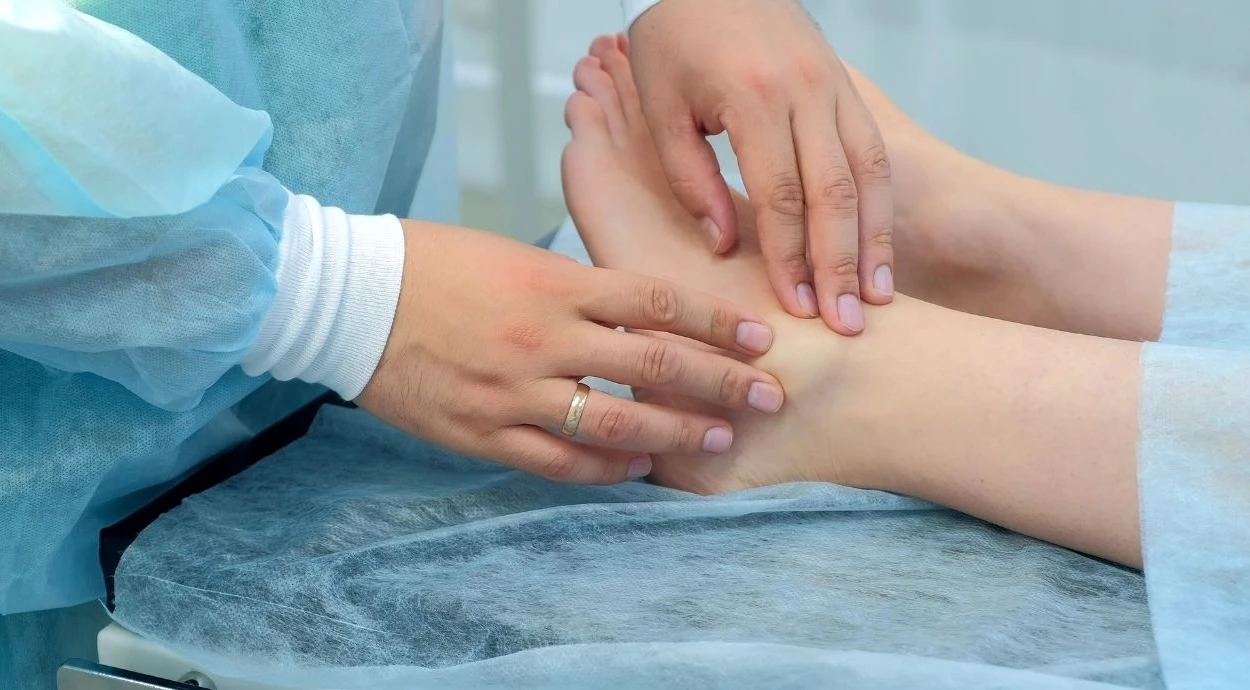
A hygroma has the appearance of a rounded or oval formation under the skin, which is usually clearly outlined and noticeably protrudes above the surface. Most often, it appears on the hand, in particular in the area of the wrist or fingers, but it can also form on the leg — in the area of the foot or ankle joint.
According to external signs, a hygroma has the following features:
-
a smooth surface without changes in the color of the skin;
-
an elastic or dense consistency when touched;
-
clear boundaries, the formation is easily detected by palpation;
-
sizes can vary — from a few millimeters to several centimeters;
-
the skin over the formation is usually mobile and not fused with the capsule.
In most cases, a hygroma is not accompanied by pain, especially in the initial stages. However, as it increases in size, it can create discomfort, restrict movement, or cause a feeling of pressure if it is located near nerve endings.
Sometimes the size of the neoplasm may change: it becomes more noticeable after physical exertion and decreases at rest. This is due to the accumulation or redistribution of fluid inside the capsule.
How to distinguish a hygroma from other formations under the skin
A hygroma has characteristic signs, however, in appearance it can be confused with other subcutaneous formations. It is impossible to establish the diagnosis accurately on your own, so it is important to focus on general differences and consult a doctor.
Most often, a hygroma is differentiated from the following formations:
-
lipoma (fatty lump) — soft, mobile, not connected with the joint, usually does not change in size depending on the load;
-
atheroma — a denser formation associated with the sebaceous gland, sometimes has a central “point” (excretory duct);
-
tendon ganglion — a formation close to a hygroma, but with other anatomical features;
-
inflammatory infiltrates or abscesses — accompanied by pain, redness, and increased skin temperature;
-
soft tissue tumors — require mandatory diagnostics to exclude a malignant process.
The following signs are more characteristic of a hygroma:
-
location near a joint or tendon;
-
clear contours and a rounded shape;
-
elastic consistency;
-
possible change in size after exertion;
-
usually no inflammation of the skin over the formation.
Only a specialist can determine exactly what kind of formation it is. To confirm the diagnosis, ultrasound examination (ultrasound) is most often used, which makes it possible to assess the structure, contents, and connection with the joint or tendon.
Can a hygroma go away on its own
In some cases, a hygroma really can decrease in size or temporarily disappear without treatment. This is due to a reduction in the load on the joint or tendon, as well as partial redistribution of fluid inside the capsule. However, such changes do not mean that the problem is completely resolved.
Doctors at «Oxford Medical» explain: a hygroma has a capsule that remains even after the size decreases. Therefore, the formation may appear again or increase with repeated load, injuries, or tissue irritation. That is why spontaneous “disappearance” is most often a temporary effect rather than a full recovery.
The following points should be taken into account:
-
small asymptomatic hygromas can sometimes remain unchanged or decrease for a long time;
-
with regular load, they increase more often;
-
periods are possible when the formation becomes less noticeable but does not disappear completely;
-
without eliminating the cause, the risk of recurrence remains.
If the neoplasm does not cause pain and does not increase, the doctor may recommend observation. But if it grows, interferes with movement, or causes discomfort, other treatment options should be considered.
Why does a hygroma hurt
A hygroma is not always accompanied by pain. In many cases, it remains asymptomatic for a long time and causes only aesthetic discomfort. However, the appearance of pain usually indicates additional changes in the tissues or an increase in the size of the formation.
The main reasons why a hygroma may hurt:
-
pressure on nerve endings — when the formation increases in size, it may compress surrounding tissues;
-
mechanical irritation — during movement in the joint or from rubbing against clothing;
-
inflammation — in case of irritation or trauma to the capsule;
-
increased load on the area where the neoplasm is located;
-
localization in places of active mobility (for example, the wrist or foot).
The intensity of the pain can vary — from slight discomfort to pronounced sensations during movement or pressure. Sometimes pain occurs only during physical exertion and does not bother the person at rest.
It is important to take into account that the appearance of pain is a signal that should not be ignored. In such cases, a consultation with a dermatologist or another specialized specialist is advisable in order to assess the condition of the formation, exclude complications, and determine further tactics. Timely assessment makes it possible not only to reduce symptoms, but also to prevent further enlargement of the neoplasm or the development of an inflammatory process.
How to treat a hygroma
.jpg)
The approach to treating the neoplasm depends on its size, localization, the presence of symptoms, and the impact on everyday life. It is important to understand that treatment should be aimed not only at removing the formation itself, but also at the cause of its appearance — excessive load, trauma, or chronic tissue irritation.
Modern treatment methods include observation, conservative approaches, and surgical removal. The choice of tactics is determined individually after examination.
How to treat a hygroma at home and whether it is worth doing
The question of how to get rid of a hygroma on the hands arises quite often, especially if the formation does not cause pain and seems insignificant. That is why at home people sometimes try to affect a hygroma with the help of compresses, ointments, or load restriction.
However, it is important to understand: such methods do not remove the capsule of the formation and cannot completely solve the problem.
What can really help:
-
reducing the load on the area;
-
temporary immobilization (for example, fixation of the joint);
-
avoiding repeated microtraumas.
At the same time, attempts to independently puncture or “crush” a hygroma are dangerous. This can lead to inflammation, infection, and recurrence, sometimes even of a larger size.
Therefore, home methods can be considered only as auxiliary measures, but not as полноценное лечение.
When observation by a doctor is sufficient
Doctors at «Oxford Medical» explain that in a number of cases active treatment is not required. If the hygroma is small, does not hurt, does not increase, and does not restrict movement, the doctor may recommend dynamic observation.
This approach involves:
-
regular examinations;
-
monitoring changes in size and symptoms;
-
recommendations regarding load.
Observation makes it possible to avoid unnecessary intervention if the formation does not progress. At the same time, it is important to remain under the supervision of a specialist in order to change tactics in time when symptoms appear.
When and how a hygroma is removed
Indications for active treatment include pain, rapid growth, restriction of movement, pressure on surrounding structures, or marked aesthetic discomfort. In such cases, removal of the hydatidiform mole is considered, and the method depends on its size, location, and symptoms.
The main methods include:
-
Puncture. The hygroma is punctured and the fluid is removed with a syringe. Sometimes anti-inflammatory or sclerosing agents are then injected. The method is minimally traumatic, but the capsule remains, so there is a high risk of recurrence.
-
open surgical removal. A small incision is made through which the hygroma is completely excised together with the capsule and its base. This is the most effective method, since it removes the source of fluid accumulation.
-
Endoscopic removal. It is performed through small punctures using special instruments. This approach is less traumatic, allows reducing scarring, and shortens the recovery period.
Complete removal of the capsule is considered the most effective, since it is the capsule that is responsible for repeated fluid accumulation. The operation is performed by a surgeon, who chooses the method of intervention taking into account the localization of the neoplasm and its features.
Usually, the procedure is performed under local anesthesia, takes little time, and does not require hospitalization. In most cases, treatment is carried out in an ambulatory surgery center, which allows returning to the usual rhythm of life on the same day.
After removal, it is important to follow the doctor's recommendations for wound care and load restriction. This promotes proper healing and helps reduce the risk of recurrence of the hygroma.
The information in the article is provided for ознакомления and is not an instruction for self-diagnosis and self-treatment. If symptoms of the disease appear, you should consult a doctor.
Sources:
US National Library of Medicine