Sign up via call center
Department
CT of joints in the private clinic Oxford Medical Kyiv

CT of joints

CT scan of the joints

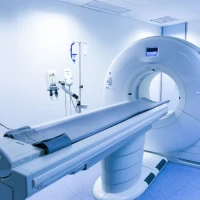
Computed tomography of joints is a fast, reliable and noninvasive way to diagnose diseases affecting the joints. The Oxford Medical Clinic uses a 64-slice German tomographic scanner Somatom Go.Up manufactured by Siemens, which is used to examine the shoulder, elbow, wrist, hip, knee, ankle joints, as well as pelvic bones. In addition to a joint itself the condition of adjacent soft tissues and cartilages are studied.

Types of computed tomography of joints

Overview of the most common types of joint CT scans:

CT scan of the knee joint

The knee joints are the most mobile in the human body. They have a complex anatomical structure and are quite often injured in both the elderly and young. A CT scan of the knee joint may be needed for injuries, the appearance of a crunch, limited mobility, knee deformation or constant pain. The price for a computed tomography of the knee joint is generally affordable, given this and the high informativeness of the examination, it is often prescribed for injuries and pathologies of the knee joint. The price for a CT scan of the knee joint is not very high, so anyone who needs it can undergo the examination.

CT scan of the knee joint: what does it show?

A computed tomography of the knee allows you to obtain images of the bones that form the joint, as well as the adjacent ligaments, tendons and soft tissues. CT scans diagnose arthritis, arthrosis, fractures, sprains and tears of ligaments, cysts, exostoses (bone growths), and other pathologies.

CT scan of the hip joint

The hip joints are the largest in the body. They bear the maximum load during walking and other movements. Since the tissues of the joints do not regenerate, many people develop diseases as they age. A CT scan of the hip joints allows you to assess their extent and determine what treatment is needed.

CT scan of the shoulder joint

The shoulder joint is one of the most mobile in the body. It is responsible for arm movements, lifting heavy objects and other activities. If the knee and hip joints are more likely to suffer in the elderly due to thinning cartilage and chronic diseases, then injuries and fractures of the shoulder joint, on the contrary, occur more often in young people. Athletes are at particular risk.

Indications for a computed tomography scan of the shoulder joint may be aching or acute pain in the shoulder, limited mobility or deformation of the shoulder, swelling and other disorders. Computed tomography of the shoulder allows you to visualize the joint and the tissues surrounding it, and determine an accurate diagnosis.

CT scan of the elbow joint

Computed tomography of the elbow joint may be necessary for persistent pain, impaired mobility of the elbow, change in its shape, the appearance of edema and other symptoms. The study allows you to diagnose cracks and fractures, rupture and sprain of ligaments, inflammatory and degenerative diseases, neoplasms and other pathologies. Since the price of a CT scan of the elbow joint is relatively low, but it provides important diagnostic information, the examination is prescribed to many patients.

Indications for CT scan of joints

CT is indispensable in the diagnosis of joint injuries and foreign bodies in them.
It is also actively used in the process of treatment planning and as
a method of monitoring its effectiveness.

With the help of computed tomography of the joint,
it is possible to detect the following diseases:

abnormalities in the development of the joint and adjacent tissues

arthrosis

arthritis

osteomyelitis

osteophytes

fluid accumulation

tumors

List of diseases

How to prepare for a CT scan of the joints

Computed tomography of the joints can be performed either with the use of a special contrast agent that enhances the sharpness of the image, or without it. In the latter case preliminary preparation is not necessary - the patient simply removes metal jewelry, devices and accessories just before the examination.

CT with contrast material requires more careful preparation: it is important to notify the doctor about the medications taken, the presence of allergies to seafood and iodine-containing drugs. The doctor should also be warned about existing diseases of the heart, kidneys, thyroid gland, diabetes and asthma before the examination. The patient having the enumerated diseases may need additional diagnostics, and in severe form they may be a contraindication for the use of a contrast agent. 

In case of CT of the joint with a contrast material, the patient is supposed to refrain from taking food or fluids 4-6 hours before the examination.

How the joint CT scan is performed

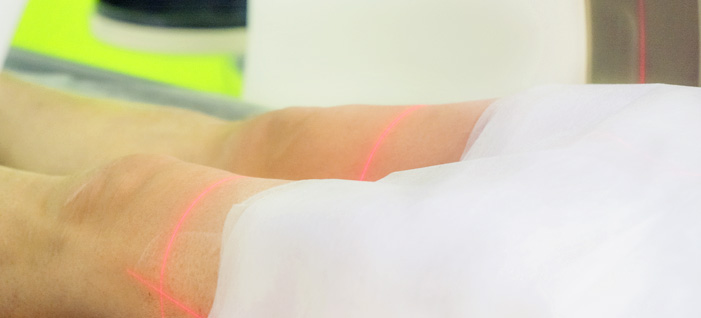
If the condition of large joints (shoulder, knee, hip) is examined, the patient is placed on his back on the pull-out table of the tomographic scanner. When performing CT scans of other joints, other methods of patient placement are possible, allowing only the limb that needs to be examined to be placed in the CT scanner. In the case of CT with contrast material, a catheter is inserted into the patient's vein, through which a contrast agent enters the bloodstream with the help of an automatic injector.

The scanning process is controlled by the diagnostic doctor, who, after placing the patient on the scanner table, is located in an adjacent room equipped with a window for observation and an intercom device for communicating with the patient.

The patient does not experience painful or unpleasant sensations during the computed tomography of the joint. When a contrast agent is administered, a metallic taste may appear in the mouth or a feeling of warmth throughout the body, but these phenomena disappear very quickly without a trace.

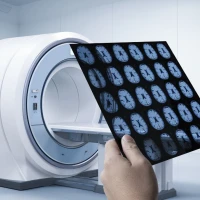
When the procedure is finished the patient is given a film with the results and a printed conclusion of the diagnostician. If the study was conducted with a contrast material – the patient is recommended to drink more fluids to remove it quickly from the body.

You can make an appointment for a joint CT scan at the «Oxford Medical» Clinic in Kiev by phone or by writing to the chat operator on the website.

Contraindications to CT of joints

There are very few contraindications to CT of the joints, and they only apply to the examination with a contrast agent.

It is not recommended for use in:

  • renal failure;
  • liver failure;
  • decompensated diabetes mellitus;
  • allergy to iodine or other components of the contrast agent;
  • the presence of metal implants in the body;
  • acute diseases.

In the presence of any diseases, the specialist individually decides whether the examination can be performed.

Our services
Bone and joint CT services
CT scan of two joints (both feet with ankle/knee/hip joints)
2589.00 ₴
Sign up by the call center
CT scan of one joint (one foot with ankle/knee/hip)
1969.00 ₴
Sign up by the call center

Q&A

MRI or CT of the knee joint: which is better?

CT and MRI have different indications and diagnostic value. Only a doctor can determine which study will be more informative. CT is based on the use of X-ray radiation, and MRI - a high-frequency electromagnetic field. CT is better suited for imaging bones, joints and internal organs with a dense tissue structure, and MRI - soft tissues, blood vessels and the brain. You can do a CT scan of the knee joint in Kyiv at the Oxford Medical Medical Center.

What does a CT scan of the knee joint show?

A CT scan of the knee joint provides visualization of the bones that form it, as well as the surrounding ligaments, tendons, and soft tissues. The images can help your doctor diagnose arthritis, osteoarthritis, bone fractures, sprains or tears, cysts, exostoses (bone growths), and other pathologies.

How is a CT scan of the knee joint done?

A CT scan of the knee joint is a quick and painless procedure. The patient lies on his back on a sliding table of the CT scanner, after which he is moved inside the machine (it is not completely closed, has a wide diameter and lighting). There, many X-ray images are taken within a minute. They are transmitted to a computer, where three-dimensional black and white images are formed, which show thin sections of tissues.

How much does a knee CT scan cost?

Prices for knee CT scans may vary between clinics. It is better not to choose where to get the examination based on cost. It is usually lower where the device is older, and, accordingly, the quality of the images may be worse. At «Oxford Medical», knee CT scans are performed on a Siemens Somatom Go.UP tomograph, which provides 64-slice tissue scanning with a step of 0.7 mm. You can find out the price for knee CT scans here.

CT scan of the hip joint: price?

The price for a computed tomography of the hip joint is relatively low. It may vary in different clinics, which primarily depends on the cost, and therefore the quality of the images, of the device. At «Oxford Medical», CT is performed on an expert-class tomograph, which allows you to visualize changes from 1 mm in size. You can find out the price for a CT scan here.

You can make an appointment for a CT scan of the joints at the «Oxford Medical Kyiv» clinic by phone or by writing to the chat operator on the website.

( Rating: 4.95 , Votes: 312 )

Advantages of CT of joints at Oxford Medical

New CT machine

Performing a 64-slice scan

Minimum beam load

Deciphering images by an experienced diagnostician

Possibility of consultation with doctors of various specialties

Loyalty system for regular patients

Reviews
Коломієць Катя 23.02.2024
Дуже задоволена цією клінікою,робила КТ черевної порожнини і гастроскопію дуже вдячна спеціалістам гарне обслуговування . Дякую ще дівчаткам на інформаційній.
Star Star Star Star Star
Роман 24.10.2022
Дякую за якісне КТ легенів , результати надійшли вже на наступний день. Дуже ввічливий персонал.
Star Star Star Star Star
Current information
All Articles
Sign up
in the clinic
online
This site is protected by reCAPTCHA technology, and the Google Privacy Policy and Terms of Service apply.
Hello!
Let's take care
about your health:
Sign up via call center

We use cookies and other technologies to remember your preferences and find out exactly how you use and interact with the site.

By using our site, you also agree to the terms of the "User Agreement" and "Regulation on the processing and protection of personal data". By clicking "I AGREE", you consent to the processing of your data.