Contents:
- What CT without contrast is and when it is prescribed
- What CT with contrast is and how it is performed
- How CT with contrast differs from CT without contrast
- Risks and contraindications of CT with contrast
- What is better — CT with contrast or without
Computed tomography (CT) is one of the most informative methods of modern diagnostics. However, depending on the clinical situation, the doctor may prescribe an examination without a contrast agent or with its intravenous administration. The choice of the method is determined by what information needs to be obtained to establish an accurate diagnosis.
You should not decide on your own whether contrast is needed. For some diseases, a standard scan is sufficient, while in other cases contrast enhancement helps to assess the condition of blood vessels and internal organs in more detail or detect pathological changes that may be less noticeable on standard images.
In this article, we explain how the two types of CT differ and in which cases each of them is used. We will also explain how both examinations are performed and how they differ.
What CT without contrast is and when it is prescribed
CT without contrast enhancement is a method of radiological diagnostics that allows layered images of organs and tissues to be obtained without the administration of a contrast agent. Non-contrast CT is widely used in emergency medicine, as well as during scheduled examinations. According to RadiologyInfo, in many clinical situations it is sufficient to establish a diagnosis.
Most often, computed tomography without contrast is prescribed for:
- injuries of the head, chest, abdomen, spine and limbs;
- suspected fractures or bone cracks;
- acute cerebral circulatory disorders or intracranial hemorrhage;
- diseases of the lungs and paranasal sinuses;
- suspected urinary stone disease;
- assessment of the condition of the spine, joints and bone tissue.
Doctors at Oxford Medical explain: non-contrast CT is the optimal choice when assessing anatomical changes in organs and tissues is sufficient to establish a diagnosis. The doctor determines the need to use a contrast agent before the examination begins, taking into account the symptoms, preliminary diagnosis and clinical objective.
What CT with contrast is and how it is performed
CT with contrast is performed when more detailed information about the condition of organs, tissues or blood vessels is needed. For this purpose, the patient is given an iodine-based contrast agent intravenously, which temporarily circulates through the bloodstream and helps to better visualize certain structures during scanning.
Before the examination begins, an intravenous catheter is placed in the patient, through which the contrast agent is administered by an automatic injector at a specific moment of the study. During administration, a short-term feeling of warmth throughout the body or a metallic taste in the mouth is possible — this is a normal reaction that passes quickly.
Doctors at Oxford Medical explain: the decision whether to undergo a CT scan with contrast is made individually. This method is most often used when it is necessary to clarify the nature of pathological changes, in particular when oncological diseases or vascular pathologies are suspected.
How CT with contrast differs from CT without contrast
.jpg)
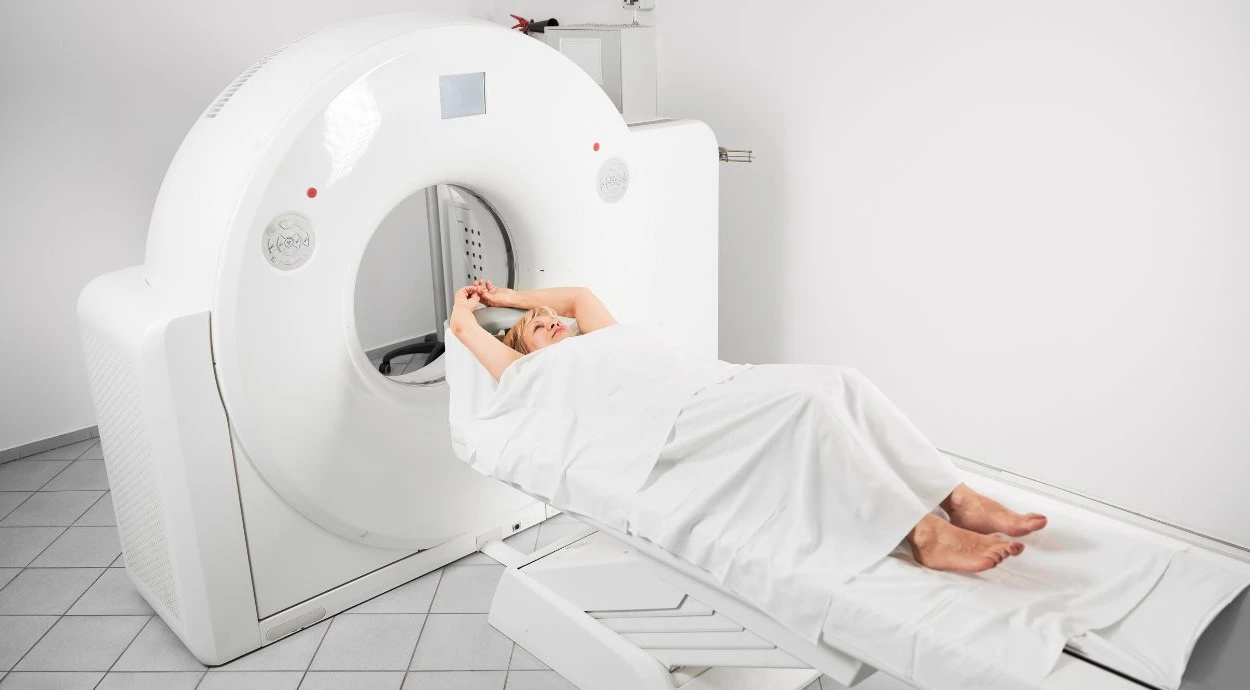
Both types of examination are performed according to the same principle, but the difference between CT with contrast and without lies in the amount of information that can be obtained during the examination. In addition, the indications for performing the procedure, preparation and contraindications differ.
Image clarity and detail
The main difference between CT with contrast and without lies in the informativeness of the examination. Non-contrast CT shows bone structures, lungs, hemorrhages and calculi well, while contrast enhancement helps to assess blood vessels, internal organs, the borders of neoplasms and the features of their blood supply more clearly. According to NCBI, the use of a contrast agent can significantly increase the informativeness of the examination in certain clinical situations.
Indications and limitations
The choice between CT with contrast and without it always depends on the clinical situation. The doctor determines which method will help obtain the most complete information and will be appropriate for a specific patient.
| CT without contrast | CT with contrast |
| Injuries and fractures | Assessment of arteries and veins (CT angiography) |
| Suspected intracranial hemorrhage | Suspected tumors and oncological diseases |
| Urinary stone disease | Diseases of the liver, pancreas, kidneys |
| Lung diseases | Diseases of the abdominal and pelvic organs |
| Assessment of bones, joints and spine | Clarification of the nature of neoplasms, cysts and inflammatory processes |
| Monitoring the consequences of injuries | Planning surgical intervention and monitoring treatment results |
Doctors at Oxford Medical explain: a contrast agent is used only when it can increase the informativeness of the examination. Before its administration, the doctor checks for possible contraindications and, if necessary, may prescribe additional examinations, in particular tests to assess kidney function.
At the same time, CT is not the optimal examination method in all clinical situations. In some cases, the doctor may prescribe MRI if it is necessary to assess soft tissues, the brain or spinal cord, intervertebral discs, ligaments or joint structures in more detail. Therefore, the choice of diagnostic method depends not only on the need for contrast enhancement, but also on which organs and tissues need to be examined.
Preparation and duration of the procedure
Preparation for CT depends not only on the use of a contrast agent, but also on which area of the body needs to be examined. The patient receives exact recommendations when scheduling the examination or from the doctor who prescribed it.
Main features of preparation:
- before CT with contrast, it is usually recommended not to eat for 4–6 hours;
- before some types of CT without contrast, in particular of the abdominal organs, it may also be recommended to refrain from eating for several hours;
- as prescribed by the doctor, a blood test to assess kidney function may be required before CT with contrast;
- before the examination, it is important to inform the doctor about possible pregnancy, allergic reactions, chronic diseases and medications you are taking.
The scanning process itself during both types of CT takes only a few minutes. The difference is that additional time is needed for preparation before a contrast-enhanced examination, so the total duration of the procedure may be slightly longer.
Risks and contraindications of CT with contrast
CT with contrast is an informative diagnostic method, but before it is performed, it is important to consider possible limitations. The main risks are not related to the scanning itself, but to the administration of an iodine-containing agent, so before the procedure the doctor reviews the patient's medical history and, if necessary, prescribes additional tests.
CT with contrast enhancement may be contraindicated or require additional preparation in cases of:
- allergy to iodine-containing contrast agents;
- severe kidney dysfunction;
- some thyroid diseases;
- pregnancy;
- use of certain medications;
- severe general condition of the patient.
In most patients, the agent is well tolerated. Sometimes a short-term feeling of warmth, a metallic taste in the mouth, nausea or mild discomfort may occur. Serious adverse reactions are rare.
If the examination is performed in an emergency setting, for example in patients with severe injuries or during treatment of myocardial infarction, the doctor makes an individual decision on the possibility of using a contrast agent, taking into account the balance of benefits and potential risks.
What is better — CT with contrast or without
There is no definitive answer to this question. It cannot be said that one method is better than the other, because each has its own indications and is used for different diagnostic tasks.
If standard CT is sufficient to establish a diagnosis, there is no need to administer a contrast agent. At the same time, in situations where it is necessary to assess blood vessels, internal organs or the nature of pathological changes in more detail, the doctor may recommend a contrast-enhanced examination.
It is important to understand that CT does not replace other methods of diagnosis and treatment. For example, in acute cardiac conditions, in particular when treatment of myocardial infarction is needed, ECG, laboratory tests, consultation with a cardiologist and specialized medical care are the priorities.
Doctors at Oxford Medical explain: the best choice is not one or another type of CT, but the method that most accurately corresponds to the clinical situation. That is why the decision to conduct an examination with or without contrast is made by the doctor after assessing the symptoms, preliminary diagnosis and results of other examinations.
The difference between CT with contrast and without does not lie in one method being better, but in each of them having its own indications. To make the examination as informative and safe as possible, it is important to follow the doctor's recommendations.
The information in the article is provided for informational purposes and is not an instruction for self-diagnosis or treatment. If symptoms of a disease appear, you should consult a doctor.
Sources: