


Contents:
- What is testosterone?
- Where is testosterone produced?
- What is testosterone responsible for?
- The effects of testosterone on the male body
- The role of testosterone in the female body
- Normal testosterone levels
- What are normal testosterone levels in men?
- What are normal testosterone levels in women?
- Free and total testosterone: what is the difference?
- When should testosterone levels be tested?
- How to check testosterone levels?
Testosterone plays an important role in maintaining men's health. It affects sexual desire, sperm production, muscle mass development, and bone strength. At the same time, this hormone is also essential for the female body, although it is produced in significantly smaller amounts.
The concentration of the hormone in the blood changes with age and depends on various factors. Both a deficiency and an excess of the hormone can affect well-being, sexual function, and reproductive health. However, it is impossible to reliably determine its level based on symptoms alone.
In this article, we will examine the main functions of the hormone and the normal ranges of its concentration in the blood for men and women. We will separately explain how to check testosterone levels and when it is necessary, as well as what should be considered when evaluating the results.
What is testosterone?
Testosterone is a steroid sex hormone that belongs to the group of androgens. It is produced in the bodies of men and women, but its concentration is significantly higher in men.
Hormone production is regulated by the hypothalamus and pituitary gland — structures of the brain that control the functioning of the sex glands. The hormone enters the bloodstream and acts on various tissues and organs through specific androgen receptors. Some testosterone is also converted into other biologically active hormones, particularly dihydrotestosterone and estradiol.
Where is testosterone produced?
According to the National Institutes of Health, approximately 95% of testosterone in men is produced in the testes, specifically in Leydig cells located between the seminiferous tubules. The remainder is formed mainly through the conversion of other steroid hormones, particularly adrenal androgens.
In women, this hormone is synthesized in the ovaries and adrenal glands. In addition, some of the hormone is formed in peripheral tissues, particularly adipose tissue, through the conversion of other androgens.
Testosterone production in men occurs under the control of the hormonal system:
- The hypothalamus releases gonadotropin-releasing hormone (GnRH), which stimulates the pituitary gland.
- The pituitary gland produces luteinizing hormone (LH), which travels through the bloodstream to the testes.
- Under the influence of LH, Leydig cells synthesize testosterone.
A feedback mechanism operates between these organs. When the hormone concentration increases, the hypothalamus and pituitary gland reduce the stimulation of its production. If the hormone level decreases, stimulation may increase.
Hormone secretion follows a daily rhythm. In men, especially younger men, its concentration is usually highest in the morning and gradually decreases throughout the day. That is why the timing of blood collection is important for a reliable assessment of hormonal status.
What is testosterone responsible for?
This hormone affects the functioning of the reproductive system, muscle development, bone health, and metabolism. Its functions differ somewhat depending on a person's sex and age.
The effects of testosterone on the male body
During puberty, the hormone ensures the development of the reproductive organs, deepening of the voice, growth of facial and body hair, and an increase in muscle mass.
In adult men, it performs the following functions:
- maintains sexual desire;
- together with other hormones, ensures sperm production;
- stimulates protein synthesis and the maintenance of muscle mass;
- helps preserve bone mineral density;
- stimulates red blood cell production in the bone marrow;
- participates in regulating the ratio of muscle to adipose tissue.
A hormone deficiency may cause decreased libido, reduced muscle mass, and decreased bone density. A prolonged hormone deficiency may also negatively affect reproductive function.
At the same time, these manifestations are not specific to hormonal deficiency. According to the recommendations of the Endocrine Society, a diagnosis of hypogonadism is established when the corresponding symptoms are present and low hormone levels have been repeatedly confirmed.
The role of testosterone in the female body
In women, testosterone participates in the regulation of sexual desire and physiological processes in reproductive tissues. It is also a precursor of estradiol — one of the main female sex hormones.
The most characteristic changes occur with an excess of androgens. This may be accompanied by:
- excessive facial and body hair growth;
- the appearance of acne and increased skin oiliness;
- thinning of scalp hair;
- menstrual cycle irregularities;
- absence of ovulation.
One of the common causes of these manifestations is polycystic ovary syndrome. However, similar symptoms may also occur with other diseases and therefore require examination.
Doctors at «Oxford Medical» note that a combination of menstrual cycle irregularities with acne, excessive hair growth, or hair loss may indicate hormonal disorders. If such symptoms are present, a consultation with a gynecologist is recommended to determine their cause and establish the necessary scope of examination.
Normal testosterone levels

Normal levels depend primarily on a person's sex and age. Two indicators are taken into account when assessing hormonal status — total and free testosterone. Each of them has separate reference values.
What are normal testosterone levels in men?
According to Mayo Clinic Laboratories, the total testosterone level in men aged 18 and older is usually 8.3–33.0 nmol/L (240–950 ng/dL). The normal range for free testosterone in men aged 18–69 years, measured by the equilibrium dialysis method, is 35–155 pg/mL.
Hormone concentration may gradually decrease with age. However, diagnosing its deficiency requires not only test results but also the presence of characteristic symptoms. A low value must be confirmed by a repeat morning test.
What are normal testosterone levels in women?
In women aged 18 and older, the total testosterone level is approximately 0.28–2.08 nmol/L (8–60 ng/dL). The normal range for free testosterone in women aged 18–69 years, measured by the equilibrium dialysis method, is 0.1–6.4 pg/mL.
Hormone concentration may change with age, particularly during menopause. To determine the cause of an abnormal value, symptoms and the results of additional examinations must be taken into account.
Free and total testosterone: what is the difference?
Testosterone circulates in the blood in protein-bound and free forms. Total testosterone reflects the combined concentration of both forms of the hormone, while free testosterone represents only the portion that is not bound to proteins and can directly enter cells and affect their functioning.
Approximately 98% of the hormone is bound to albumin and sex hormone-binding globulin (SHBG). The free fraction accounts for approximately 1–3% of the total amount.
Doctors at «Oxford Medical» explain: total testosterone is usually measured for the initial assessment of hormonal status. Testing the free fraction may be necessary if the total value is near the lower limit of the normal range or if a change in SHBG levels is suspected.
At the same time, a normal total testosterone level does not always mean a sufficient concentration of its free fraction. That is why, in some cases, both indicators must be taken into account to correctly assess hormonal status.
When should testosterone levels be tested?
The test is prescribed when symptoms that may indicate a hormonal imbalance are present. The examination helps identify a hormone deficiency or excess, but its results are evaluated together with the patient's complaints and other clinical data.
Men are advised to check their testosterone levels if they experience the following symptoms:
- decreased sexual desire;
- a decrease in the number of morning erections;
- erectile dysfunction;
- decreased muscle mass and strength;
- persistent fatigue, reduced work capacity;
- reduced facial and body hair growth;
- difficulties conceiving a child.
The test may also be part of an examination when male infertility is suspected. In such cases, in addition to testosterone, the levels of other hormones that regulate sperm production may be measured.
Women may be prescribed the test if they have irregular menstruation, excessive facial and body hair growth, acne, or suspected polycystic ovary syndrome.
How to check testosterone levels?
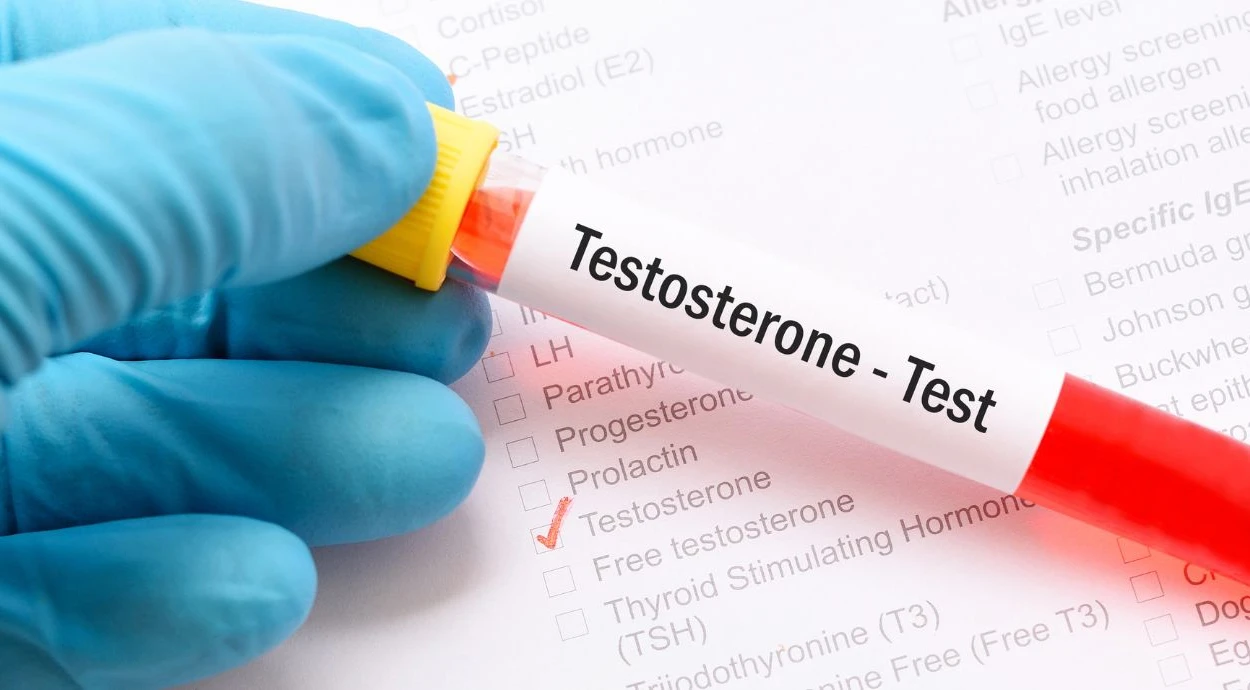
To determine the hormone level, a venous blood test is required. Usually, total testosterone is tested first, and if necessary, the free fraction, SHBG, and other hormonal indicators are additionally measured.
To obtain reliable results, it is important to prepare properly for the examination:
- have blood drawn in the morning, preferably between 7:00 and 10:00;
- arrive on an empty stomach, after fasting overnight;
- avoid intense physical activity the day before;
- ensure a full night's sleep;
- do not undergo testing during an acute illness.
If the result indicates a decreased hormone concentration, the test is repeated on another morning to confirm the value.
For correct interpretation of the results, a consultation with an endocrinologist is necessary. The doctor will evaluate the indicators taking into account age, symptoms, and health status, and, if necessary, prescribe additional examinations to determine the cause of the abnormalities.
The information in this article is provided for informational purposes and is not intended as instructions for self-diagnosis or self-treatment. If symptoms of a disease appear, you should consult a doctor.
Sources: