Contents:
- What is deep vein thrombosis (DVT)
- What causes deep vein thrombosis
- How to understand that there is a blood clot in the leg
- What to do in case of leg thrombosis
- Is it possible to clear veins of blood clots
- What to do so that a blood clot in the leg dissolves
- How to reduce swelling in deep vein thrombosis
- How to sleep with deep vein thrombosis
- How long people live with deep vein thrombosis
- Is it possible to have surgery with deep vein thrombosis
- How to prevent DVT
Deep vein thrombosis is one of the conditions that can develop almost unnoticed for a long time. Some people experience only mild discomfort in the leg, while in others the symptoms appear suddenly and intensify quickly. That is why it is important to pay attention not only to pronounced pain or swelling, but also to less obvious changes — a feeling of fullness, a local increase in skin temperature, or a change in its color.
The difficulty is that the manifestations of thrombosis can resemble other diseases of the blood vessels, muscles, or joints. Because of this, people often postpone examination, attributing the symptoms to fatigue, physical exertion, or varicose veins. At the same time, timely diagnosis is especially important in DVT, because the disease can lead to dangerous complications.
In this article, we will consider what deep vein thrombosis is, what a blood clot on the leg looks like, why it occurs and when urgent medical care is needed, as well as which treatment methods are used.
What is deep vein thrombosis (DVT)
Deep vein thrombosis is a condition in which a blood clot forms in the deep veins, partially or completely blocking the vessel lumen and disrupting normal blood outflow. DVT most often develops in the veins of the lower limbs — in the area of the lower leg, the popliteal region, or the thigh.
Normally, blood flows freely through the veins toward the heart. If blood flow slows down, the vessel wall is damaged, or blood clotting increases, the risk of blood clot formation rises. At first, the clot may be small, but over time it can sometimes enlarge and spread along the vein.
DVT is dangerous not only because of local symptoms. The main risk is that part of the clot may break off and travel with the bloodstream into the vessels of the lungs. This condition is called pulmonary embolism and requires emergency medical care.
To confirm the diagnosis, the doctor may prescribe an ultrasound of the deep veins, which allows assessment of vessel patency, clot location, and the degree of blood flow disturbance. Blood tests and other examination methods may also be performed depending on the clinical situation.
What causes deep vein thrombosis
Deep vein thrombosis occurs due to a combination of factors that affect blood circulation, the condition of the venous wall, and the blood clotting system. The risk of a clot forming increases when blood moves more slowly through the veins or the body becomes more prone to excessive clotting.
One of the most common causes is prolonged immobility. DVT may develop after complex surgeries, prolonged bed rest, air travel, or long trips when a person barely moves their legs for many hours in a row. Because of this, venous outflow slows down, creating conditions for clot formation.
The risk is also increased by:
- varicose veins;
- injuries of the lower limbs;
- obesity;
- smoking;
- pregnancy and the postpartum period;
- oncological diseases;
- hormonal therapy or the use of oral contraceptives;
- hereditary blood clotting disorders;
- age over 60 years.
The doctors of Oxford Medical warn: DVT can occur not only in people with varicose veins or chronic vascular diseases. Sometimes thrombosis is diagnosed in relatively young patients after dehydration, intense physical exertion, or prolonged immobilization.
How to understand that there is a blood clot in the leg
.jpg)
The symptoms of deep vein thrombosis may differ depending on the location of the clot, its size, and the degree of blood flow disturbance. In some people, signs appear gradually over several days, while in others they arise suddenly and intensify quickly.
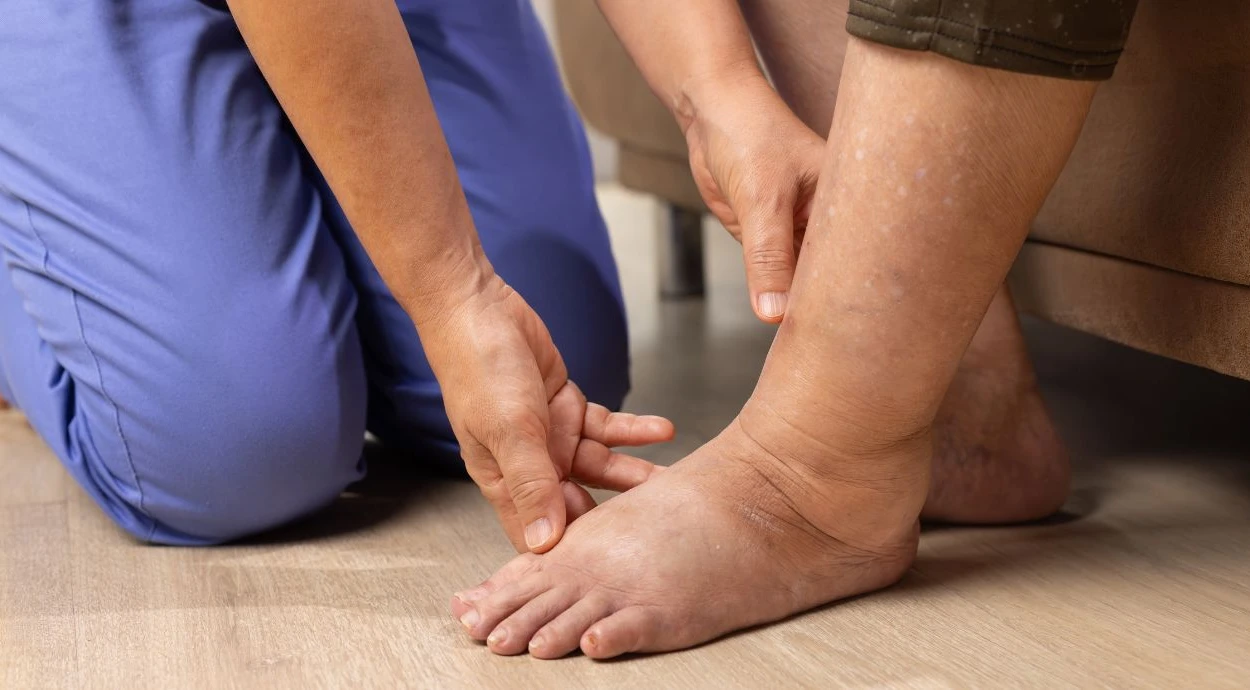
Most often, DVT affects one leg. A person may notice that the limb has become more swollen or denser to the touch. Sometimes there is a feeling of fullness or internal pressure in the calf, which worsens during walking or prolonged standing.
Symptoms that may indicate deep vein thrombosis include:
- swelling of one leg;
- pain or discomfort in the calf or thigh;
- a feeling of heaviness and tension;
- a local increase in skin temperature;
- redness, bluish discoloration, or paleness of the skin;
- increased pain when putting weight on the leg;
- dilation of superficial veins.
The doctors of Oxford Medical note: it is important to understand that the intensity of symptoms does not always correspond to the level of danger. Even moderate swelling or mild pain may be a manifestation of DVT. It is recommended not to self-diagnose and not to try to rub or massage the leg if thrombosis is suspected, as this may worsen the condition.
Blood clot on the leg: early stage
In the early stages, thrombosis may manifest with nonspecific symptoms, which is why people often do not see a doctor immediately. In the initial stage, discomfort in the calf, a feeling of tightness, or moderate swelling that may increase by evening most often appears.
Sometimes the symptoms resemble muscle overstrain after physical activity. A person may feel:
- mild pulling pain in the leg;
- a feeling of warmth in a specific area;
- tingling or a feeling of fullness;
- increased sensitivity when pressing on the calf;
- slight asymmetry of the legs due to swelling.
In some patients, the early manifestations of thrombosis are absent altogether. That is why after surgeries, injuries, long flights, or forced low mobility, it is important to carefully monitor the condition of the legs and not ignore new symptoms.
How the leg hurts with thrombosis
Pain in deep vein thrombosis is usually pulling, bursting, or pulsating in nature. Most often it is localized in the calf, less often — in the thigh or throughout the entire leg. Discomfort may intensify during walking, climbing stairs, or prolonged standing.
Unlike ordinary muscle pain after physical exertion, symptoms in DVT are often accompanied by swelling, a feeling of heat, and tissue tension. In some people, the leg becomes denser to the touch, and the skin becomes shiny or changes color.
Sometimes the pain in thrombosis is moderate and does not interfere with walking, which is why people postpone visiting a doctor. However, when a combination of pain, swelling, and skin color changes appears, it is important to undergo an examination as soon as possible and consult a vascular specialist or phlebologist.
How to understand that a blood clot in the leg has broken off
The most dangerous complication of deep vein thrombosis is the detachment of part of the clot and its entry into the vessels of the lungs. This condition is called pulmonary embolism and requires emergency care.
A detached blood clot may be suspected when the following symptoms appear suddenly:
- severe shortness of breath;
- a feeling of lack of air;
- chest pain;
- severe weakness;
- rapid heartbeat;
- dizziness;
- cough, sometimes with blood;
- bluish discoloration of the lips or skin.
The doctors of Oxford Medical warn: in such a situation, it is necessary to immediately call an ambulance, even if the symptoms partially decrease after a few minutes. Until the medical team arrives, the person should preferably remain at rest and avoid physical exertion. It is not recommended to go to the hospital independently in case of pronounced shortness of breath or chest pain.
What to do in case of leg thrombosis
.jpg)
Treatment tactics depend on the location of the clot, the degree of vein blockage, the duration of symptoms, and the patient’s general condition. In most cases, medication therapy is used to reduce blood clotting and prevent the clot from enlarging.
According to the recommendations of the European Society for Vascular Surgery (ESVS), anticoagulant therapy is the basis of DVT treatment, and the duration of treatment is determined individually, taking into account the cause of thrombosis, the risk of recurrent clot formation, and the likelihood of bleeding.
For deep vein thrombosis, the doctor may recommend:
- anticoagulants to prevent clot growth;
- compression therapy;
- control of physical activity;
- correction of risk factors;
- control of concomitant diseases.
If medication treatment does not provide a sufficient result or there is a high risk of complications, minimally invasive procedures may be recommended.
In certain cases, thrombolysis is used — a method in which drugs are administered through a catheter or intravenously to dissolve the clot. This approach is most often used in extensive thrombosis and significant impairment of venous outflow, when it is important to quickly restore vessel patency and reduce the risk of severe consequences for the limb. In massive thrombosis, thrombectomy may also be performed — surgical removal of the clot from the vein lumen.
Is it possible to clear veins of blood clots
Many patients, after being diagnosed, ask how to clear the veins of blood clots and whether it is possible to completely remove blood clots from the vessels. It is important to understand that deep vein thrombosis is not treated by “cleaning” the veins in the everyday sense. It is dangerous to use folk methods or medications on your own without a doctor’s prescription.
After a clot forms, the body can gradually partially break it down naturally. At the same time, the main goal of treatment of leg vein thrombosis is to stop the clot from enlarging, prevent it from breaking off, and restore normal venous circulation. For this purpose, medication and compression therapy are used, and if necessary — minimally invasive or surgical techniques.
In some patients, the vein lumen is almost completely restored after treatment. In other cases, changes in the venous wall or partial impairment of vessel patency may remain. That is why after DVT, it is important to follow the doctor’s recommendations and monitor the condition of the veins even after the symptoms disappear.
What to do so that a blood clot in the leg dissolves
The basis of therapy is anticoagulants — drugs that reduce blood clotting and help the body gradually break down the clot naturally.
The duration of treatment depends on the cause of thrombosis, the location of the clot, and the risk of complications. In some cases, therapy lasts several months, and sometimes longer. It is not allowed to stop taking medications or change the dosage on your own.
To improve venous outflow, the doctor may also recommend:
- wearing compression hosiery;
- moderate physical activity;
- body weight control;
- adequate fluid intake;
- smoking cessation;
- avoiding prolonged sitting or standing without movement.
In the acute period, it is important to avoid excessive loads, intensive massage, and heat procedures. At the same time, complete immobility without a doctor’s recommendation is also undesirable, because moderate activity helps maintain normal blood circulation.
The doctors of Oxford Medical note that folk methods should not be used without consulting a specialist, especially warming compresses, aggressive ointments, or intensive leg massage. Such actions do not accelerate clot dissolution and may worsen the condition.
How to reduce swelling in deep vein thrombosis
To reduce swelling, it is usually recommended to:
- move more during the day, but without excessive loads;
- avoid prolonged sitting;
- keep the legs slightly above body level during rest;
- wear compression hosiery if prescribed by the doctor;
- avoid tight clothing that compresses the legs;
- maintain adequate fluid intake.
According to the recommendations of the European Society for Vascular Surgery (ESVS), in deep vein thrombosis, moderate physical activity and properly selected compression therapy may be recommended to improve venous outflow and reduce symptoms. Calm walking and light activity may be useful, because the work of the calf muscles helps improve venous circulation. At the same time, prolonged standing in one place often increases swelling and the feeling of heaviness.
How to sleep with deep vein thrombosis
It is important to choose a sleeping position that does not worsen venous outflow and does not create additional pressure on the vessels. In most cases, it is recommended to sleep with the legs slightly elevated. For this, you can place a small bolster or pillow under the lower legs or under the mattress at the lower part of the bed.
This position helps reduce blood stagnation in the veins, relieve swelling, and reduce the feeling of heaviness in the legs. At the same time, the legs do not need to be raised too high — a moderate elevation is sufficient. During sleep, it is advisable to avoid positions in which the legs are strongly bent or pressed against each other for a long time.
How long people live with deep vein thrombosis
Life expectancy with deep vein thrombosis depends not only on the fact of clot formation itself, but also on how quickly treatment was started, whether complications occurred, and whether risk factors can be controlled. With timely diagnosis and properly selected therapy, many people live a full life without significant limitations.
The acute period of the disease poses the greatest danger, when there is a risk of clot detachment and the development of pulmonary embolism. That is why, if DVT is suspected, it is important not to postpone examination and to follow all the doctor’s recommendations.
After thrombosis, some patients may face post-thrombotic syndrome — a chronic disorder of venous outflow accompanied by swelling, a feeling of heaviness, pain, or skin changes. To reduce the risk of such complications, body weight control, sufficient physical activity, smoking cessation, and prevention of recurrent clot formation are important.
In some people, the risk of recurrent thrombosis persists for a long time, especially with hereditary clotting disorders, oncological diseases, or chronic vein diseases. In such cases, long-term monitoring and supportive therapy may be needed.
The doctors of Oxford Medical recommend that after DVT, patients regularly undergo follow-up examinations and do not ignore the recurrence of swelling, pain, or a feeling of heaviness in the legs.
Is it possible to have surgery with deep vein thrombosis
This issue is decided individually. Everything depends on the location of the clot, the risk of its detachment, the patient’s general condition, and the urgency of the surgical intervention itself.
In the acute period of DVT, planned surgeries are often postponed, especially if there is a high risk of thromboembolic complications. This is because any surgical intervention and postoperative reduced mobility can affect the blood clotting system and increase the risk of worsening the condition.
At the same time, in some situations, surgery is performed even in the presence of thrombosis if it is urgent or vital. In such cases, doctors assess possible risks in advance and choose a strategy for preventing complications.
Before surgical intervention, the patient may be recommended:
- additional vein examinations;
- adjustment of anticoagulant therapy;
- use of compression hosiery.
After surgical treatment, it is important to resume moderate physical activity as early as possible, if the patient’s condition allows it. Prolonged lying without movement after surgeries is one of the risk factors for recurrent clot formation.
The doctors of Oxford Medical warn: if a person has already had DVT in the past, this must be reported to the surgeon and anesthesiologist before any surgical intervention, even dental or minimally invasive.
How to prevent DVT
To reduce the likelihood of thrombosis, it is recommended to:
- move regularly throughout the day;
- avoid prolonged sitting without breaks;
- maintain a normal body weight;
- follow an adequate fluid intake regimen;
- quit smoking;
- control chronic diseases;
- wear compression hosiery as recommended by the doctor;
- gradually restore activity after surgeries or injuries.
During long trips, it is useful to periodically get up, walk, move the feet, and not sit motionless for many hours in a row. If a person belongs to a high-risk group, the doctor may additionally recommend medication-based thrombosis prevention.
The information in the article is provided for informational purposes and is not an instruction for self-diagnosis or self-treatment. If symptoms of the disease appear, you should consult a doctor.
Sources:
European Society for Vascular Surgery