Sign up via call center
Department
Remove a nerve from a tooth in Kyiv | Oxford Medical

Ceramic inlays

When a tooth has significant destruction after caries, an old large filling, or root canal treatment, patients often hesitate: whether to place a crown or whether it is possible to opt for a more conservative restoration. In many situations, modern prosthetic dentistry makes it possible to preserve more of the natural tooth structure while achieving a strong and long-lasting result. It is precisely for such cases that ceramic inlays are used — individually fabricated micro-prostheses that accurately reproduce the anatomy of the tooth and help restore comfort during chewing.

What Are Ceramic Inlays for Teeth

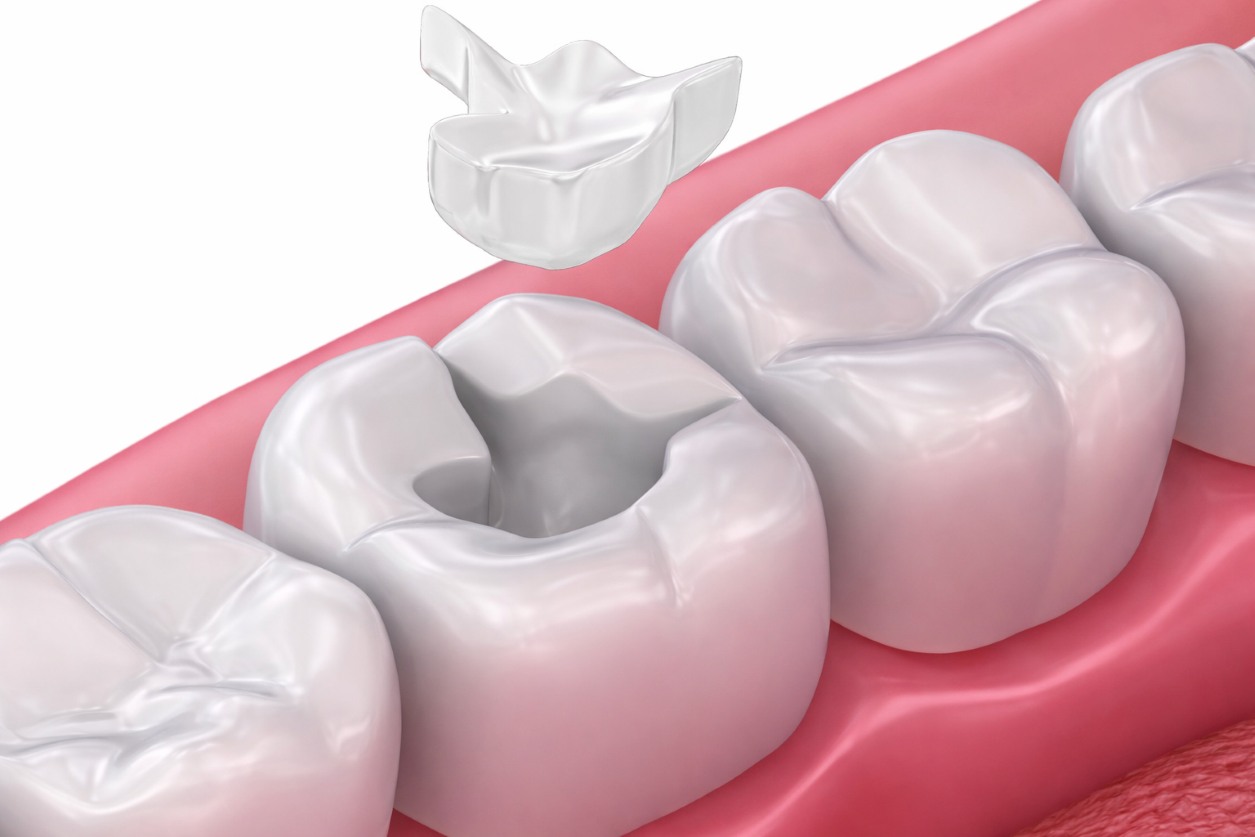
A ceramic inlay is a microprosthesis that is placed into a prepared tooth cavity instead of a large filling when direct restoration is no longer sufficient for reliability. Unlike a filling, an inlay is individually fabricated in a laboratory and then fixed to the tooth using special adhesive systems.

Ceramics are valued for the combination of aesthetics and strength: the material closely imitates the natural color of enamel, does not become stained like composite materials, and allows the chewing surface to be restored as accurately as possible.

What Are Ceramic Inlays for Teeth

Ceramic Inlays: Indications

The placement of ceramic inlays is used when a tooth has significant destruction,
but it can still be preserved and restored without full crown coverage.

Main indications:

significant destruction of the chewing surface or tooth walls, when a conventional filling will not provide sufficient strength and stability;

restoration of a tooth after root canal treatment, when additional reinforcement of hard tissues is required;

presence of a large old filling with compromised sealing, marginal gaps, or cracks in the tooth walls;

the need for a durable and anatomically precise restoration of the chewing surface for proper load distribution during chewing.

List of diseases

Contraindications to Ceramic Inlay Placement on a Tooth

A ceramic inlay is not the optimal choice in every situation. In some cases, another restoration method is required.

Main contraindications:

  • excessive destruction of the tooth — if the volume of hard tissues is insufficient for reliable fixation of the inlay, the doctor may recommend another type of orthopedic construction;

  • active inflammation or complications in the root area — the inflammatory process must first be treated and the condition of the tissues stabilized;

  • pronounced tooth mobility in periodontal diseases — in such cases, it is important to first normalize the condition of the gums and supporting tissues;

  • uncontrolled bruxism — with constant excessive clenching or grinding of the teeth, the risk of overload and chipping increases.

The final decision regarding the possibility of placing inlays is made by the doctor after examination and diagnostics.

On Which Teeth Are Ceramic Onlays Placed?

Most often, ceramic inlays are placed on chewing teeth — premolars and molars, as they bear the main load during eating. However, in certain cases, such restorations may also be used in the smile zone if it is necessary to accurately restore the shape and contact surfaces and a crown is not mandatory.

Ceramic Inlays: Advantages and Disadvantages

Like any orthopedic solution, ceramic onlays have their strengths and certain limitations.

Advantages:

  • precise fit — they are individually fabricated, ensuring tight adaptation and high-quality sealing, which reduces the risk of secondary caries;

  • aesthetics — ceramics accurately reproduce the natural appearance and color of enamel;

  • high strength — the restoration withstands chewing loads better than a large filling;

  • conservative approach — often allows preservation of more natural tooth structure compared to crown preparation.

Disadvantages:

  • at least two visits to the dentist are required — tooth preparation and impression taking, followed by placement;

  • higher cost compared to conventional tooth filling — this is associated with the complex laboratory manufacturing process and the cost of the material itself;

  • not suitable for extensive destruction — if the tooth requires full coverage or has insufficient support, the doctor selects another solution.

Types of Ceramic Inlays

Ceramic onlays differ depending on which part of the tooth surface they restore. The following options are most commonly used:

  • inlay — restores the internal part of the chewing surface without covering the cusps;

  • onlay — covers part of the chewing surface and one or several cusps, helping to strengthen weakened walls;

  • overlay — covers a larger area of the chewing surface and provides maximum tissue protection without full crown preparation.

It is the overlay that is sometimes referred to in everyday speech as an onlay: it provides a greater coverage area than classic ceramic dental inlays.

Stages of Fabrication and Placement of a Ceramic Inlay

To ensure that the onlay fits precisely, withstands daily chewing load, and looks aesthetically pleasing, the treatment is carried out step by step.

Consultation and Diagnostics

The doctor performs an examination, evaluates the condition of the bite, and checks for old restorations and possible cracks. If necessary, an X-ray examination is performed to make sure that the root and surrounding tissues are in a stable condition.

Preparation

Before fabricating the inlay, it is important to completely remove caries and eliminate materials of old fillings that have lost their sealing ability. The doctor shapes the cavity for the future restoration so that it has reliable support, can be firmly fixed, and restores the correct anatomy of the chewing surface.

Impressions or Digital Scanning

Accurate data about the shape of the tooth, contact surfaces, and bite characteristics are obtained. This is necessary for the individual fabrication of the inlay in the laboratory.

Temporary Restoration

During the fabrication period, a temporary filling is placed. It protects the prepared tooth until the permanent restoration is fixed.

Try-In and Fixation

After fabrication, the doctor tries in the inlay, checks the accuracy of fit, contacts with adjacent teeth, and bite closure. The restoration is then fixed with adhesive cement to ensure reliable bonding with the tooth tissues and marginal sealing.

Bite Control and Recommendations

After fixation, the doctor checks occlusal contacts and, if necessary, performs minimal adjustment and polishing.

Service Life of Ceramic Inlays

Ceramic inlays for teeth last for many years; however, the exact duration depends on individual factors: the condition of the tooth tissues, the quality of fixation, bite characteristics, and daily oral hygiene. Chewing load also plays an important role — particularly the habit of clenching teeth at night or during stress.

To ensure long-term durability of the restoration, it is important to:

  • maintain daily oral hygiene and regularly clean interdental spaces;

  • attend preventive check-ups and professional cleanings according to the recommended schedule;

  • use a protective night guard in cases of bruxism, if recommended by the doctor.

Following these recommendations helps maintain marginal sealing, avoid excessive load on the tooth, and extend the service life of the ceramic onlay.

Private Clinic Services in Kyiv: How Much Does a Ceramic Inlay Cost at the Private Clinic «Oxford Medical»

The cost of ceramic inlays depends on the area of the damaged tooth surface and the need for prior root canal treatment. You can предварительно review the prices for medical services in Kyiv at the dental department of «Oxford Medical» here. The exact cost is determined by the doctor after examination and preparation of an individual treatment plan.

If you need a consultation, you can book an appointment at a convenient time by phone or via the online booking form on the website.

Frequently asked questions

What to Do If a Tooth Hurts Under a Ceramic Inlay?

Pain may occur for various reasons: loss of marginal sealing, development of secondary caries, or pulp inflammation. It is impossible to solve the problem independently, so you should consult a dentist as soon as possible. The doctor will perform an examination, take radiographic diagnostics, determine the cause, and then suggest the optimal treatment option.

Can a Ceramic Inlay Be Placed on a Front Tooth?

Yes, in some cases a ceramic inlay can also be placed on a front tooth, but this depends on the size of the defect and the bite. If the destruction is significant but the walls are preserved, the inlay can provide accurate restoration of shape and color. If full coverage of the visible surface or aesthetic correction is required, veneers or crowns are more often chosen.

Can a Ceramic Inlay Be Placed Instead of a Filling?

Yes, if the defect is large and a conventional filling will not provide sufficient strength and durability. A ceramic inlay fits tightly to the hard tissues and withstands chewing load better. In such cases, it is a more reliable restoration option compared to a large filling.

( Rating: 4.69 , Votes: 36 )
Dentistry
Our services
Consultations
Dentist consultation
1.00 ₴
Add Added
Services
Combined inlay (metal + OPAC) with installation
4000.00 ₴
Sign up by the call center
Ceramic restoration with increased aesthetic requirements
22000.00 ₴
Sign up by the call center
Ceramic veneer or restoration (with installation)
9000.00 ₴
Sign up by the call center
Ceramic veneer or restoration of high artistic performance (with installation)
15000.00 ₴
Sign up by the call center

Advantages of Ceramic Inlay Placement at «Oxford Medical» Clinic

Individual treatment planning. The doctor evaluates the condition of the tooth and bite, selects restoration options, and explains them so that the decision is well-informed.

Modern diagnostics. The use of radiological methods and digital technologies allows accurate assessment of the tooth condition and achievement of a stable, long-term result.

High-quality materials and precision manufacturing. Proven materials are used for fabrication, and the restoration is individually created to ensure tight adaptation and a natural appearance.

Comprehensive approach. The patient can undergo all necessary stages of diagnostics, treatment, and orthopedic restoration within one clinic, without unnecessary time loss and with a clear sequence of actions.

Reviews
Ганна 22.01.2026
Дуже вдячні лікарю, адміністрації, всій команді. Приїхали у Київ на операцію з Запоріжжя. У день операції у клініці було відсутнє живлення через масовані обстріли на енергосистему. Колектив з порозумінням сприйняв нашу ситуацію, приїзд за важких умов, професійно організували оперування в іншій кліниці. Ви команда професіоналів! Дякуємо!
Star Star Star Star Star
Катерина 15.01.2026
Віталіна Павлівна дуже уважно поставилася до моєї ситуації. Працює дуже акуратно, не було жодного відчуття страху. Після лікування нарешті зник дискомфорт, за що їй щиро вдячна.
Star Star Star Star Star
Current information
All Articles
Sign up via call center
in the clinic
online
This site is protected by reCAPTCHA technology, and the Google Privacy Policy and Terms of Service apply.
Hello!
Let's take care
about your health:
Sign up via call center

We use cookies and other technologies to remember your preferences and find out exactly how you use and interact with the site.

By using our site, you also agree to the terms of the "User Agreement" and "Regulation on the processing and protection of personal data". By clicking "I AGREE", you consent to the processing of your data.