Used to assess facial symmetry and detect transverse developmental disorders of the jaws.
planning orthodontic treatment;

 Adults Adults Adults Adults Adults Adults Adults Adults Adults
  Children Children Children Children


 Hotline:
 Adults Adults Adults Adults Adults Adults Adults Adults Adults Children Children Children Children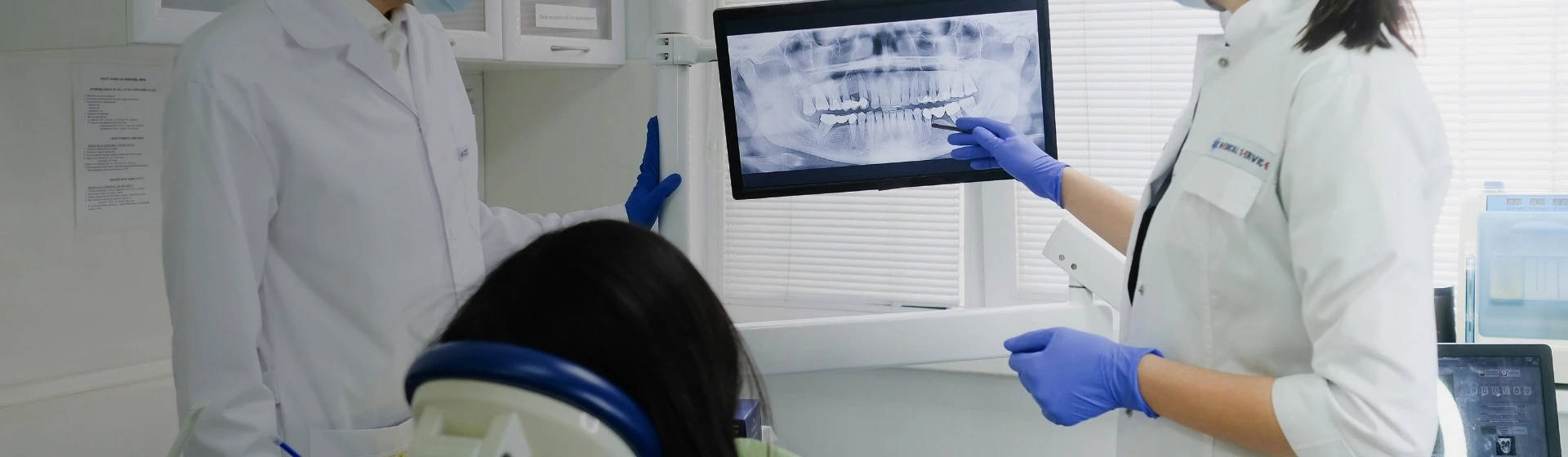
The accuracy of orthodontic treatment begins with proper diagnostics. When it comes to correcting malocclusion, a visual examination or a standard X-ray is not enough. In such cases, teleradiography is prescribed — a diagnostic method that allows evaluation of the relationship between bone structures and teeth as a whole.
Teleradiography in Kyiv at the «Оксфорд Медікал» dental clinic is performed using modern digital equipment, ensuring clear imaging and minimal radiation exposure. This makes it possible to obtain precise data for developing an individualized treatment plan and achieving a predictable result.
Teleradiography (TRG) is a method of X-ray diagnostics used to assess the relationship between the bony structures of the skull, jaws, and teeth in a standard projection. The examination provides a clear image of the facial profile and helps determine anatomical features that influence bite formation.
Unlike localized X-rays that show individual teeth or specific areas of the jaw, TRG covers a broader anatomical region. The doctor evaluates not only the position of the teeth but also the relationship between the upper and lower jaws, facial proportions, and the direction of skeletal growth.
In fact, jaw teleradiography forms the basis for cephalometric analysis — specialized measurements that help accurately plan further treatment. That is why TRG in orthodontics plays an important role in the comprehensive assessment of the clinical situation.
TRG provides the doctor with a comprehensive understanding of the anatomy of the maxillofacial region and the characteristics of the bite. Unlike panoramic X-rays, a teleradiograph allows assessment not only of the teeth but also of the relationship between skeletal structures.
The examination shows:
the relative position of the upper and lower jaws;
the inclination and position of anterior and posterior teeth;
facial proportions and the patient’s profile;
the direction of jaw growth in children and adolescents;
the condition of the temporomandibular joint (TMJ).
The obtained teleradiograph serves as the basis for precise calculations and the development of an individualized treatment plan. While an orthopantomogram (OPG) allows evaluation of the dental arches and roots, jaw teleradiography complements it with analysis of skeletal structures and helps identify the cause of malocclusion.
Dental TRG is a mandatory stage of comprehensive diagnostics before starting treatment. It helps the doctor determine not only the position of the teeth but also the cause of malocclusion — whether it is related to jaw growth characteristics or only to their неправильное расположение.
Based on the image, cephalometric analysis is performed — a system of precise measurements that allows:
determining the type of bite and the degree of its disturbance;
identifying the nature of the malocclusion and its cause;
predicting the growth of skeletal structures in children and adolescents;
selecting the optimal strategy for correcting malocclusion;
monitoring changes during treatment and evaluating its effectiveness.
During the image analysis, the doctor separately evaluates the position and size of the upper jaw relative to the base of the skull — these parameters are reflected by upper jaw teleradiography as part of a comprehensive examination. Thus, teleradiography makes orthodontic treatment predictable and максимально individualized.
Teleradiographic examination is prescribed by a doctor when an accurate assessment
of the relationship between the jaws and the facial skeletal structures is required.
Main indications include:


planning orthodontic treatment;
diagnosis of malocclusion anomalies;
preparation for orthognathic surgery;
assessment of jaw relationship in temporomandibular joint (TMJ) dysfunction.

Teleradiography is considered a safe method of X-ray diagnostics, as it is associated with minimal radiation exposure. There are virtually no absolute contraindications to its performance.
The main limitation is pregnancy, especially the first trimester. In such cases, the examination is carried out only when there are clear clinical indications and after assessing the balance between benefits and potential risks. Difficulties may also arise in patients who are unable to remain still during the imaging procedure or who are in a severe general condition.
In orthodontic practice, two main types of teleradiographic examination are used, and the choice depends on the clinical situation.
The most common type of image in orthodontics. It allows evaluation of the relationship between the upper and lower jaws, determination of the type of bite, assessment of tooth inclination and the direction of skeletal growth, as well as analysis of the facial profile.
Used to assess facial symmetry and detect transverse developmental disorders of the jaws.
The type of examination is determined individually by the doctor, depending on which parameters need to be analyzed for treatment planning.
Teleradiography provides objective information about jaw structure and helps the doctor accurately determine the nature of malocclusion.
The main advantages include:
the ability to assess the relationship between the upper and lower jaws;
determination of whether the malocclusion is related to tooth position or jaw development characteristics;
analysis of the direction of skeletal growth in children and adolescents;
evaluation of the facial profile before starting orthodontic treatment.
As a result, treatment is planned not only based on tooth position but also taking into account the anatomical features of the maxillofacial region.
Among the possible disadvantages:
the presence of minimal radiation exposure;
the two-dimensional nature of the image, which in complex clinical cases may require additional examination.
In most clinical situations, the advantages of the examination significantly outweigh its limitations; therefore, TRG is a standard diagnostic method in orthodontics.
A teleradiograph is performed quickly and does not require special preparation. Before the examination, the patient is asked to remove metal jewelry and items in the head and neck area that may affect image quality.
During the imaging procedure, the patient assumes a specific position near the device. The head is stabilized with light supports to ensure correct projection and measurement accuracy. It is important to remain still throughout the examination.
The procedure is painless and takes only a few minutes. After that, the image is immediately transferred to the doctor for analysis and necessary calculations.
The price of teleradiography depends on the type of projection and the scope of diagnostics (in one or two projections). You can предварительно check the cost here. If you need to undergo a TRG X-ray in Kyiv, you can schedule an examination at a convenient time through the contact center using the phone numbers listed on the website.
At the «Оксфорд Медікал» clinic, all necessary medical services in Kyiv are available, allowing you to complete full diagnostics and receive a comprehensive treatment plan in one place.
An orthopantomogram (OPG) is a panoramic X-ray of the dental arches that allows assessment of root condition, bone tissue, the presence of impacted teeth, or inflammatory processes. A teleradiograph (TRG) shows the relationship between the jaws, the position of the teeth relative to the base of the skull, and facial proportions. While OPG is mainly used to evaluate the condition of the teeth, TRG is a key examination for planning orthodontic treatment.
TRG is a two-dimensional X-ray image taken in a standard projection and is mainly used in orthodontics for cephalometric analysis. Computed tomography (CT) is a three-dimensional examination that allows detailed evaluation of bone structures in volume. CT provides more spatial information but is used based on specific indications when more in-depth diagnostics are required. In most cases, TRG alone is sufficient for planning bite correction.


Fast procedure without pain or complicated preparation for adults and children.
Modern digital equipment provides clear imaging and minimal radiation exposure during the examination.
Accurate cephalometric analysis enables the doctor to develop a well-grounded individualized treatment plan.
A wide range of services at the private clinic in Kyiv allows patients to complete the full cycle of orthodontic treatment in one place.


 5
5  22+
22+  22+ Years of experience
  Kyiv, Pavlivska St., 26/41
 4.91 16+ 16+ Years of experience Kyiv, Pavlivska St., 26/41
  4.96 16+ 16+ Years of experience Kyiv, Pavlivska St., 26/41



 in the clinic
  online
  Hello!