Sign up via call center
Department
Types of occlusion: treatment of malocclusion in Kiev | Oxford Medical

Types of dental occlusion and their treatment

Bite disorders are a common problem faced by both children and adults. In some patients, the changes are noticeable immediately, for example in the form of asymmetry of the smile or uneven position of the teeth. In other cases, the deviations are minor and are detected only during an examination by an orthodontist.

Even small disorders can affect the health of the teeth, speech and overall comfort. Therefore, it is important to assess the condition of the bite in time and determine whether it requires correction.

At Oxford Medical dentistry, we use modern methods of diagnosis and treatment: digital planning, aligners and various types of bracket systems. This approach makes it possible to effectively correct the bite in patients of any age, ensuring a predictable result and the maximum possible comfort during treatment.

If you want to improve the health and aesthetics of your smile, make an appointment for a consultation with a dentist at a time convenient for you.

What is a bite

A bite is the mutual position of the upper and lower jaws at the moment the teeth are closed. Comfort during chewing, clarity of speech and even distribution of the load on the teeth and the temporomandibular joint depend on its characteristics.

Normally, a correct bite is formed, in which the teeth close harmoniously, without distortions and excessive tension. If the relationship of the jaws deviates from the norm, bite anomalies occur, which can affect both the aesthetics of the smile and the functionality of the dentoalveolar system.

Signs that may indicate a bite disorder

Bite anomalies are not always noticeable at first glance, however certain changes may indicate
deviations from what a bite should be like in normal conditions.

Common manifestations of a bite disorder:

uneven position of the teeth or asymmetry of the lower part of the face;

incomplete or incorrect closure of the teeth;

tension, clicking or crunching in the temporomandibular joint;

appearance of chips or uneven wear of the enamel.

List of diseases

Causes of bite pathologies

The formation of the bite depends on a combination of hereditary and external factors that affect tooth growth and jaw development. Some disorders are formed even before birth, others arise in early childhood or gradually develop under the influence of habits and living conditions.

The main causes of bite pathologies:

Hereditary features of jaw structure

The sizes, shape and types of jaws are often genetically determined. If there were bite disorders in the family, the child has an increased risk of developing similar deviations, including the formation of a too narrow or underdeveloped lower jaw.

Dietary features in childhood

Soft, mashed or too liquid food reduces the load on the masticatory muscles. As a result, the jaws develop less actively, which can lead to narrowing of the dental arches and disturbed closure.

Nasal breathing disorders

Adenoids, rhinitis, nasal septum deviation or other ENT pathologies force the child to breathe through the mouth. This changes the position of the tongue, slows the growth of the upper jaw and can cause the formation of an incorrect bite.

Harmful childhood habits

Prolonged sucking of a finger or a pacifier, biting of the lip or cheek, as well as an incorrect posture during sleep can influence the position of the teeth and the shape of the jaws.

Early loss of primary teeth

Caries, injuries or premature extraction lead to displacement of adjacent teeth and impaired eruption of permanent teeth, which over time forms incorrect closure.

Complications during pregnancy and disorders of bone tissue development.

Some deviations arise already at the stage of intrauterine development due to infections, toxicosis in the mother or genetic disorders that affect bone growth and facial proportions.

Why an incorrect dental bite is dangerous?

Bite disorders over time affect not only appearance but also the health of the teeth, gums and the functioning of the temporomandibular joints. Uneven load that occurs with incorrect closure of the teeth gradually leads to changes that become more noticeable each year and may require longer treatment. That is why it is important not to ignore the problem, even if at first glance it seems minor.

Consequences to which an incorrect bite may lead:

  • Damage and premature loss of teeth.
    Due to uneven pressure, teeth wear down faster, cracks, chips and increased sensitivity may appear. Over time this increases the risk of gum inflammation and loss of supporting tissues.
  • Gum problems.
    Incorrect closure can cause excessive load on certain areas, making the gums more sensitive and prone to irritation and inflammation.
  • Disorders of the temporomandibular joint.
    Patients may notice clicking, tension or pain in the TMJ area. Without treatment these symptoms increase and affect the ability to chew normally.
  • Chewing and digestion problems.
    Teeth cannot properly grind food, so large pieces enter the stomach, which complicates the digestion process and may cause abdominal discomfort.
  • Psychological discomfort.
    Pronounced bite anomalies affect the aesthetics of the face and smile, which often lowers self-esteem and influences communication and self-confidence.

Types of incorrect bite

An incorrect bite can manifest in different ways, therefore, to accurately determine the disorder, the orthodontist assesses the position of the teeth, the relationship of the jaws and the character of the closure. There are several basic incorrect types of bite that are most common in children and adults. These are usually what is meant when speaking about types of dental bites with deviations from the norm.

Here are the main incorrect bites:

Distal bite

The upper jaw is located excessively forward relative to the lower jaw. The face appears more convex, and the lower part shortened. It is often accompanied by protrusion of the front teeth.

Mesial bite

The lower jaw is pushed forward. In this case the lower incisors cover the upper ones, and the facial profile looks more “protruding”.

Open bite

The front teeth do not close even with full closure of the posterior teeth. This can cause difficulties with chewing, speech disorders and aesthetic discomfort.

Deep bite

The upper front teeth excessively cover the lower ones, which can lead to trauma to the soft tissues, enamel wear and TMJ disorders.

Crossbite

One of the jaws is shifted to the right or left, causing uneven closure of the teeth. It can cause facial asymmetry and uneven load on the teeth.

Diagnosis of bite anomalies

Bite assessment begins with an orthodontic consultation. The doctor evaluates the position of the teeth, the relationship of the jaws, the character of the closure and the functioning of the temporomandibular joint. Such an examination makes it possible to detect early signs of deviations, but instrumental examinations are always required for accurate diagnosis.

The next stage is a photo protocol – a series of intraoral and extraoral photographs that help analyse facial symmetry, profile and features of the smile. In parallel, intraoral scanning or impression taking is performed to create digital models of the jaws. This makes it possible to accurately assess the position of the teeth and the character of the closure.

Radiological examinations are mandatory. Panoramic radiography (OPTG) shows the general condition of the teeth, roots, bone tissue and the presence of tooth germs. To analyse the relationship of the jaws, the direction of growth and assess facial proportions, cephalometric radiography (TRG) in lateral projection is used. In complex cases, computed tomography (CT) may be performed, which provides a three-dimensional image and allows detailed study of jaw anatomy.

Comprehensive diagnostics ensures accurate assessment of the bite and makes it possible to choose the most effective treatment plan for each patient.

Methods of treating malocclusion

The choice of bite treatment method depends on the patient’s age, the degree of anomaly, features of jaw growth and the overall condition of the dentoalveolar system.

Modern orthodontics offers comprehensive solutions that make it possible to precisely move teeth, influence jaw growth and provide a stable long-term result.

Below are the main methods used in the treatment of bite disorders.

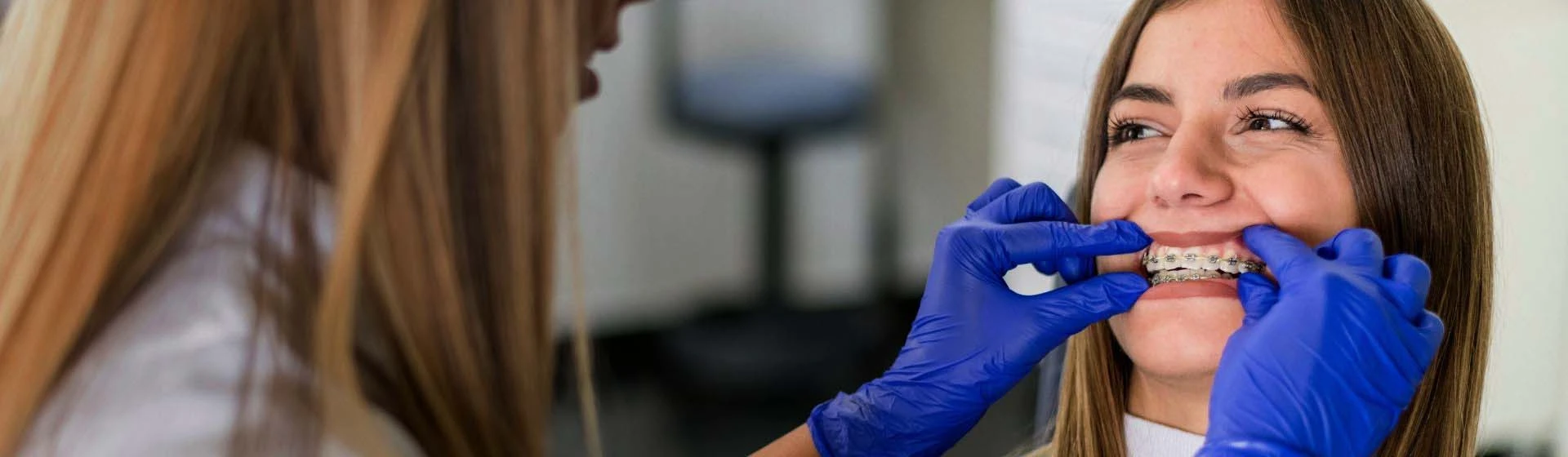
Bracket systems

Bracket systems are used in situations when complex tooth movements in three planes are required and correct jaw closure must be formed.

Metal, ceramic or lingual braces make it possible to accurately control the position of each tooth and correct even pronounced anomalies.

This is one of the most reliable methods of treating distal, mesial, deep and crossbites. Braces are used in both adolescents and adults.

Aligners

Aligners are transparent orthodontic trays that gradually move the teeth in a given direction.

They are effective in mild and moderate anomalies, including crowding, interdental gaps and certain types of bite disorders. If necessary, the orthodontist can use elastics or additional elements, which expands the capabilities of the method.

Treatment is comfortable, almost invisible to others and does not interfere with daily activities, but requires discipline in wearing them 20–22 hours a day.

Orthodontic and functional appliances

In children and adolescents the jaws are actively growing. To influence this process and correct the direction of development of bone structures, various types of appliances are used:

  • Removable appliances (plates, myofunctional trays).
    They help to correct jaw growth, normalise swallowing, tongue position and muscle function. They are effective in early treatment and help prevent the formation of more complex anomalies in the future.
  • Fixed appliances (for palatal expansion, for example Hyrax or Haas).
    They are used to expand a narrow upper jaw and create additional space for the teeth. This is one of the most effective methods of treating upper jaw constriction in children.

Properly selected appliances make it possible to avoid more complex interventions in adulthood.

Orthognathic surgery

If the bite deformity is associated not only with tooth displacement but also with skeletal changes (a protruding or underdeveloped jaw), orthodontic methods may be insufficient. In such cases, orthognathic surgery is used – operations that allow changing the position of the jaws and restoring harmonious facial proportions.

Treatment takes place in several stages: first, orthodontic preparation is carried out using bracket systems or other orthodontic constructions, then surgical correction of jaw position is performed, and the final stage includes precise alignment of the dental arches and consolidation of the result with retention methods.

Retention – maintaining the result

After completing active treatment, it is important to maintain the result achieved, since teeth have a natural tendency to return to their original position. For this purpose, the following are used:

  • fixed retainers – a thin wire bonded to the inner surface of the teeth;
  • removable retention trays – made individually and worn according to a schedule.

The duration of the retention period is determined by the orthodontist, but usually it lasts no less than the treatment itself.

Services of a private clinic in Kyiv: prices for bite correction

The cost of bite correction depends on the severity of the disorders and the chosen treatment method.

Our clinic offers modern medical services in Kyiv, which include accurate diagnostics and effective treatment according to an individually developed programme.

You can check the prices in advance here. The doctor will provide more precise information regarding the features of bite correction and the cost of treatment after examination and diagnostics.

Make an appointment for a consultation using the online booking form or by calling our contact centre.

Frequently asked questions

What is a correct bite?

A correct bite is such closure of the teeth in which the upper and lower jaws work in coordination. The upper incisors slightly cover the lower ones, the dental arches are even, and the load during chewing is distributed evenly. This type of bite ensures healthy functioning of the temporomandibular joints, comfort and natural aesthetics of the smile.

How should teeth close?

Correct closure of the teeth implies even contact of the upper and lower dental arches. The upper incisors should cover the lower ones by one third, and the posterior teeth should fit closely to each other without gaps. Proper closure of the teeth ensures comfortable chewing, prevents enamel wear and reduces the risk of overloading the temporomandibular joints.

How is a distal bite treated?

The treatment method depends on the age and the degree of displacement of the lower jaw. In children, appliances that stimulate its growth are used. In adolescents and adults, aligners or braces are used to align the dental arches and improve the relationship of the jaws. In complex cases, combined treatment may be required.

How to correct an incorrect bite?

Correction of an incorrect bite includes the use of aligners, braces, appliances to normalise jaw growth or a combination of several methods. The choice of method depends on the type of disorder, the person’s age and the condition of the teeth. The doctor performs diagnostics, draws up an individual plan and controls tooth movement in order to achieve a stable and functionally correct result.

( Rating: 4.76 , Votes: 51 )
Dentistry
Our services
Consultations
Dentist consultation
1.00 ₴
Add Added
Services
3D visualization of the treatment plan with the "Angel Aligner" system
33200.00 ₴
Sign up by the call center
3D visualization of the treatment plan with the Invisalign system
46200.00 ₴
Sign up by the call center
Activation of the bracket system, 1 jaw
750.00 ₴
Sign up by the call center
Bi-Helix/Quad-Helix device with installation
8300.00 ₴
Sign up by the call center
Carriere Motion device with installation
22000.00 ₴
Sign up by the call center

Advantages of bite correction at Oxford Medical

Digital diagnostics makes it possible to accurately assess the bite and plan treatment with a predictable result.
The use of all modern correction methods allows choosing the optimal option for any clinical situation.

Orthodontists have many years of experience and continuously improve their qualifications.

Comfortable reception conditions, a friendly atmosphere and caring staff.

Our doctors

Okopna Yulia Alekseevna
5
rating (18)
6+
Years of experience
Dentist orthodontist
6+ Years of experience
Consultation 1
Kyiv, Pavlivska St., 26/41
Make an appointment
Komerista Yulia Volodymyrivna - pediatric dentist at the private medical clinic Oxford Medical Kyiv
4.82
rating (28)
9+
Years of experience
Dentist-orthodontist
9+ Years of experience
Consultation 1
Kyiv, Andriy Verkhoglyad St., 14B
Make an appointment
Alekseev Volodymyr Oleksandrovych - dentist of the private clinic Oxford Medical Kyiv
4.95
rating (19)
12+
Years of experience
Dentist-orthodontist, gnathologist
12+ Years of experience
Consultation 1880
Kyiv, Pavlivska St., 26/41
Kyiv, Andriy Verkhoglyad St., 14B
Make an appointment
Zrazhevska Alina Yuriyivna
4.93
rating (15)
11+
Years of experience
Orthodontist, First Category, PhD in Medical Sciences
11+ Years of experience
Consultation 1
Make an appointment
All doctors
Reviews
Ганна 22.01.2026
Дуже вдячні лікарю, адміністрації, всій команді. Приїхали у Київ на операцію з Запоріжжя. У день операції у клініці було відсутнє живлення через масовані обстріли на енергосистему. Колектив з порозумінням сприйняв нашу ситуацію, приїзд за важких умов, професійно організували оперування в іншій кліниці. Ви команда професіоналів! Дякуємо!
Star Star Star Star Star
Катерина 15.01.2026
Віталіна Павлівна дуже уважно поставилася до моєї ситуації. Працює дуже акуратно, не було жодного відчуття страху. Після лікування нарешті зник дискомфорт, за що їй щиро вдячна.
Star Star Star Star Star
News
All Articles
Sign up via call center
in the clinic
online
This site is protected by reCAPTCHA technology, and the Google Privacy Policy and Terms of Service apply.
Hello!
Let's take care
about your health:
Sign up via call center

We use cookies and other technologies to remember your preferences and find out exactly how you use and interact with the site.

By using our site, you also agree to the terms of the "User Agreement" and "Regulation on the processing and protection of personal data". By clicking "I AGREE", you consent to the processing of your data.