

 Adults Adults Adults Adults Adults Adults Adults Adults Adults
  Children Children Children Children


 Hotline:
 Adults Adults Adults Adults Adults Adults Adults Adults Adults Children Children Children Children



Colposcopy
Colposcopy in Kiev
Colposcopy is an examination of the vagina and cervix using an optical device that provides multiple magnification and illumination of the examined area. It allows detection of erosion, ectopy, dysplasia, neoplasms, and some other cervical diseases.
Colposcopy is performed by a gynecologist during a consultation. It is a highly informative examination that provides immediate results. In addition, the procedure is minimally invasive and completely painless.
Types of colposcopy
Simple colposcopy – the doctor examines the cervix through the colposcope to assess the shape and size of the external os, vascular pattern, and characteristics of the mucous membrane.
Extended colposcopy – the specialist applies Lugol's solution and/or acetic acid to the mucous membrane, which causes a specific reaction and allows diagnosis and assessment of the spread of erosion, dysplasia, and certain other conditions.
Extended colposcopy is more informative, which is why it is performed more often, especially when there are indications for the procedure.
Symptoms for which colposcopy is prescribed
Colposcopy is carried out for preventive purposes, during preconception planning, and when symptoms of gynecological diseases appear.
Indications for colposcopy include:
-
Menstrual cycle disorders;
-
Pain in the lower abdomen and lower back;
-
Bleeding outside the menstrual cycle;
-
Atypical vaginal discharge (heavy, altered consistency, color, or with an unpleasant odor);
-
Pain and bleeding during or after intercourse;
-
Positive papillomavirus test (Pap smear);
-
Predisposition to oncological diseases;
-
Previously diagnosed precancerous conditions.
Many conditions detectable by colposcopy are asymptomatic. They can only be found during examination. Therefore, colposcopy is recommended annually for all women, and after the age of 40 – twice a year.
The examination is also important during preconception planning, as cervical pathologies can provoke complications during pregnancy and childbirth. Sometimes, colposcopy is also performed during pregnancy.
Indications for colposcopy
Colposcopy is performed both for preventive purposes and in the presence of certain diseases. Indications for the procedure include:
-
Cervical erosion;
-
Genital warts;
-
Intermenstrual bleeding;
-
Abnormal Pap test results;
-
Precancerous conditions;
-
Malignant diseases;
-
Monitoring during treatment and evaluation of its effectiveness.
Preparing for colposcopy
Colposcopy can be performed at any time except during menstruation. However, the optimal time is a few days before or after the period.
In the 2–3 days prior to the procedure, women are advised to:
-
Abstain from unprotected intercourse;
-
Avoid using vaginal suppositories and tampons;
-
Refrain from douching.
If colposcopy is performed for medical reasons, the gynecologist may give individual recommendations regarding preparation and the day of the procedure.
How is colposcopy performed?
Colposcopy is performed by an obstetrician-gynecologist during an examination on a gynecological chair with the use of speculums. The colposcope is placed at a distance that allows the doctor to examine the tissues through a magnifying lens. Some devices also allow photos to be taken to monitor changes over time or display the image on a computer screen.
Gynecology uses simple and extended colposcopy. The second involves special tests with iodine or vinegar solutions. The doctor applies the solution to the mucosal tissues. Under its influence, altered cells change color. This helps determine the boundaries of erosion, dysplasia, or other mucosal changes.
The examination takes up to 20 minutes. It is completely safe and painless. The doctor usually explains the results immediately.
Which diseases can be diagnosed with colposcopy?
Colposcopy helps diagnose neoplasms (polyps, warts, fibroids) on the cervix and vaginal walls, as well as structural cell changes.
Colposcopic examination can detect the following conditions:
-
Cervical erosion;
-
Ectopy;
-
Dysplasia;
-
Endometriosis;
-
Endocervicitis;
-
Polyps, warts, fibroids;
-
Cervical cancer.
During colposcopy, in addition to the examination, the gynecologist may perform a scraping or biopsy (sampling a tissue fragment for cytological and histological analysis). These may be necessary for diagnosing inflammatory and infectious diseases or identifying the nature of cell changes (atypia, precancerous conditions, and cancer).
Contraindications to colposcopy
Colposcopy is a simple and safe procedure, so contraindications are few and mostly temporary.
The procedure is not recommended:
-
Within 2 months after childbirth;
-
After gynecological surgery;
-
In the presence of uterine inflammatory processes;
-
During menstruation;
-
In case of allergy to iodine or vinegar.
Advantages of colposcopy at “Oxford Medical”
At “Oxford Medical,” obstetrician-gynecologists with many years of experience provide care. All diagnostic and treatment procedures are carried out using new equipment from leading global brands. All clinics — in the city center, on the right and left banks of Kyiv, and in Irpin — are fully equipped.
By contacting “Oxford Medical,” you can be sure you will receive the highest level of medical care.
Colposcopy of the cervix: cost at “Oxford Medical” clinic
You can check the cost of colposcopy here. We adhere to a policy of affordable prices and strive to make quality diagnostics and treatment accessible to as many patients as possible.
To schedule a colposcopy and consultation with an obstetrician-gynecologist, call our contact center or write in the chat.


Advantages of gynecology at Oxford Medical in Kyiv

Experienced gynecologists. Doctors with extensive clinical experience who regularly complete professional development courses.
Modern diagnostics. Ultrasound, colposcopy, hysteroscopy, laboratory tests.
Comprehensive approach to women’s health. Treatment tailored to age and comorbid conditions.
Surgical capabilities. From minimally invasive to open surgeries performed in a modern surgical facility.
Convenient clinic locations. Departments are available throughout Kyiv — on both the right and left banks.
Comfort at every stage. Attentive care, modern facilities, and a welcoming atmosphere.

Our doctors

 4.98
4.98  26+
26+ 
 26+ Years of experience
  Kyiv, Hlybochytska St., 40x
 4.9 6+
 Specialist in aesthetic gynecology.
6+ Years of experience Kyiv, Hlybochytska St., 40x Kyiv, Vasyl Lypkivskoho St., 38  4.97 20+ 20+ Years of experience Kyiv, 9 Ivana Kramskoho Street
 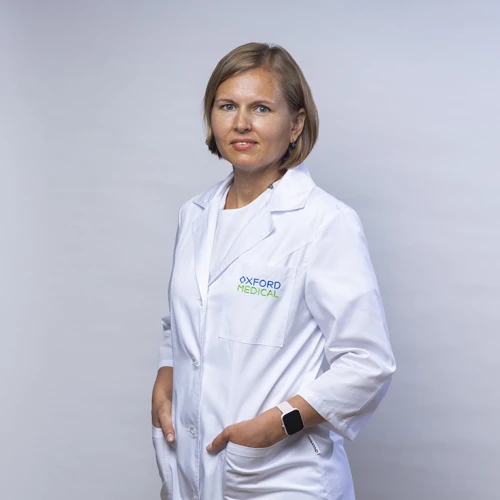 4.92 23+ 23+ Years of experience Kyiv, Hlybochytska St., 40x

 in the clinic
  online

 Hello!
Let's take care
about your health:

