






Diseases requiring surgical treatment
High-informative method to detect changes in organs, vessels, and tissues as small as 1 mm using Siemens Somatom Go.UP.

 Adults Adults Adults Adults Adults Adults Adults Adults Adults
  Children Children Children Children


 Hotline:
 Adults Adults Adults Adults Adults Adults Adults Adults Adults Children Children Children Children
 Hospitalization is available 24/7, including curfew hours.
The Oxford Medical Clinic, located at 30B Berezniakovska Street, Kyiv, operates a high-tech surgical ward. The department is always staffed by a team of surgeons and anesthesiologists who are ready to provide emergency medical care and perform urgent surgeries. The surgical ward accepts patients 24 hours a day, 7 days a week.
The clinic features a state-of-the-art operating unit where experienced surgeons perform surgeries of any complexity. Most procedures utilize innovative endoscopic techniques, radio wave, and laser surgery. Operations are carried out under continuous video surveillance, ultrasound, or X-ray (C-arm) control.
An intensive care unit is also available, equipped for continuous monitoring and support of vital body functions.
The clinic offers cozy single and double rooms with private bathrooms, air conditioning, televisions, and other amenities to ensure a comfortable stay. Patients can remain in the clinic as long as their condition requires.

 Looking for a place to record...


You can receive high-quality medical care in the surgical ward in cases of:


Diseases requiring surgical treatment
Acute conditions with sudden deterioration in health
Closed and open injuries
Burns, bleeding, and similar emergencies

High-informative method to detect changes in organs, vessels, and tissues as small as 1 mm using Siemens Somatom Go.UP.
Quick, safe, painless, and accurate diagnostic tool.
Simple and effective visualization using Philips ClearVue and Toshiba Nemio XG devices.
Reliable method for visual examination of internal organs using a thin tube with a camera.
 Typically, 8-12 hours without food or drink. Confirm with your doctor. Tests and examinations such as ultrasound, ECG, CT, and X-rays can be conducted at the clinic.
  All advices

Equipment from leading brands: Philips, Siemens, Nihon, Hamilton Medical, B. Braun, Olympus
Experienced surgeons
Endoscopic surgeries in day hospital settings
Laser and radio wave surgery
Intensive care unit
24/7 patient admission
In-house ambulance service
Comfortable hotel-style rooms

 4.9
4.9  47+
47+ 
 47+ Years of experience
 4.58 42+ 42+ Years of experience
  Kyiv, st. Bereznyakivska, 30b
  4.82 29+ 29+ Years of experience Kyiv, st. Bereznyakivska, 30b
  4.92 42+ 42+ Years of experience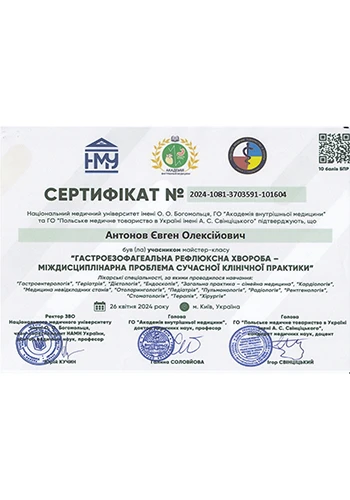
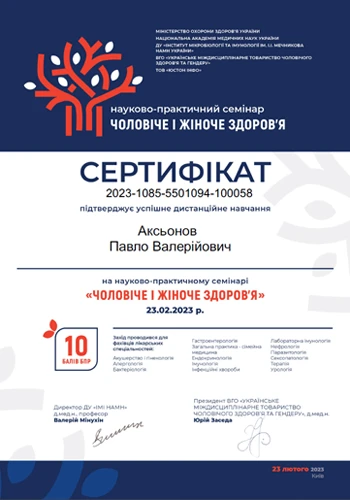
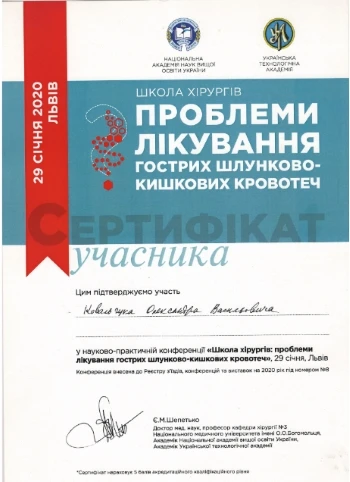
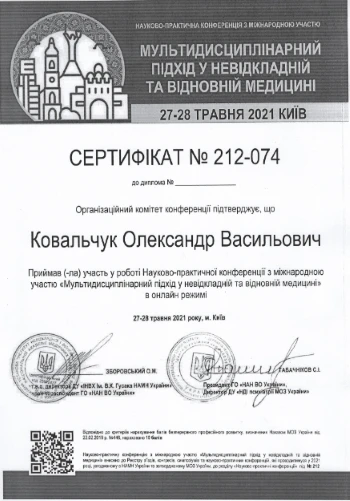

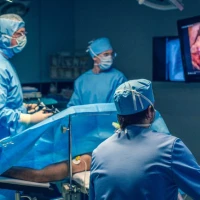

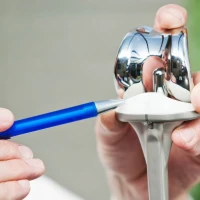
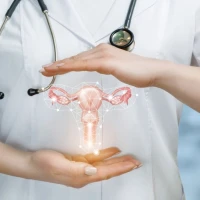
At the "Oxford Medical" clinic at 30B Bereznyakovskaya St., Kyiv, a high-tech surgical inpatient department is equipped. The department is always staffed by a team of surgeons and anesthesiologists, ready to provide emergency medical care and perform urgent surgery. The surgical inpatient department admits patients 24 hours a day, 7 days a week.
The clinic has a high-tech operating unit, where experienced surgeons perform surgeries of any complexity. In most cases, innovative endoscopic techniques, radio-wave, and laser surgery are used. Operations are performed under continuous video monitoring, ultrasound, or X-ray (C-arm) control.
There is also an intensive care unit, equipped for continuous monitoring and support of vital body functions.
The clinic is equipped with comfortable single and double wards with private bathrooms, air conditioning, TV, and other amenities for a comfortable stay. A patient may remain in the clinic as long as their condition requires.
In the general surgery department, planned and urgent surgeries are performed for diseases and injuries of the abdominal organs.
Indications for surgery may include:
stomach and duodenal ulcer;
appendicitis;
cholecystitis;
pancreatitis;
intestinal obstruction;
hernias;
diverticulitis;
peritonitis;
benign neoplasms;
oncological pathologies and others.
In most cases, surgeries are performed laparoscopically. Several punctures no more than 1 cm in diameter are made in the abdominal wall, through which the necessary manipulations are carried out using endoscopic equipment. Due to the absence of a large incision, the rehabilitation period is much easier and faster.
When performing gynecological surgeries, it is very important to minimize damage to healthy tissues to preserve a woman’s reproductive functions. At "Oxford Medical," all surgeries are performed using modern minimally invasive techniques. In particular, for such conditions as erosion, leukoplakia, and cervical dysplasia, as well as some others, surgeries are performed using laser or radio-wave surgery. For more complex pathologies (endometriosis, fibroids), hysteroscopy and laparoscopy are used.
In the department of operative gynecology, the following surgeries are performed:
hysteroscopy (examination and surgical treatment of the uterine cavity);
removal of polyps, cysts, fibroids, fibromas, and other neoplasms;
adnexectomy (removal of ovaries and fallopian tubes);
intimate plastic surgery (vaginoplasty, labiaplasty, etc.) and other surgeries.
The urological surgeons of "Oxford Medical" perform surgical treatment of the urinary system organs in men and women: kidneys, ureters, bladder, prostate, and genital organs.
In the department of operative urology, the following are performed:
puncture and biopsy of the prostate and other organs;
crushing and removal of stones in the kidneys, bladder, and ureters;
TUR (transurethral resection) of the bladder and prostate;
removal of polyps, cysts, and tumors;
surgical treatment of ureterocele, varicocele, and hydrocele;
orchiopexy and orchiectomy;
nephropexy and nephrectomy;
plastic surgeries (ureteroplasty, testicular endoprosthesis, etc.), as well as other urological surgeries.
Surgeries are performed by experienced surgeons using new equipment from leading brands. Most urological interventions are carried out under constant ultrasound or video monitoring.
The "Oxford Medical" clinics are equipped with the most accurate diagnostic and surgical equipment. Before surgery, a patient undergoes a comprehensive examination that allows detection of even the smallest neoplasms, the presence of metastases, their localization, and size. Surgeries are performed mainly laparoscopically.
In the department of oncosurgery, removal of neoplasms is carried out:
of the genitourinary organs (kidneys, bladder, prostate, uterus, etc.);
of the mammary glands;
of the stomach and duodenum;
of the liver;
of the pancreas;
of the adrenal glands;
of the retroperitoneal space.
After surgery, follow-up diagnostics are performed, after which oncologists determine the tactics of further treatment. At "Oxford Medical," chemotherapy according to international treatment protocols is also available.
Surgeries for ENT diseases are performed using the following methods:
endoscopy;
shaver technique;
laser;
or radio-wave surgery.
Such surgeries are minimally traumatic and can be performed in a day hospital setting, but if 24-hour medical supervision is required, the patient is hospitalized in the clinic.
In the otolaryngology department, the following are performed:
puncture of the maxillary sinuses;
maxillary sinusotomy;
vasotomy (treatment of vasomotor rhinitis);
septoplasty (correction of the nasal septum);
otoplasty (correction of ear shape);
adenotomy (removal of adenoids);
tonsillectomy (removal of tonsils);
removal of polyps and cysts;
extraction of foreign bodies from ENT organs.
Maxillofacial surgeons help to surgically correct congenital defects, aesthetic imperfections, and consequences of facial and head injuries. Specialists also perform plastic surgeries.
In the department of maxillofacial surgery, the following are performed:
tooth and cyst removal;
osteoplasty (bone augmentation);
dental implantation;
treatment of jaw fractures;
incision of furuncles, abscesses of the maxillofacial area;
removal of neoplasms in the face and neck area;
blepharoplasty (correction of eyelid shape);
otoplasty (correction of ear shape);
removal of Bichat’s fat pads and other surgeries.
The surgical inpatient department "Oxford Medical" is located at 30B Bereznyakivska St. The clinic has a convenient location, particularly for those who are looking for a surgeon on the Left Bank. Although the hospital is located in the Bereznyaky district, it is easy to reach from other neighborhoods as well. If you need a surgeon in Pozniaky or a surgeon in Osokorky, you can also visit our clinic and receive high-quality medical care in comfortable conditions.
The clinic operates around the clock, providing medical care 24/7 both in planned cases and in acute conditions
Preparation for a planned operation includes a consultation with a doctor, blood and urine tests, instrumental examinations such as ECG, X-ray, ultrasound and CT scan. The patient also receives recommendations on taking medications and diet before the operation. Oxford Medical uses the Fast Track Surgery protocol, which facilitates preoperative preparation and rehabilitation after surgery.
At Oxford Medical, surgeries are performed both through open access and using minimally invasive laparoscopic and endoscopic methods. The latter allow to minimize the duration of hospitalization, facilitate preparation and recovery after surgery. In most cases, our surgeons use these methods.
Several types of anesthesia are used in surgery: local, regional, and general. The choice depends on the type of surgery and the patient's condition. Local anesthesia numbs only a small area, regional anesthesia blocks pain in a large area of the body, and general anesthesia puts the patient into a state of anesthesia.
The Oxford Medical Hospital provides the most comfortable conditions for patients, including single and double hotel-type rooms with three meals a day. Regarding the rules of staying in the hospital: patients should follow all instructions regarding treatment, preparation for surgery and rehabilitation after surgery, and inform the medical staff about any changes in their well-being. You cannot leave the clinic on your own.
The surgical hospital admits patients with diseases that require surgical intervention. These can be both planned operations and life-threatening emergencies. The patient's condition is assessed by a doctor based on clinical manifestations and examination results. Hospitalization at the Oxford Medical hospital is possible 24/7.
 in the clinic
  online
  Hello!


