


The presence of a spleen tumor is an indication for surgical treatment. The necessity of surgery primarily depends on whether the tumor is benign or malignant. For a benign tumor, follow-up monitoring may be recommended.
Sign up via call center 
 Adults Adults Adults Adults Adults Adults Adults Adults Adults
  Children Children Children Children
Department
Adults Outpatient department
Adults Outpatient department
Inpatient department
Adults Inpatient department
Aesthetic medicine
Adults Aesthetic medicine
Dentistry
Adults Dentistry
Plastic surgery
Adults Plastic surgery
Diagnostics
Adults Diagnostics
Analyzes
Adults Analyzes
Outbound services
Adults Outbound services
Children Outpatient department
Children Outpatient department
Dentistry
Children Dentistry
Diagnostics
Children Diagnostics

Kyiv


 Hotline:
 Request a call:


Department
Adults Outpatient department
Adults Outpatient department
Inpatient department
Adults Inpatient department
Aesthetic medicine
Adults Aesthetic medicine
Dentistry
Adults Dentistry
Plastic surgery
Adults Plastic surgery
Diagnostics
Adults Diagnostics
Analyzes
Adults Analyzes
Outbound services
Adults Outbound services
Children Outpatient department
Children Outpatient department
Dentistry
Children Dentistry
Diagnostics
Children Diagnostics

Surgery treatment of spleen tumours
Surgical interventions in the inpatient department are covered by the loyalty program, which makes treatment even more affordable.
Spleen tumors are neoplasms that develop from morphologically altered cells in the parenchyma of the organ. They can be either benign or malignant. If pathology is detected, surgery is most often prescribed, but sometimes follow-up monitoring may be recommended.
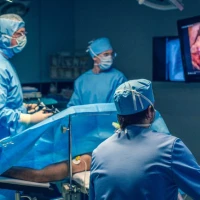
At Oxford Medical, removal of spleen tumors is mainly performed by the laparoscopic method. This is a minimally invasive surgery: several punctures up to 1 cm in diameter are made on the peritoneum, through which a laparoscope equipped with a video camera and endoscopic instruments are introduced.
Laparoscopy allows to:
-
minimize damage to healthy tissues;
-
reduce the risk of complications;
-
shorten the hospitalization period to 1–3 days and facilitate rehabilitation;
-
simplify preparation for surgery according to the Fast Track Surgery protocol;
-
avoid the formation of an unaesthetic scar.
Indications for spleen tumor removal
In the early stages, spleen tumors develop asymptomatically. Pain and other signs appear as the neoplasm grows and compresses vessels and/or adjacent organs. The disease is often detected during routine examinations or diagnostics of other abdominal organ diseases.
The necessity of surgery is determined individually by doctors. First of all, it depends on the probable morphological nature of the tumor (malignant or benign). Its size, location, and other characteristics affect only the scope of surgical intervention.
If the tumor shows signs of being benign, the patient may be placed under follow-up monitoring: examinations are carried out regularly to control the neoplasm. However, statistics have shown that in 30% of patients a tumor that was initially considered benign turned out to be malignant, confirmed by histological analysis of a tissue sample. Therefore, the presence of any tumor in the spleen is a potential indication for surgical treatment.
Preparation for surgery
To clarify the diagnosis, the patient may be prescribed:
-
ultrasound of abdominal organs;
-
computed tomography;
-
magnetic resonance imaging;
-
celiacography (X-ray examination of abdominal organ arteries using a contrast agent);
-
spleen biopsy with subsequent histological analysis of the sample (to determine whether the tumor is benign or malignant);
-
laboratory tests.
After hospitalization, the patient also undergoes ECG and preoperative blood tests (for blood type and Rh factor, coagulation, common infections, etc.). Thanks to the Fast Track Surgery protocol, the patient does not need prolonged fasting before surgery, nor mechanical bowel cleansing.
On the eve of the operation, the surgeon gives the patient detailed preparation recommendations.
How is spleen tumor removal performed?
For spleen tumors, 2 types of operations are performed:
-
Resection – an organ-preserving operation in which only the affected part of the spleen is removed.
-
Splenectomy – a radical operation involving removal of the entire organ. It is prescribed for malignant neoplasms, as well as large benign tumors that have affected most of the parenchyma.
Whenever possible, Oxford Medical surgeons perform organ-preserving operations. Removal of the spleen is carried out only when resection is impractical.
Regardless of the scope of the intervention, laparoscopic access is usually used. Instead of an incision, several punctures up to 1 cm are made on the peritoneum. Through one of them carbon dioxide is introduced, which allows lifting the abdominal wall and enlarging the operative field. After that, a laparoscope equipped with a miniature camera is inserted. The image is transmitted to the monitor screen with 40–50-fold magnification. This allows the doctor, using endoscopic instruments, to perform all manipulations with maximum precision.
Rehabilitation period
Immediately after surgery, the patient is brought out of anesthesia. He spends several hours in the intensive care unit under hardware monitoring and medical supervision. After that, if the condition is stable, the patient is transferred to the ward.
As a rule, on the day of surgery the patient is advised bed rest. Getting up and walking around the ward, as well as drinking and eating light food, are allowed the very next day.
The length of hospitalization during laparoscopic surgery is 1–3 days.
For several weeks, the patient is recommended to:
-
avoid intensive physical activity and heavy lifting;
-
follow a diet and nutritional regimen;
-
take prescribed medications and attend postoperative check-ups on time.
Most patients return to their usual lifestyle after 2–4 weeks, but full rehabilitation may take about 2 months.
If the tumor is malignant, the patient may be prescribed chemotherapy or other treatment.
Possible complications of spleen tumors
Neoplasms of the spleen can provoke the following complications:
-
anemia;
-
weakened immunity;
-
compression of adjacent organs and impaired function;
-
rupture of the spleen and internal bleeding;
-
development of metastases (in primary malignant tumor).
Timely surgical treatment reduces the risk of these complications.
Treatment of spleen tumors: price at Oxford Medical
The cost of the operation depends on:
-
the extent of the surgical intervention - resection or removal of the entire spleen;
-
the use of laparoscopic or open access.
You can find out the cost of surgical treatment at «Oxford Medical» here. Only a doctor can give you a more accurate estimate of the price, taking into account the diagnosis and other individual characteristics. Make an appointment for a consultation at a time convenient for you.
At «Oxford Medical», removal of spleen tumors is performed in a high-tech surgical hospital. It is equipped with new equipment that allows you to diagnose neoplasms from 1 mm in size, as well as perform minimally invasive and open surgeries of any complexity. In addition, the clinic is equipped with intensive care units with equipment to monitor and support vital body functions.
Since the safety and effectiveness of surgical treatment depend not only on the quality of the equipment, but also, first of all, on the professionalism of surgeons, a team of highly qualified specialists has been assembled at «Oxford Medical». Many have the highest medical category, the title of candidate or doctor of medical sciences, as well as many years of experience.
You can make an appointment for a consultation with a surgeon by calling the numbers listed on the website or using the online application form.
Frequently asked questions about surgical treatment of spleen tumors
How to treat a spleen tumor?
What are the symptoms of spleen tumors?
In the early stage, spleen tumors develop without symptoms. As the neoplasm increases in size, pain, heaviness, a feeling of fullness in the left hypochondrium, enlargement and asymmetry of the abdomen, prolonged low-grade fever, weakness, loss of appetite, and weight loss may occur. These symptoms are also characteristic of other diseases – examinations are required to establish a diagnosis.
Surgical ward
General Surgery
Surgical treatment of spleen tumors
Show more 
Our services
Consultations

Consultation with a surgeon
1100.00 ₴
Add Added 
General surgery services
Ultrasound-guided puncture of cystic formation of III complexity category
5389.00 ₴
Sign up by the call center
Operation of the II category of complexity performed by a doctor of medical sciences
59889.00 ₴
Sign up by the call center
Operation of the III category of complexity
59889.00 ₴
Sign up by the call center
Operation of the III category of complexity performed by a doctor of medical sciences
69889.00 ₴
Sign up by the call center
Hartmann's operation
46889.00 ₴
Sign up by the call center

Advantages of spleen tumor treatment at Oxford Medical

performing surgeries with minimally invasive laparoscopic method
use of the Fast Track Surgery protocol for simplified preparation and rehabilitation
high professionalism of surgeons who have already performed hundreds of successful operations
availability of intensive care units (ICU)
possibility of comprehensive treatment of malignant tumors with chemotherapy, targeted and immunotherapy
comfortable single and double inpatient rooms with private bathrooms, air conditioning, and everything necessary for convenience
Show more 
Our doctors

 4.58
4.58  42+
42+ Surgeon-oncologist of the highest category, Candidate of Medical Sciences
 42+ Years of experience
 Consultation 1989
 Kyiv, st. Bereznyakivska, 30b
 4.84 40+
 4.95 43+
 Surgeon of the highest category
Candidate of Medical Sciences
Candidate of Medical Sciences
43+ Years of experience Consultation 1100
Kyiv, st. Bereznyakivska, 30b  4.5 4+
Reviews
Альона 29.01.2026
Щиро дякую хірургу Фроловій Єлені Юріївні за суперово виконану операцію. Втручання було невелике, але для мене дуже важливе — і все пройшло швидко, акуратно та без ускладнень. Лікар уважна, спокіна, усе пояснив перед процедурою, так як я боялась- вона мене підтримувала та відволікала)) Загоєння проходило добре, шви зняла безболісно, результатом повністю задоволена. Дуже приємно мати справу з таким відповідальним і людяним спеціалістом. Рекомендую від щирого серця.

Яніна 18.01.2026
Хочу висловити подяку Мудрієвському Богдану Любомировичу. Моєму батьку було зроблено ургентно (15.12.2025) операцію по видаленню жовчного міхура. Поки я їхала в лікарню лікар і медперсонал підготували тата до операції. Велика подяка Богдану Любомировичу за Професіоналізм, за чітке пояснення і відповіді на всі питання. Цей лікар не тільки Професіонал своєї справи з великої літери, це ще і чудова людина!!! Бажаємо Богдану Любомировичу міцного здоров'я і завжди залишатися такою ж чудовою та розуміючою людиною
Current information

23 December 2025
Laparoscopy in gynecology: how modern methods are changing approaches to operations

27 July 2025
Removal of the Thyroid Gland: Consequences, Rehabilitation, and Life After Surgery

23 July 2025
Everything About Joint Replacement: Price, When, For Whom, and How Arthroplasty Can Be Performed

18 March 2025
What is uterine suturing and when is it performed?
Sign up
 in the clinic
  online

 Hello!
Let's take care
about your health:
Sign up via call center 
