


rash in the form of raised areas of skin;
Most often, the reaction is triggered by nuts, seafood, eggs, citrus fruits, chocolate and similar foods.

 Adults Adults Adults Adults Adults Adults Adults Adults Adults
  Children Children Children Children


 Hotline:
 Adults Adults Adults Adults Adults Adults Adults Adults Adults Children Children Children Children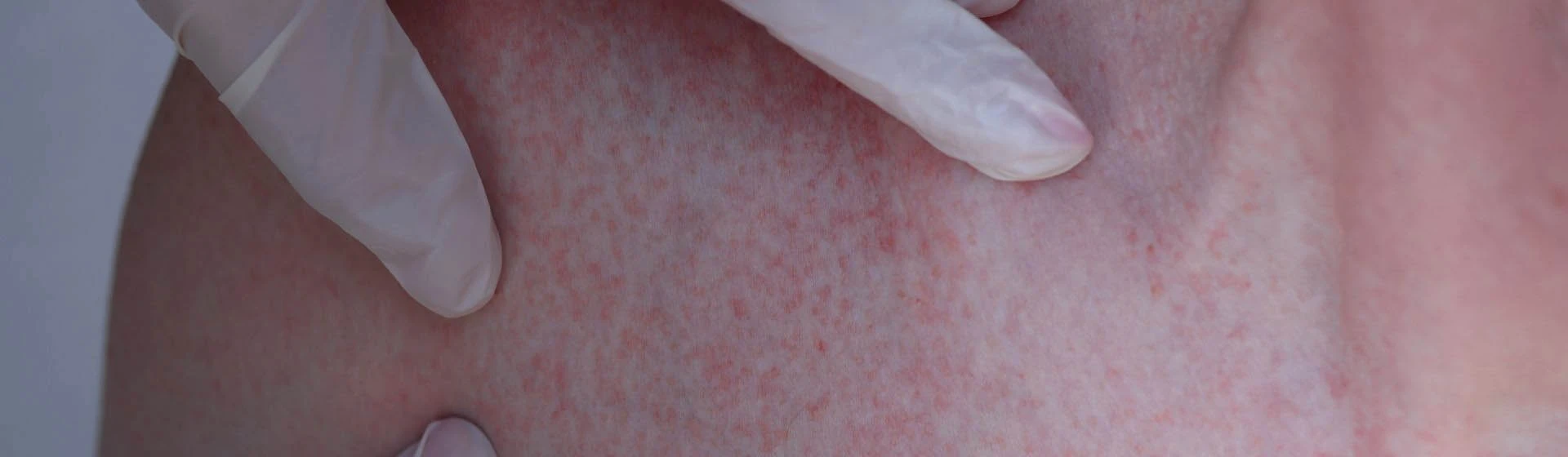
Urticaria is a skin rash in the form of red or pale-pink areas that usually itch severely. Externally, the rash resembles nettle stings, which is why it received this name.
Urticaria can be associated with allergy, infectious diseases, stress or other factors. In many cases, it is difficult to identify the cause without examination, so it is important to see a doctor to determine what exactly caused the rash and to choose an effective treatment plan.
At Oxford Medical medical centre, we help patients eliminate the visible rash, control the course of the disease and prevent recurrent flare-ups thanks to modern diagnostics and individual therapeutic approaches.
If you are worried about urticarial rash, make an appointment with a doctor by phone or via the online booking form on the website.
Urticaria in adults usually appears suddenly and may progress over a short period of time.
The most typical symptoms of urticaria include:


rash in the form of raised areas of skin;
redness of the skin around the lesions;
formation of blisters of various sizes;
itching of varying intensity;
burning or tightness of the skin;
spread of the rash to new areas;
enlargement of rash elements and their merging with each other;
worsening of symptoms in the evening or at night.

In some cases, urticaria may be accompanied by angioedema (Quincke’s oedema) — swelling of the lips, eyelids, tongue or other areas, which requires urgent medical attention. Alarm signs include difficulty breathing, sudden weakness or a drop in blood pressure.
You should see a doctor if the rash does not disappear within a few days, is accompanied by pronounced itching or other systemic symptoms. Timely consultation will help determine the cause and prevent complications.
In children, urticaria has its own features related to the activity of the immune system and skin sensitivity. Urticaria in a child often develops faster than in adults and manifests with more intense itching and swelling.
The following features of the course are typical for childhood:
Children also have a higher risk of systemic reactions, including swelling of the lips, tongue or difficulty breathing — such manifestations require immediate medical attention.
Most cases of urticaria in children are acute and respond well to treatment if the child is seen by a doctor in time.
The causes of urticaria can be diverse, as it occurs in response to a certain internal or external trigger. It is based on the release of inflammatory mediators that cause itching and redness of the skin. To determine what exactly triggered the reaction, the doctor performs individual diagnostics, because the cause is not always obvious.
The most common causes:
Most often, the reaction is triggered by nuts, seafood, eggs, citrus fruits, chocolate and similar foods.
Antibiotics, painkillers, NSAIDs, vitamin complexes and food supplements can trigger an acute or recurrent reaction.
Viral and bacterial infections can activate the immune system, causing temporary eruptions.
Helminth infections sometimes trigger an immune response that manifests as rash and itching.
Household chemicals, cosmetics, latex products, plants or toxic substances can provoke a reaction when in direct contact with the skin.
Cold, heat, sunlight, pressure or friction may cause rash in people prone to such reactions.
The immune system may react to its own cells, which is typical for some cases of chronic urticaria.
Prolonged stress or abrupt emotional changes can intensify the body’s response and may lead to the development of stress-related (nervous) urticaria.
During the consultation, the doctor examines the skin and takes a medical history: clarifies the relationship between the onset of the rash and food, medicines, infections, stress or other factors. This helps to form an initial hypothesis about the cause of the disease and choose the necessary scope of examinations. If necessary, allergology specialists are involved in the diagnosis, which allows for a more accurate determination of the Allergen and adjustment of further treatment tactics.
Standard diagnostic methods for urticaria include:
If physical forms of urticaria are suspected (cold-induced, heat-induced, dermographic, etc.), the doctor may perform special provocation tests. This is also relevant if photodermatosis is suspected, when the rash occurs in response to exposure to ultraviolet light. In complex clinical situations, diagnostics may require a comprehensive approach and the involvement of several specialists to determine the cause of the reaction as accurately as possible and to choose the optimal treatment strategy.
Urticaria has different forms that differ in their mechanisms of occurrence, duration and the body’s response to triggers. For consistency with medical practice, the classification is conventionally divided into three large groups. In the literature, this condition is also referred to as urticaria, and the characteristic lesions as urticarial rash.
Acute urticaria
Lasts up to 6 weeks. It often occurs after contact with food allergens, intake of medicines, as a result of infections or exposure to other triggers.
Chronic urticaria
Lasts more than 6 weeks. It has a wavelike course and may be associated with autoimmune processes, endocrine and systemic disorders.
Spontaneous urticaria
Develops without obvious influence of external factors. It is often associated with internal processes (infections, autoimmune reactions, thyroid diseases, chronic pathologies).
Inducible urticaria
Occurs in response to a specific provoking factor. The most common types are:
These forms are less common but important for accurate diagnosis, as they require a specific treatment approach.
Allergic urticaria
Associated with an immune response to an allergen (food, medicines, insect stings, latex, etc.). Symptoms usually develop quickly.
Non-allergic (pseudoallergic) urticaria
May occur in response to foods, additives or drugs, but without IgE-mediated allergy. The mechanisms are different, but the clinical manifestations are similar.
Pharmacologically induced urticaria
Occurs due to the direct action of medications, without a classic allergic reaction.
Stress-induced (nervous) urticaria
Triggered by emotional overload, prolonged stress, lack of sleep or psycho-emotional changes.
Treatment of urticaria depends on the form, causes and intensity of symptoms, so it is always selected individually. The main goal of therapy is to reduce the rash, relieve itching, prevent new episodes and influence possible mechanisms of the reaction.
In allergic urticaria, treatment is aimed at eliminating contact with the allergen and using modern therapeutic methods that allow rapid reduction of the rash and control of further reactions of the body.
The basis of treatment is second- and third-generation antihistamines — they reduce itching, redness and swelling. In more persistent or chronic cases, other lines of therapy may be used to achieve deeper control of the immune response.
In some cases of skin rash, treatment also includes the use of creams that help reduce discomfort.
In severe forms, immunomodulatory or targeted therapies may be used. This is relevant in autoimmune mechanisms, which often underlie chronic forms of urticaria.
Self-treatment of urticaria is undesirable: it may temporarily reduce symptoms but make it more difficult to identify the real cause and delay appropriate therapy. Timely medical consultation is necessary to accurately determine the cause of the rash and choose the most effective treatment.
Prevention of urticaria is aimed at reducing the risk of recurrent rash and controlling skin condition in the long term. The set of measures is selected individually, taking into account the causes and characteristics of the disease.
The main recommendations include:
Regular consultations and monitoring of dynamics help reduce the frequency of relapses in both children and adults and allow timely response to changes in the course of the disease.
The cost of treatment may vary depending on the severity of the disease, the required volume of examinations and the chosen therapy method. You can find out the price of a doctor’s consultation here, and here you can see the list of all services of the private clinic in Kyiv on the pricing page.
The doctor will provide more detailed information on treatment options during the initial consultation. Make an appointment at a convenient time for you by phone or via the online booking form on the website.
First, the doctor determines what exactly caused the rash. Most often, modern antihistamines are prescribed to reduce itching and redness. If the reaction recurs or lasts a long time, additional tests are performed and individual treatment is selected. This helps not only to relieve symptoms but also to prevent new episodes.
Urticaria may occur due to allergy to certain foods, reactions to medicines, infections, physical factors (cold, heat, pressure), contact with irritants or severe stress. In some patients, it is difficult to identify the exact cause, so the doctor performs individual examination and assessment of possible triggers.
Urticaria appears as an itchy red or pale-pink rash resembling nettle stings. The lesions may vary in size, change shape, merge with each other and appear on new areas of the skin. Most patients experience pronounced itching and burning.
During exacerbation, it is recommended to avoid foods that often provoke allergic reactions: citrus fruits, chocolate, nuts, seafood, smoked and spicy dishes and foods with additives. The diet should be gentle. Since triggers are individual, the final list of foods to avoid is determined by the doctor.
You cannot catch urticaria. It is not transmitted by contact because it is not an infectious disease. It is an immune system reaction to a trigger, not a virus or bacterium. Therefore, being near a person with urticaria is completely safe and does not pose a risk to others.
Itching can be alleviated with modern antihistamines, cool compresses, avoiding heat, friction and contact with irritants. It is important not to scratch the rash so as not to worsen the condition of the skin. Medicines should be selected by a doctor, as incorrect self-treatment may mask symptoms or complicate the course of the disease.


Experienced dermatologists and allergists who work according to international guidelines and select therapy individually.
Modern equipment for comprehensive assessment of the patient’s condition and selection of the most effective treatment strategy.
A wide range of medical services in Kyiv, allowing you to undergo diagnostics and treatment in one medical centre.
Comfortable conditions and attentive attitude to every patient.

 4.91
4.91  23+
23+ 
 23+ Years of experience
 4.96 25+ 25+ Years of experience
  Kyiv, Knyaziv Ostrozkyh St., 46/2 Kyiv, Oleksandra Olesia St., 2
  4.92 18+ 18+ Years of experience Kyiv, Mykhayla Hryshka St., 1
  4.95 16+ 16+ Years of experience Kyiv, Hlybochytska St., 40x


 in the clinic
  online
  Hello!


